
Switch off
Oliver Optic
THE CLASSIC COLLECTION · 1896
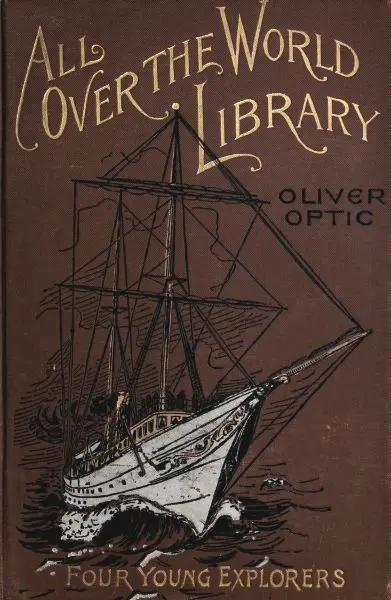
"Four Young Explorers; Or, Sight-Seeing in the Tropics" by Oliver Optic is a fictional adventure novel written in the late 19th century. The story revolves around a group of adventurous young boys—primarily Louis Belgrave and his companions—who explore various tropical locations, including Borneo and its surrounding rivers. As they venture away from the routine sightseeing of cities and monuments, they engage in hunting, fishing, and discovering the local flora and fauna. The opening of the book introduces the four young explorers as they leave the cruise ship, the Guardian-Mother, to spend three weeks in the wilderness of Borneo. Accompanied by a native guide named Achang, they travel up the Sarawak River in a steam-launch named the Blanchita, excited to experience a more primitive lifestyle filled with adventure. They quickly take to hunting and fishing, growing weary of their previous travel experiences in grand cities, indicating a desire for hands-on exploration of the natural world. The narrative sets the stage for the explorers' interactions with local wildlife, the land, and the unique cultures they will encounter throughout their adventurous journey.
Introduction adapted from the source catalogue; source summaries may be automatically generated.
Free to read · English · 92,310 words · No account needed
MAKE TIME FOR A GOOD BOOK
On by default. Untick to stop anonymous reading totals. Each page counts after 10 seconds in view. How this works.
Anonymous counting is on unless you have switched it off.
"Bekase the lanthern in the cab'n bloinds your two oyes, and makes the darkness shoine broighter nor the loight," said Felix, as he looked at his watch. "Sure, it's tin minutes afther foive in the marnin'. These beds are altogidther too foine, Captain."
"How's that, Flix?" asked Scott, as he opened the netting and leaped out
of bed.
"They're too comfor-ta-ble, bad 'cess to 'em, and a b'y cud slape till sundown in 'em till the broke o' noight."
"Dry up, Flix, or else speak English," called Louis, as he left his bed. "There is no end of 'paddies' along this river, and I'm sure they cannot understand your lingo."
"Is it paddies in this haythen oisland?" demanded Felix, suspending the operation of dressing himself, and staring at his fellow deck-hand. "I don't belayve a wurrud of ut!"
"Are there no paddies up this river, Achang?" said Louis, appealing to
the Bornean.
"Plenty of paddies on all the streams about here," replied the native.
"And they can't oondershtand Kilkenny Greek! They're moighty quare
paddies, thin."
"They are; and I am very sure they won't answer you when you speak to them with that brogue," added Louis.
"We will let that discussion rest till we come to the paddies," interposed the captain, as he completed his toilet, and left the cabin.
By this time all the party had left their beds and dressed themselves; for their toilet was not at all elaborate, consisting mainly of a woollen shirt, a pair of trousers, and a pair of heavy shoes, without socks. Felipe had steam enough on to move the boat; and the seamen had wiped the moisture from all the wood and brass work, and had put everything in good order.
"Are you a pilot for this river, Achang?" asked Scott, as the party came together in the waist, the space forward of the engine.
"I am; but there is not much piloting to be done, for all you have to do is to keep in the middle of the stream," replied the Bornean. "I went up and down all the rivers of Sarawak in a sampan with an English gentleman who was crocodiles, monkeys, mias, snakes, and birds picking up."
"Wrong!" exclaimed Morris. "You know better than that, Achang."
The native repeated the reply, putting the verb where it ought to be.
"He was a naturalist," added Louis.
"Yes; that was what they called him in the town."
"I think we all know the animals of which you speak, Achang, except one," said Louis. "I never heard of a mias."
"That is what Borneo people call the orang-outang," replied the native.
Your reading position is saved on this browser. Take it to another device with a library code. Reading pages adapt to text, rather than matching a printed edition.
BEHIND THE BOOK
This eBook is for the use of anyone anywhere in the United States and most other parts of the world at no cost and with almost no restrictions whatsoever. You may copy it, give it away or re-use it under the terms of the Project Gutenberg License included with this eBook or online at www.gutenberg.org. If you are not located in the United States, you will have to check the laws of the country where you are located before using this eBook. Read the source licence.
The original source file, including credits and licence, is retained by this library. Request an original-format copy at no charge. Please include the book title and Project Gutenberg identifier #24252.
KEEP YOUR CURIOSITY GOING
Wilfrid Scawen Blunt
Wilfrid Scawen Blunt

E. W. (Edgar Watson) Howe
Coulson Kernahan

Maurice Baring
Frances Wright
