
The Writing of News A Handbook with Chapters on Newspaper Correspondence and Copy Reading
Charles G. (Charles Griffith) Ross
THE CLASSIC COLLECTION · 1914
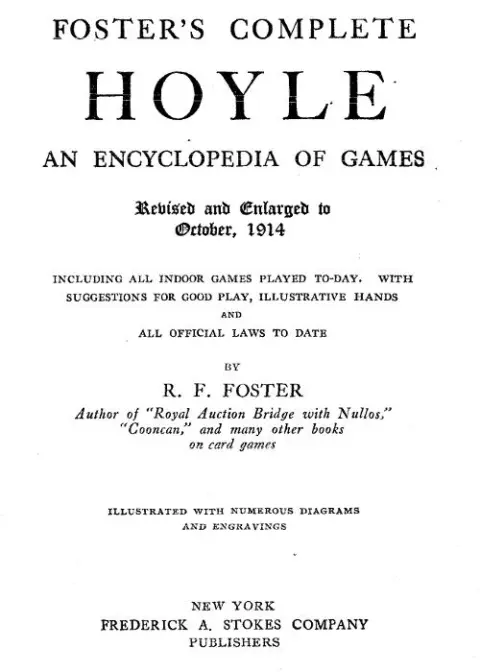
"Foster's Complete Hoyle: An Encyclopedia of Games" by R. F. Foster is an exhaustive reference work on indoor games, likely written in the early 20th century. The book serves as a comprehensive guide that catalogues a multitude of games, offering systematic instructions and rules that can enhance players' understanding and enjoyment of both new and traditional games. It aims to provide clarity on the official laws governing these games, alongside suggestions for good play and illustrative hands. The opening of the work establishes its authority by discussing the historical significance of the term "Hoyle," which has come to embody the ultimate reference for game rules. Foster emphasizes that the rules of many popular games, particularly card games, vary widely among localities and that his compilation aims to offer a standardized set of rules. By tracing the development and variations of various games, he sets the stage for a systematic presentation of games, beginning with foundational insights into the whist family, thereby enabling readers to grasp both the diversity and the common principles underlying indoor gaming.
Introduction adapted from the source catalogue; source summaries may be automatically generated.
Free to read · English · 319,976 words · No account needed
MAKE TIME FOR A GOOD BOOK
On by default. Untick to stop anonymous reading totals. Each page counts after 10 seconds in view. How this works.
Anonymous counting is on unless you have switched it off.
Bridge, and How to Play It, by A. Dunn, Jr., 1899.
Foster’s Bridge Manual, by R.F. Foster, 1900.
Foster on Bridge, by R.F. Foster, 1900.
The Bridge Manual, by John Doe, 1900.
Bridge Abridged, by W. Dalton, 1901.
Elwell on Bridge, by J.B. Elwell, 1902.
Foster’s Bridge Tactics, by R.F. Foster, 1903.
Foster’s Self-playing Bridge Cards, 1903.
The Bridge Book, by A. Dunn, Jr., 1903.
Bridge Up to Date, by C.S. Street, 1903.
Sixty Bridge Hands, by C.S. Street, 1903.
Laws and Principles of Bridge, by “Badsworth,” 1903.
Bridge Whist in Brief, by Fisher Ames, 1904.
Bridge at a Glance, by W. Dalton, 1904.
The Gist of Bridge, by R.F. Foster, 1904.
Bridge Developments, by Robertson and Wallaston, 1904.
Advanced Bridge, by J.B. Elwell, 1904.
Auction Bridge, by John Doe, 1904.
Bridge that Wins, by A. Metcalfe, 1905.
Foster’s Complete Bridge, by R.F. Foster, 1905.
Foster’s Bridge Maxims, by R.F. Foster, 1905.
The Bridge Blue Book, by P.F. Mottelay, 1906.
Good Bridge, by C.S. Street, 1907.
Practical Bridge, by J.B. Elwell, 1908.
Auction Bridge Up to Date, by W. Dalton, 1909.
Principles of Auction Bridge, by “Badsworth,” 1910.
Auction Bridge Up to Date, by R.F. Foster, 1910.
Advanced Auction Bridge, by R.F. Foster, 1911.
Auction Bridge, by “Bascule,” 1911.
New Auction and Dummy Play, by J.B. Gleason, 1912.
Fine Points of Bridge, by Florence Irwin, 1912.
Auction Bridge, by J.B. Elwell, 1912.
Royal Auction Bridge, by R.F. Foster, 1912.
Scientific Auction Bridge, by E.V. Shepard, 1913.
Auction of To-day, by Milton Work, 1913.
Royal Auction and Nullos, by R.F. Foster, 1914.
Auction Developments, by Milton Work, 1914.
Whitehead’s Conventions of Auction Bridge, by Wilbur C. Whitehead, 1914.
=CARDS.= Whist is played with a full pack of fifty-two cards, ranking A K Q J 10 9 8 7 6 5 4 3 2; the Ace being the highest in play, but ranking below the deuce in cutting. Two packs are generally used, the one being shuffled while the other is dealt.
=MARKERS= are necessary to keep the score. The most common are red and white circular counters; the white being used for the points in each game, and the red for the games themselves, or for rubber points. It is better to have two sets, of different colours, each set consisting of four circular and three oblong counters, the latter being used for the rubber points, or for games.
=PLAYERS.= Whist is played by four persons. When there are more than four candidates for play, five or six may form a “table.” If more than six offer for play, the selection of the table is made by cutting.
The table being formed, the four persons who shall play the first rubber are determined by cutting, and they again cut for partners, and the choice of seats and cards.
Your reading position is saved on this browser. Take it to another device with a library code. Reading pages adapt to text, rather than matching a printed edition.
BEHIND THE BOOK
This eBook is for the use of anyone anywhere in the United States and most other parts of the world at no cost and with almost no restrictions whatsoever. You may copy it, give it away or re-use it under the terms of the Project Gutenberg License included with this eBook or online at www.gutenberg.org. If you are not located in the United States, you will have to check the laws of the country where you are located before using this eBook. Read the source licence.
The original source file, including credits and licence, is retained by this library. Request an original-format copy at no charge. Please include the book title and Project Gutenberg identifier #53881.
KEEP YOUR CURIOSITY GOING
Charles G. (Charles Griffith) Ross
Hannah Webster Foster

Emily Lawless
Edwin Hamlin Carr

Charles De Lano Hine
Andrew Ure