
The Writing of News A Handbook with Chapters on Newspaper Correspondence and Copy Reading
Charles G. (Charles Griffith) Ross
THE CLASSIC COLLECTION · 1914
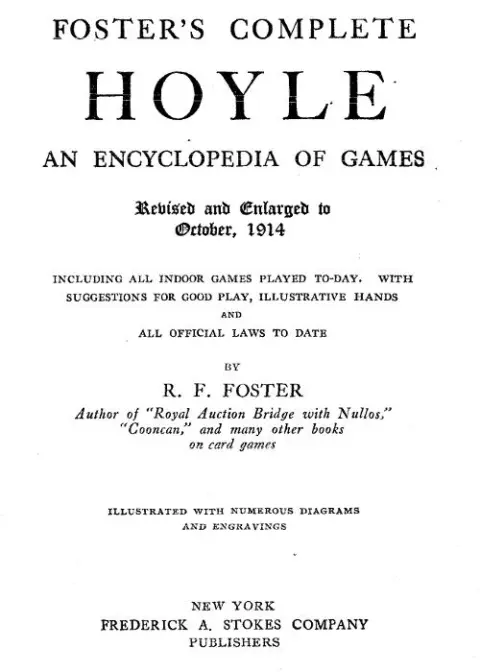
"Foster's Complete Hoyle: An Encyclopedia of Games" by R. F. Foster is an exhaustive reference work on indoor games, likely written in the early 20th century. The book serves as a comprehensive guide that catalogues a multitude of games, offering systematic instructions and rules that can enhance players' understanding and enjoyment of both new and traditional games. It aims to provide clarity on the official laws governing these games, alongside suggestions for good play and illustrative hands. The opening of the work establishes its authority by discussing the historical significance of the term "Hoyle," which has come to embody the ultimate reference for game rules. Foster emphasizes that the rules of many popular games, particularly card games, vary widely among localities and that his compilation aims to offer a standardized set of rules. By tracing the development and variations of various games, he sets the stage for a systematic presentation of games, beginning with foundational insights into the whist family, thereby enabling readers to grasp both the diversity and the common principles underlying indoor gaming.
Introduction adapted from the source catalogue; source summaries may be automatically generated.
Free to read · English · 319,976 words · No account needed
MAKE TIME FOR A GOOD BOOK
On by default. Untick to stop anonymous reading totals. Each page counts after 10 seconds in view. How this works.
Anonymous counting is on unless you have switched it off.
[3] Law 84 prohibits a revoking side from scoring little slam, and provides that tricks received by the declarer as penalty for a revoke shall not entitle him to a little slam not otherwise obtained. If a declarer bid 7 and take twelve tricks he counts 20 for little slam, although his declaration fails.
[4] He may consult his partner before making his decision.
[5] See Law 14 as to value of cards in cutting.
[6] This error, whenever discovered, renders a new deal necessary.
[7] A correct pack contains exactly fifty-two cards, one of each
denomination.
[8] One trick more than six.
[9] A declaration becomes final when it has been passed by three
players.
[10] For amount scored by declarer, if doubled, see Laws 53 and 56.
[11] When the penalty for an insufficient declaration is not demanded, the bid over which it was made may be repeated unless some higher bid have intervened.
[12] The question, “Partner, will you select the penalty, or shall I?” is a form of consultation which is not permitted.
[13] The penalty is determined by the declarer (see Law 66).
[14] See Law 50a.
[15] If more than one card be exposed, all may be called.
[16] The rule in Law 50c as to consultations governs the right of adversaries to consult as to whether such direction be given.
[17] Should the declarer play third hand before the second hand, the fourth hand may without penalty play before his partner.
[18] As to the right of adversaries to consult, see Law 50a.
[19] Either adversary may decide which card shall be considered played to the trick which contains more than four cards.
[20] See Law 73.
[21] The dummy may advise the declarer which penalty to exact.
[22] The value of the three tricks, doubled or redoubled, as the case may be, is counted in the trick score.
In the game of Auction slight intimations convey much information. The code succinctly states laws which fix penalties for an offence. To offend against etiquette is far more serious than to offend against a law; for in the latter case the offender is subject to the prescribed penalties; in the former his adversaries are without redress.
1. Declarations should be made in a simple manner, thus: “one heart,” “one no trump,” “pass,” “double”; they should be made orally and not by gesture.
2. Aside from his legitimate declaration, a player should not show by word or gesture the nature of his hand, or his pleasure or displeasure at a play, bid, or double.
3. If a player demand that the cards be placed, he should do so for his own information and not to call his partner’s attention to any card or play.
Your reading position is saved on this browser. Take it to another device with a library code. Reading pages adapt to text, rather than matching a printed edition.
BEHIND THE BOOK
This eBook is for the use of anyone anywhere in the United States and most other parts of the world at no cost and with almost no restrictions whatsoever. You may copy it, give it away or re-use it under the terms of the Project Gutenberg License included with this eBook or online at www.gutenberg.org. If you are not located in the United States, you will have to check the laws of the country where you are located before using this eBook. Read the source licence.
The original source file, including credits and licence, is retained by this library. Request an original-format copy at no charge. Please include the book title and Project Gutenberg identifier #53881.
KEEP YOUR CURIOSITY GOING
Charles G. (Charles Griffith) Ross
Hannah Webster Foster

Emily Lawless
Edwin Hamlin Carr

Charles De Lano Hine
Andrew Ure