
The Writing of News A Handbook with Chapters on Newspaper Correspondence and Copy Reading
Charles G. (Charles Griffith) Ross
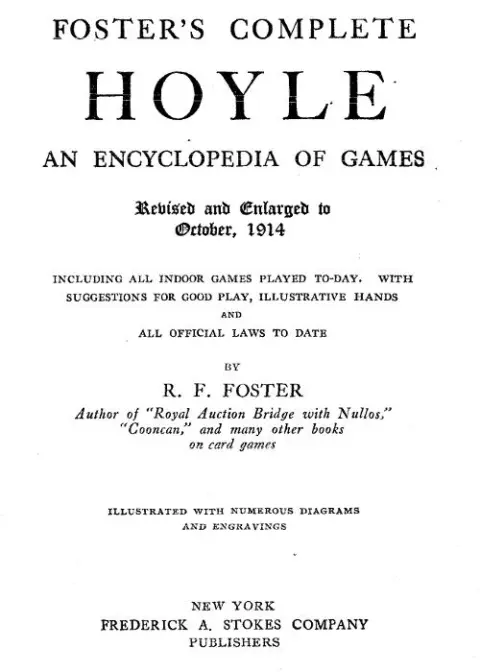
THE CLASSIC COLLECTION · 1914
"Foster's Complete Hoyle: An Encyclopedia of Games" by R. F. Foster is an exhaustive reference work on indoor games, likely written in the early 20th century. The book serves as a comprehensive guide that catalogues a multitude of games, offering systematic instructions and rules that can enhance players' understanding and enjoyment of both new and traditional games. It aims to provide clarity on the official laws governing these games, alongside suggestions for good play and illustrative hands. The opening of the work establishes its authority by discussing the historical significance of the term "Hoyle," which has come to embody the ultimate reference for game rules. Foster emphasizes that the rules of many popular games, particularly card games, vary widely among localities and that his compilation aims to offer a standardized set of rules. By tracing the development and variations of various games, he sets the stage for a systematic presentation of games, beginning with foundational insights into the whist family, thereby enabling readers to grasp both the diversity and the common principles underlying indoor gaming.
Introduction adapted from the source catalogue; source summaries may be automatically generated.
Free to read · English · 319,976 words · No account needed
MAKE TIME FOR A GOOD BOOK
On by default. Untick to stop anonymous reading totals. Each page counts after 10 seconds in view. How this works.
Anonymous counting is on unless you have switched it off.
=Irregular Remarks.= A player calling attention in any manner to the trick or to the score, may be called upon to play his highest or lowest of the suit led; or to trump or not to trump the trick during the play of which the remark is made.
=Scoring.= A game consists of fifty-one points; fourteen of which must be made on every deal, as follows:--
1 for =High=, or the Ace of trumps.
1 for =Low=, or the Deuce of trumps.
1 for the =Jack= of trumps.
1 for =Game=, or the Ten of trumps.
5 for =Right Pedro=, or the Five of trumps.
5 for =Left Pedro=, or Five of the same colour as the trump suit. All points count to the side winning them.
Any trumps found among the discards at the end of the hand count for the side that made the trump.
At the end of the hand, the number of points won by each side is added up, and the lower deducted from the higher, the difference being scored by the winners of the majority. If the result is a tie, neither scores. For instance: If A-B make 11, Y-Z must make the remaining 3, which deducted from 11 leaves 8 points for A-B to score.
If the side naming the trump suit fails to make as many points as they bid, they score nothing for that deal, and the number bid is scored by the adversaries, in addition to any other points that the adversaries may have made in play. The number bid and the number actually won, must be compared before deducting the points made by the adversaries.
The side first making fifty-one points wins the game.
=Text Books.= There are two very good text-books on the game.
The Laws and Principles of Cinch, by G.W. Hall, 1891.
The Laws and Etiquette of Cinch, issued by the Chicago Cinch Club,
1890.
Hearts is supposed by some persons to be an entirely new game; but its leading principle, losing instead of winning tricks, is to be found in many other card games, some of which are quite old. Slobberhannes, Enflé, Schwellen, Polignac, and The Four Jacks, all belong to the same family, but most of them have given way to the more popular game of Hearts.
There are several varieties of Hearts, but the principal arrangements are the same in all, and the chief differences are in the manner of settling at the end of the hand.
=CARDS.= Hearts is played with a full pack of fifty-two cards, which rank A K Q J 10 9 8 7 6 5 4 3 2: the ace is the highest in play, but in cutting it ranks below the deuce. There is no trump suit.
Your reading position is saved on this browser. Take it to another device with a library code. Reading pages adapt to text, rather than matching a printed edition.
BEHIND THE BOOK
This eBook is for the use of anyone anywhere in the United States and most other parts of the world at no cost and with almost no restrictions whatsoever. You may copy it, give it away or re-use it under the terms of the Project Gutenberg License included with this eBook or online at www.gutenberg.org. If you are not located in the United States, you will have to check the laws of the country where you are located before using this eBook. Read the source licence.
The original source file, including credits and licence, is retained by this library. Request an original-format copy at no charge. Please include the book title and Project Gutenberg identifier #53881.
KEEP YOUR CURIOSITY GOING
Charles G. (Charles Griffith) Ross
Hannah Webster Foster

Emily Lawless
Edwin Hamlin Carr

Charles De Lano Hine
Andrew Ure