
Fors Clavigera (Volume 5 of 8) Letters to the workmen and labourers of Great Britain
John Ruskin

THE CLASSIC COLLECTION · 1884
"Fors Clavigera (Volume 6 of 8)" by John Ruskin is a series of letters published during the 1870s. Addressed to British workmen and laborers, these pamphlets explore Ruskin's moral and social vision centered on the dignity of sincere labor. Inspired by his mentor Thomas Carlyle, Ruskin tackles various topics aimed at influencing social change. The collection includes his infamous attack on James McNeill Whistler's paintings, which sparked a libel case that temporarily ended Ruskin's art criticism career.
Introduction adapted from the source catalogue; source summaries may be automatically generated.
Free to read · English · 102,917 words · No account needed
MAKE TIME FOR A GOOD BOOK
On by default. Untick to stop anonymous reading totals. Each page counts after 10 seconds in view. How this works.
Anonymous counting is on unless you have switched it off.
In the meantime, for those of us who are Christians, our own way is plain. We can with perfect ease ascertain what usury is; and in what express terms forbidden. I had partly prepared, for this Fors, and am able to give, as soon as needful, an analysis of the terms ‘Increase’ and ‘Usury’ throughout the Old and New Testaments. But the perpetual confusion of the English terms when the Greek and Latin are clear, (especially by using the word ‘increase’ in one place, and ‘generation’ in another, at the English translator’s pleasure,) renders the matter too intricate for the general reader, though intensely interesting to any honest scholar. I content myself, therefore, with giving the plain Greek and plain English of Leviticus xxv. 35 to 37. [61]
Ἐὰν δὲ πένηται ὁ ἀδελφός σου, καὶ ἀδυνατήσῃ ταῖς χερσὶν αὐτοῦ παρὰ σοὶ, ἀντιλήψῃ αὐτοῦ ὡς προσηλύτου καὶ παροίκου, καὶ ζήσεται ὁ ἀδελφός σου μετὰ σοῦ.
Οὐ λήψῃ παρ’ αὐτοῦ τόκον, οὐδὲ ἐπὶ πλήθει, καὶ φοβηθήσῃ τὸν θεόν σου· ἐγὼ κύριος· καὶ ζήσεται ὀ ἀδελφός σου μετὰ σοῦ.
Τὸ ἀργύριόν σου οὐ δώσεις αὐτῷ τόκῳ, καὶ ἐπὶ πλεονασμῷ οὐ δώσεις αὐτῲ βρώματά σου·
“And if thy brother be poor, and powerless with his hands, at thy side, thou shalt take his part upon thee, to help him, [62] as thy proselyte and thy neighbour; and thy brother shall live with thee. Thou shalt take no usury of him, nor anything over and above, and thou shalt fear thy God. I am the Lord, and thy brother shall live with thee. Thou shalt not give him thy money, for usury; and thou shalt not give him thy food, for increase.”
There is the simple law for all of us;—one of those which Christ assuredly came not to destroy, but to fulfil: and there is no national prosperity to be had but in obedience to it.
How we usurers are to live, with the hope of our gains gone, is precisely the old temple of Diana question. How Robin Hood or Cœur de Lion were to live without arrow or axe, would have been as strange a question to them, in their day. And there are many amiable persons who will not directly see their way, any more than I do myself, to an honest life; only, let us be sure that this we are leading now is a dishonest one; and worse, (if Dante and Shakspeare’s mind on the matter are worth any heed, of which more in due time,) being neither more nor less than a spiritual manner of cannibalism, which, so long as we persist in, every word spoken in Scripture of those who “eat my people as they eat bread,” is spoken directly of us. [63] It may be an encouragement to some of us—especially those evangelically bred—in weaning ourselves slowly from such habits, to think of our dear old converted friend, Friday. We need not fear our power of becoming good Christians yet, if we will: so only that we understand, finally and utterly, that all gain, increase, interest, or whatever else you call it or think it, to the lender of capital, is loss, decrease, and dis-interest, to the borrower of capital. Every farthing we, who lend the tool, make, the borrower of the tool loses. And all the idiotical calculations of what money comes to, in so many years, simply ignore the debit side of the book, on which the Labourer’s Deficit is precisely equal to the Capitalist’s Efficit. I saw an estimate made by some blockhead in an American paper, the other day, of the weight of gold which a hundred years’ ‘interest’ on such and such funds would load the earth with! Not even of wealth in that solid form, could the poor wretch perceive so much of the truth as that the gold he put on the earth above, he must dig out of the earth below! But the mischief in real life is far deeper on the negative side, than the good on the positive. The debt of the borrower loads his heart, cramps his hands, and dulls his labour. The gain of the lender hardens his heart, fouls his brain, and puts every means of mischief into his otherwise clumsy and artless hands.
Your reading position is saved on this browser. Take it to another device with a library code. Reading pages adapt to text, rather than matching a printed edition.
John Ruskin

John Ruskin

John Ruskin
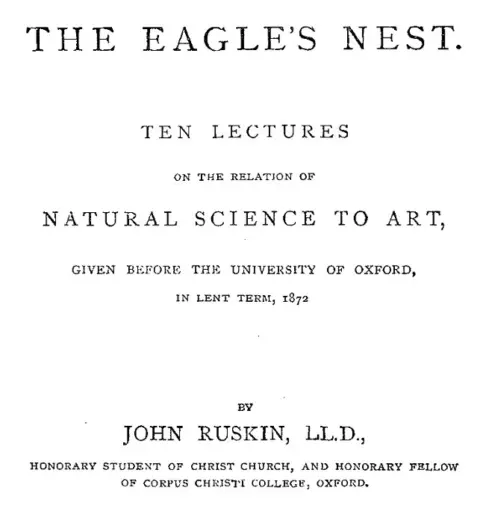
John Ruskin
BEHIND THE BOOK
This eBook is for the use of anyone anywhere in the United States and most other parts of the world at no cost and with almost no restrictions whatsoever. You may copy it, give it away or re-use it under the terms of the Project Gutenberg License included with this eBook or online at www.gutenberg.org. If you are not located in the United States, you will have to check the laws of the country where you are located before using this eBook. Read the source licence.
The original source file, including credits and licence, is retained by this library. Request an original-format copy at no charge. Please include the book title and Project Gutenberg identifier #70181.
KEEP YOUR CURIOSITY GOING

David Patterson (Spirit) Hatch

David Patterson (Spirit) Hatch

David Patterson (Spirit) Hatch

Ralph Waldo Emerson

Maurice Baring

Oscar Wilde & James McNeill Whistler