
The Writing of News A Handbook with Chapters on Newspaper Correspondence and Copy Reading
Charles G. (Charles Griffith) Ross
THE CLASSIC COLLECTION · 1901
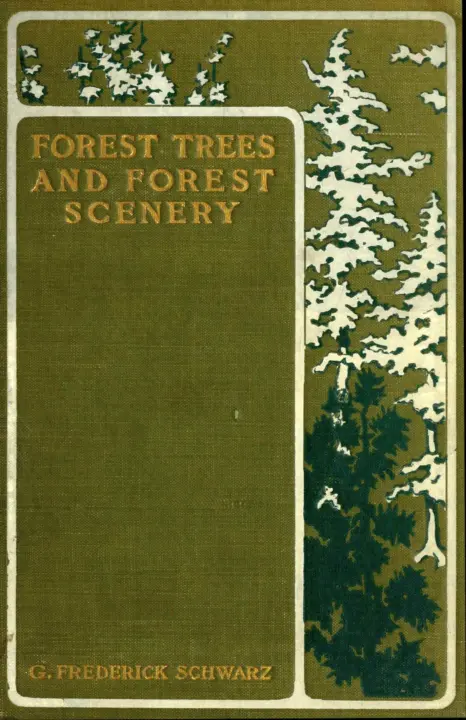
"Forest Trees and Forest Scenery" by G. Frederick Schwarz is a scientific publication written in the early 20th century. The book focuses on the beauty and aesthetic value of American forest trees and their environments, contrasting them with the artificially managed forests of Europe. The aim is to foster appreciation for the natural beauty of American forests while considering the principles of forestry that can enhance their visual and ecological value. At the start of the work, the author outlines his intention to explore the sources of beauty within American forests, emphasizing the importance of trees, shrubs, and overall scenery. The initial chapter introduces readers to individual trees based on their aesthetic qualities, with a focus on broadleaf trees, such as oaks and maples, detailing their forms and characteristics. Through descriptive language, Schwarz evokes a deep sense of appreciation for the diverse species found in the forests, while also hinting at the complexities of their distribution and the environmental factors that influence their growth.
Introduction adapted from the source catalogue; source summaries may be automatically generated.
Free to read · English · 22,846 words · No account needed
MAKE TIME FOR A GOOD BOOK
On by default. Untick to stop anonymous reading totals. Each page counts after 10 seconds in view. How this works.
Anonymous counting is on unless you have switched it off.
Note 8, page 163. To the reader who is not familiar with the origin of our forest reserves it may be of interest to know how they became established. By an act of Congress of March 3rd, 1891, the President was empowered to segregate from time to time, and for the benefit of the American people, forest areas situated within the limits of the public lands of the United States. In accordance with this act proclamations were issued by Presidents Cleveland, Harrison, and McKinley, reserving forest areas amounting thus far (September 1st, 1901) to 46,398,369 acres, or approximately 72,500 square miles. There are, however, within these areas numerous bona fide holdings of private ownership, in which the owners are carrying on extensive cutting of timber.
The reserves have been placed under the authority of the Commissioner of the General Land Office, Department of the Interior, and are entrusted to the care of specially appointed superintendents, supervisors, and rangers. Some of these forest tracts are now undergoing a careful study by experts in forestry, with the aim of subjecting them to methods of treatment specially adapted to them, in order that they may yield both useful material and a constant revenue, without impairing the productive power or vitality of the forest. The objects will thereby be fulfilled for which these reserves were established.
INDEX TO THE NAMES OF TREES
and the Synonyms in Common Use
By special permission of the Division of Publications, U. S. Department
of Agriculture
NOTE.—Only the trees that have been specially described or compared are included in the index
Basswood Tilia americana Linn. 113
Syn. American Linden
” Limetree
” Whitewood
” Beetree
Beech Fagus atropunicea (Marsh.) Sudworth 16 Syn. Red Beech Syn. Fagus ferruginea Ait. ” White Beech
Big Laurel Magnolia fœtida (Linn.) Sargent 24 Syn. Magnolia Syn. Magnolia grandiflora Linn. ” Bull Bay
Black Cherry Prunus serotina Ehrh. 113
Syn. Wild Black Cherry
” Wild Cherry
” Rum Cherry
California Black Oak Quercus californica (Torr.) Coop. 78
Syn. Black Oak
Canyon Live Oak Quercus chrysolepis Liebm. 78
Syn. Live Oak
Chestnut Castanea dentata (Marsh.) Borkh. 11 Syn. Castanea vesca β americana Michx. Castanea vulgaris ν americana A. de C.
Flowering Dogwood Cornus florida Linn. 16, 22, 73
Syn. Dogwood
” Boxwood
Honey Locust Gleditsia triacanthos Linn. 17, 113
Syn. Black Locust
” Sweet Locust
” Thorn Locust
” Three-thorned Acacia
Hornbeam Carpinus caroliniana Walt. 16
Syn. Blue Beech
” Water Beech
” Iron wood
Live Oak Quercus virginiana Mill. 6, 110 Syn. Quercus virens Ait.
Locust Robinia pseudacacia Linn. 113
Syn. Black Locust
” Yellow Locust
Mountain Ash Pyrus americana (Marsh.) de C. 113
Redbud Cercis canadensis Linn. 73, 75
Syn. Judas Tree
Red Maple Acer rubrum Linn. 12, 15, 112
Syn. Swamp Maple
” Soft Maple
” Water Maple
Red Oak Quercus rubra Linn. 16
Syn. Black Oak
Sassafras Sassafras sassafras (Linn.) Karst. 18, 112 Syn. Sassafras officinale Nees & Eberm.
Your reading position is saved on this browser. Take it to another device with a library code. Reading pages adapt to text, rather than matching a printed edition.
BEHIND THE BOOK
This eBook is for the use of anyone anywhere in the United States and most other parts of the world at no cost and with almost no restrictions whatsoever. You may copy it, give it away or re-use it under the terms of the Project Gutenberg License included with this eBook or online at www.gutenberg.org. If you are not located in the United States, you will have to check the laws of the country where you are located before using this eBook. Read the source licence.
The original source file, including credits and licence, is retained by this library. Request an original-format copy at no charge. Please include the book title and Project Gutenberg identifier #66356.
KEEP YOUR CURIOSITY GOING
Charles G. (Charles Griffith) Ross
Hannah Webster Foster

Emily Lawless
Edwin Hamlin Carr

Charles De Lano Hine
Andrew Ure