
Last letters from the living dead man
David Patterson (Spirit) Hatch
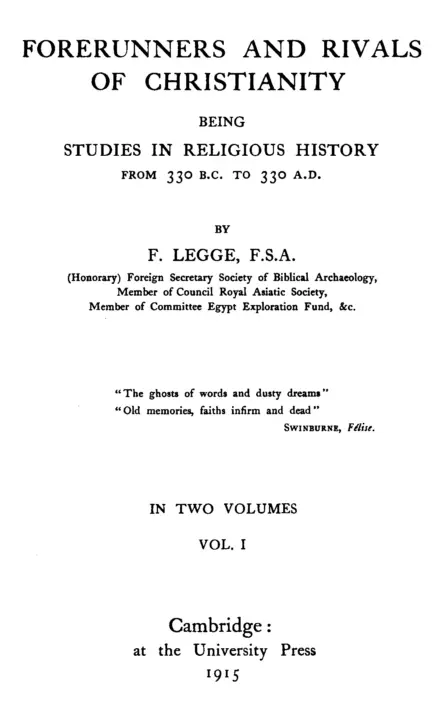
THE CLASSIC COLLECTION · 1915
"Forerunners and Rivals of Christianity: Being Studies in Religious History" by F. Legge is a scholarly historical account likely written in the early 20th century. The book explores documents crucial for understanding the origins and developments of Christianity, highlighting lesser-known religious movements and texts. Its focus is on the interplay between early Christianity and its contemporaries, including various Gnostic sects and Eastern religions. The opening of the work introduces the author's intent to compile and elucidate documents that, while previously translated, remain obscure and misunderstood in contemporary discourse. Legge expresses his desire to foster a clearer understanding of these religious fragments by providing context and commentary, which he believes will clarify their significance. He acknowledges the challenges presented by historical interpretations and notes his efforts to make these texts accessible to both scholars and the general public. Through his methodical approach, he aims to shed light on the diverse influences that shaped early Christianity.
Introduction adapted from the source catalogue; source summaries may be automatically generated.
Free to read · English · 99,528 words · No account needed
MAKE TIME FOR A GOOD BOOK
On by default. Untick to stop anonymous reading totals. Each page counts after 10 seconds in view. How this works.
Anonymous counting is on unless you have switched it off.
Probably this is the meaning of the well-known saying of Jesus, generally quoted as coming from the Gospel according to the Egyptians, in answer to Salome’s enquiry as to the time of the coming of His kingdom: Ὅταν τὸ τῆς αἰσχύνης ἔνδυμα πατήσητε, καὶ ὅταν γένται τά δύο ἔν, καὶ τὸ ἔξω ὡς τὸ ἔσω; καὶ τό ἄρρεν μετὰ τῆς θηλείας, οὔτε ἄρρεν οὔτε θῆλυ. “When ye tread under foot the garment of shame, and when the two shall be one, and the outside as the inside, and the male with the female, neither male nor female.” See Hilgenfeld, N.T. extra Canon. recept., Lipsiae, 1884, vol. IV. p. 44. “The outside as the inside” may refer to the body and the rib which was in the Genesis story taken out of it. So the Pistis Sophia (p. 378, Copt.) speaks of “the Light of Lights, the places of Truth and Goodness, the place of the Holy of Holies, the place of the Holy of all Holies, the place in which there is neither male nor female, nor shape, but Light everlasting, unspeakable.” Hippolytus, op. cit. Bk V. c. 7, p. 146, Cruice, carrying this a step further, speaks of heaven as a place “where there is neither male nor female, but a new creature, a new man who is androgyne (ἀρρηνόθηλυς).”
Footnote 629:
Hippolytus, Bk VI. c. 1, § 19, p. 266, Cruice; Irenaeus, Bk I. c. 16, § 2, p. 194, Harvey; Epiphanius, Haer. XXI. c. 2, p. 124, Oehler.
Footnote 630:
Franck, Le Gnost. Ég. p. 212.
Footnote 631:
Clem. Alex. Strom. VI. c. 2.
Footnote 632:
Maspero, Ét. Égyptol. II. pp. 187 and 385.
Footnote 633:
de Is. et Os. cc. LIII. LIV. and LVI.
Footnote 634:
Clem. Hom. II. c. 22.
Footnote 635:
Irenaeus, Bk I. c. 16, § 3, p. 194, Harvey; Hippolytus, op. cit. Bk VI. c. 1, § 20, p. 266, Cruice.
Footnote 636:
Irenaeus and Hippolytus where last quoted.
Footnote 637:
Hippolytus where last quoted.
Footnote 638:
Eusebius, Hist. Eccl. Bk II. c. 13.
Footnote 639:
Epiph. Haer. XXI. c. 4 (p. 125, vol. II. pt I., Oehler).
Footnote 640:
See last note.
Footnote 641:
Epiph. Haer. XXIV. c. 1, p. 145, Oehler. It is here attributed to Basilides, but Epiphanius has before said that this last borrowed his ideas from “Simon and Satornilus.”
Footnote 642:
Dan. X. 13.
Footnote 643:
Lucian, Pseudomantis, passim.
Footnote 644:
Epiphanius says that Simon taught none could be saved unless he learned [Simon’s] system of initiation (μυσταγωγία). See Epiph. Haer. XXI. c. 4, p. 127, Oehler.
Footnote 645:
Irenaeus, Bk I. c. 17, p. 195, Harvey.
Footnote 646:
Epiph. Haer. XXII. p. 133, Oehler; Eusebius, Hist. Eccl. Bk III. c. 26. Cf. Justin Martyr, First Apol. c. 26. Schmiedel, s.v. Simon Magus in Encyc. Bibl., says the exact contrary—a curious slip.
Footnote 647:
Theodoret, Haer. Fab. I. 1.
Footnote 648:
See note 7 supra.
Footnote 649:
Origen, cont. Celsus, Bk VI. c. 11.
Footnote 650:
Eusebius, Hist. eccl. Bk II. c. 13.
Footnote 651:
Your reading position is saved on this browser. Take it to another device with a library code. Reading pages adapt to text, rather than matching a printed edition.
BEHIND THE BOOK
This eBook is for the use of anyone anywhere in the United States and most other parts of the world at no cost and with almost no restrictions whatsoever. You may copy it, give it away or re-use it under the terms of the Project Gutenberg License included with this eBook or online at www.gutenberg.org. If you are not located in the United States, you will have to check the laws of the country where you are located before using this eBook. Read the source licence.
The original source file, including credits and licence, is retained by this library. Request an original-format copy at no charge. Please include the book title and Project Gutenberg identifier #71384.
KEEP YOUR CURIOSITY GOING
David Patterson (Spirit) Hatch

David Patterson (Spirit) Hatch

David Patterson (Spirit) Hatch
Cécile Tormay

Moritz Busch
John L. Ransom