
Last letters from the living dead man
David Patterson (Spirit) Hatch
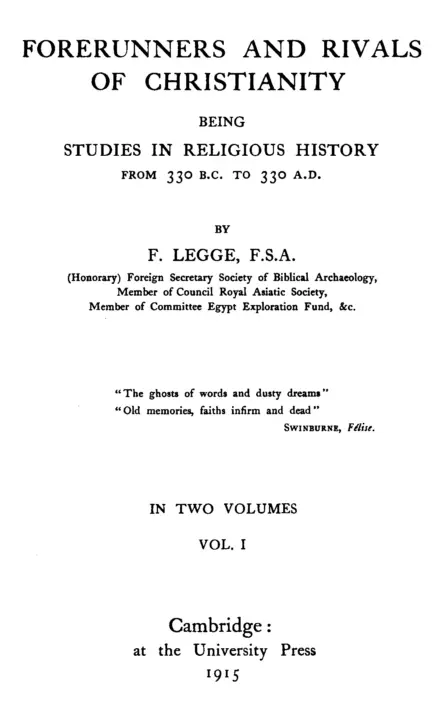
THE CLASSIC COLLECTION · 1915
"Forerunners and Rivals of Christianity: Being Studies in Religious History" by F. Legge is a scholarly historical account likely written in the early 20th century. The book explores documents crucial for understanding the origins and developments of Christianity, highlighting lesser-known religious movements and texts. Its focus is on the interplay between early Christianity and its contemporaries, including various Gnostic sects and Eastern religions. The opening of the work introduces the author's intent to compile and elucidate documents that, while previously translated, remain obscure and misunderstood in contemporary discourse. Legge expresses his desire to foster a clearer understanding of these religious fragments by providing context and commentary, which he believes will clarify their significance. He acknowledges the challenges presented by historical interpretations and notes his efforts to make these texts accessible to both scholars and the general public. Through his methodical approach, he aims to shed light on the diverse influences that shaped early Christianity.
Introduction adapted from the source catalogue; source summaries may be automatically generated.
Free to read · English · 99,528 words · No account needed
MAKE TIME FOR A GOOD BOOK
On by default. Untick to stop anonymous reading totals. Each page counts after 10 seconds in view. How this works.
Anonymous counting is on unless you have switched it off.
M. de Faye is probably right in saying (Étude Critique des Documents du Gnosticisme Chrétien, Paris, 1913, pp. 352, 353) that the Sethiani were never a very important sect. Stähelin’s theory (Die Gnostischen Quellen Hippolyts, Leipzig, 1890) that Hippolytus was deceived by a forger who drew all his “heresies” from one document (see Chapter VII, infra) is too fantastic to be correct, but it has done good service in calling attention to the family likeness between most of the systems which he sketches. Cf. E. de Faye, Intro. à l’Ét. du Gnost., Paris, 1903, p. 68. We are not likely to reach any more definite conclusion unless some lucky discovery reveals to us the sources of Hippolytus’ compilation.
Footnote 552:
Irenaeus, Bk I. c. 16, p. 191, Harvey; Hippolytus, Philosophumena, Bk VI. c. 20, p. 267, Cruice; Augustine, de Haeres. lib. cc. I., II., III.; Praedestinatus, de Haer. Bk I. c. 1; Pseudo-Tertullian, adv. omn. Haer. c. I. etc.
Footnote 553:
Acts viii. 9, 10.
Footnote 554:
From the story in Acts, it appears that what Simon tried to buy was the power of ordination. The offence in modern ecclesiastical jurisprudence seems to be the obtaining the priestly office by purchase rather than by merit or gift.
Footnote 555:
Cf. Amélineau, Gnosticisme Égyptien, p. 51.
Footnote 556:
Morrison, op. cit. p. 351. Cowley in Cheyne’s Encyclopaedia Biblica, s.v. Samaritans, omits this; but see Josephus, Ant. Bk XII. c. 2, § 1.
Footnote 557:
Josephus, op. cit. Bk XII. c. 5, § 1.
Footnote 558:
Ibid. op. cit. Bk XIII. c. 10, § 3.
Footnote 559:
Ibid. op. cit. Bk XV. c. 9, § 5.
Footnote 560:
“Neither at Jerusalem, nor on this mountain [Gerizim] shall men worship the Father,” John iv. 21.
Footnote 561:
Cowley in Encyc. Bibl. s.v. Samaritans, col. 4260. According to Renan, Les Évangiles, p. 451, the Samaritans at the beginning of our era were divided into a great number of sects, all more or less attached to Simon. The authorities he quotes are, however, too late to establish this satisfactorily.
Footnote 562:
The question was discussed and resolved, as far as it could be in the then state of our information, by Salmon in Smith’s Dictionary of Christian Biography, s.v. Clementines. Mgr. Duchesne, Early History of the Christian Church, Eng. ed. 1909, p. 96, n. 2, sums up in favour of their ultimate derivation from the Preaching of Peter composed at the end of the IInd or beginning of IIIrd cent. He thinks the Clementines orthodox save for a slight Arian tendency.
Footnote 563:
So Theodoret; but this was a common form in the patristic accounts of such disputes. It is repeated in the dispute of Archelaus with Manes, mentioned in Chapter XIII, infra, which see.
Footnote 564:
See Tischendorf’s edition, passim. The age of the book may be guessed by its containing the Quo Vadis story quoted by Origen.
Footnote 565:
Your reading position is saved on this browser. Take it to another device with a library code. Reading pages adapt to text, rather than matching a printed edition.
BEHIND THE BOOK
This eBook is for the use of anyone anywhere in the United States and most other parts of the world at no cost and with almost no restrictions whatsoever. You may copy it, give it away or re-use it under the terms of the Project Gutenberg License included with this eBook or online at www.gutenberg.org. If you are not located in the United States, you will have to check the laws of the country where you are located before using this eBook. Read the source licence.
The original source file, including credits and licence, is retained by this library. Request an original-format copy at no charge. Please include the book title and Project Gutenberg identifier #71384.
KEEP YOUR CURIOSITY GOING
David Patterson (Spirit) Hatch

David Patterson (Spirit) Hatch

David Patterson (Spirit) Hatch
Cécile Tormay

Moritz Busch
John L. Ransom