
Last letters from the living dead man
David Patterson (Spirit) Hatch
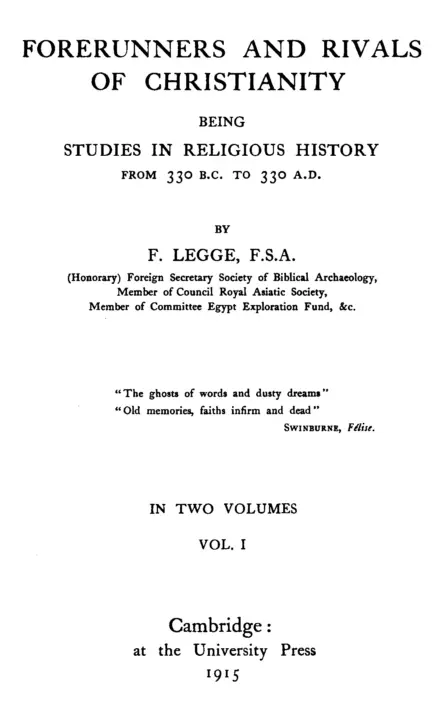
THE CLASSIC COLLECTION · 1915
"Forerunners and Rivals of Christianity: Being Studies in Religious History" by F. Legge is a scholarly historical account likely written in the early 20th century. The book explores documents crucial for understanding the origins and developments of Christianity, highlighting lesser-known religious movements and texts. Its focus is on the interplay between early Christianity and its contemporaries, including various Gnostic sects and Eastern religions. The opening of the work introduces the author's intent to compile and elucidate documents that, while previously translated, remain obscure and misunderstood in contemporary discourse. Legge expresses his desire to foster a clearer understanding of these religious fragments by providing context and commentary, which he believes will clarify their significance. He acknowledges the challenges presented by historical interpretations and notes his efforts to make these texts accessible to both scholars and the general public. Through his methodical approach, he aims to shed light on the diverse influences that shaped early Christianity.
Introduction adapted from the source catalogue; source summaries may be automatically generated.
Free to read · English · 99,528 words · No account needed
MAKE TIME FOR A GOOD BOOK
On by default. Untick to stop anonymous reading totals. Each page counts after 10 seconds in view. How this works.
Anonymous counting is on unless you have switched it off.
Simon, however, had still to account for the creation of man and the part which he played in the scheme of the universe. His reverence for Moses prevented him from directly contradicting the statement in Genesis that Yahweh “formed man out of the dust of the ground,” and this he echoes in the words of the Septuagint, which speaks of God moulding (ἔπλασε) man by “taking dust (χοῦς) from the Earth (Γῆ).” The part here played by the Yahweh of Genesis he transfers to “the Father” of his second or intermediate world[604]; and as Genesis says that God made man in his own image, he is also compelled to say that man was originally made in the likeness of the Father. But “the Father” of Simon’s intermediate world was, as we have seen, an hermaphrodite, or rather a male containing a female power within himself[605]. Hence man was originally both male and female, or in the words of the Great Announcement “not simple, but double according to image and resemblance[606].” But this was clearly not the man of this world as we know him, but the Heavenly or Archetypal Man who remained in the world above ours, and was, as Philo held, a man-woman[607]. How did Simon account for the separation of the sexes, and its influence upon subsequent humanity?
The answer to this question involves Simon’s ideas as to the cause of evil in this world and the means by which man can escape from it. Man was, as we have seen, formed out of dust, but to make him, in the words of Genesis, “a living soul,” it was necessary that he should be animated by the breath (πνεῦμα) of the Divinity. So efficiently was this done that everyone, as Simon said, has within him potentially but not in act, “that which is blessed and incorruptible,” that is to say, “He who standeth, hath stood and will stand,” or in other words the “Father” of the intermediate world. “He it is,” he goes on to say, “who stood above in the Unbegotten Power, who stands below, coming into being by reflection (ἐν εἰκόνι) in the rush of the waters, and will stand above by the side of the blessed and Unbegotten Power if he should receive reflection or image (ἐὰν ἐξεικονισθῇ)[608].” For “there are three who stand, and unless there are three aeons that stand, the unbegotten one, who according to them [Qy. the Hebrews?] was borne over the face of the water, is not in her proper place in the universe (οὐ κοσμεῖται)[609]. The which unbegotten one is fashioned by resemblance as perfect and heavenly, but becomes, in regard to Thought alone, inferior to the Unbegotten Power.” This Unbegotten Power, he goes on to say in words that remind one of several different myths[610], is the “One power cloven in twain above and below, who gives birth to itself, increases itself, seeks itself, finds itself, being its own mother, its own father, its own sister, its own spouse (σύζυγος), its own daughter, its own son, a mother-father [and is] one, being the root of all the universes[611].” It was the Thought of this Power who was charged with bringing the Divine Spark to this world; but apparently, while she was brooding over the face of the waters, she was seized by the angels and authorities whom she had produced, “through motives of jealousy, because they were unwilling to be looked upon as the progeny of any other being[612].” These words are put into the mouth of Simon by Irenaeus, who goes on to say that Thought was thus prevented from returning to the Father and was shut up in a human body. At this point, the account of Irenaeus agrees with that of the Philosophumena which narrates that (according to Simon) the world-making angels caused Thought (Ennoia) to enter one body after another, including that of Helen of Troy (causa teterrima belli), until she finally entered into the body of Simon’s companion Helena whom he found in a brothel at Tyre[613]. Hippolytus says, however, that Simon made up this part of the story out of shame as regards his disciples[614] in order to explain his companying with Helena, and it may be noticed that he nowhere quotes the Great Announcement in its support[615]. Epiphanius, who seems to have used the same documents as Irenaeus, gives a different reason for the conduct of the world-making angels from that of Irenaeus, and makes out that they were seduced by the beauty of “Epinoia,” as he calls Ennoia or Thought, the female aeon who had come down, and detained her below out of sensual desire[616]. Both Irenaeus and Epiphanius are agreed that Simon in some way “redeemed” Helena, although they do not say in what way, and Hippolytus declares that Simon having purified Helena, in like manner brought salvation to men by his own discernment[617]. Why Simon should thus have power of salvation he does not explain directly, but he, Irenaeus, and Epiphanius alike tell us, by what seems to be a wilful or unconscious misinterpretation of the account in the New Testament[618], that Simon gave himself out as the Supreme God, who, seeing that the angels mismanaged this world from their desire for rule, came here to put it right and descended through the different worlds, changing his shape in each to accord with that of the rulers therein, until he appeared here as man, “although he was not a man[619].” Hippolytus further says, as does Irenaeus, that Simon was alleged “to suffer in Judaea in the likeness of Jesus, although in appearance only, and to have appeared to the Jews as Son, to the Samaritans as Father, and to the other nations as the Holy Spirit[620].” His death he accounts for by the story, found nowhere else in post-Christian literature, that at some place, the name of which has slipped out of the text of the Philosophumena, Simon
Your reading position is saved on this browser. Take it to another device with a library code. Reading pages adapt to text, rather than matching a printed edition.
BEHIND THE BOOK
This eBook is for the use of anyone anywhere in the United States and most other parts of the world at no cost and with almost no restrictions whatsoever. You may copy it, give it away or re-use it under the terms of the Project Gutenberg License included with this eBook or online at www.gutenberg.org. If you are not located in the United States, you will have to check the laws of the country where you are located before using this eBook. Read the source licence.
The original source file, including credits and licence, is retained by this library. Request an original-format copy at no charge. Please include the book title and Project Gutenberg identifier #71384.
KEEP YOUR CURIOSITY GOING
David Patterson (Spirit) Hatch

David Patterson (Spirit) Hatch

David Patterson (Spirit) Hatch
Cécile Tormay

Moritz Busch
John L. Ransom