
Last letters from the living dead man
David Patterson (Spirit) Hatch
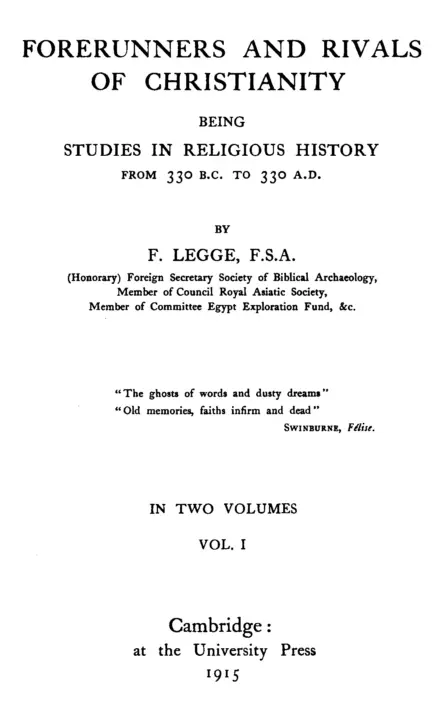
THE CLASSIC COLLECTION · 1915
"Forerunners and Rivals of Christianity: Being Studies in Religious History" by F. Legge is a scholarly historical account likely written in the early 20th century. The book explores documents crucial for understanding the origins and developments of Christianity, highlighting lesser-known religious movements and texts. Its focus is on the interplay between early Christianity and its contemporaries, including various Gnostic sects and Eastern religions. The opening of the work introduces the author's intent to compile and elucidate documents that, while previously translated, remain obscure and misunderstood in contemporary discourse. Legge expresses his desire to foster a clearer understanding of these religious fragments by providing context and commentary, which he believes will clarify their significance. He acknowledges the challenges presented by historical interpretations and notes his efforts to make these texts accessible to both scholars and the general public. Through his methodical approach, he aims to shed light on the diverse influences that shaped early Christianity.
Introduction adapted from the source catalogue; source summaries may be automatically generated.
Free to read · English · 99,528 words · No account needed
MAKE TIME FOR A GOOD BOOK
On by default. Untick to stop anonymous reading totals. Each page counts after 10 seconds in view. How this works.
Anonymous counting is on unless you have switched it off.
F. C. Porter in Hastings’ Dict. of Bible, s.v. Apocrypha, and Wellhausen as there quoted. A list of the books comprised in the expression used in the text with conjectural dates and authorship is given by R. H. Charles in the same work, s.v. Apocalyptical Literature. Cf. article under same heading (also by Charles) in Encyclopaedia Biblica. Prof. Charles is less inclined than earlier writers (e.g. Lightfoot and Kohler, opp. cit.) to credit the Essenes with the composition of the whole of this literature; but he admits that part of the Book of Enoch, chap. cviii. 1-15, is by Essene hands. The other parts attributed to the Essenes by Sieffert, Tideman, and Cheyne are indicated by him in The Book of Enoch, Oxford, 1893, pp. 13, 14, 21.
Footnote 491:
The Book of the Secrets of Enoch (Morfill and Charles trans.),
Oxford, 1896, p. 32.
Footnote 492:
Charles, Book of Enoch, cit. sup. pp. 24-33.
Footnote 493:
Id. op. cit. chap. xc. 28-38; cf. id. Crit. Hist. p. 192.
Footnote 494:
Charles, Book of Enoch, xc. 30.
Footnote 495:
Charles, Book of Enoch, p. 24.
Footnote 496:
Id. op. cit. chap. i. 4.
Footnote 497:
Id. op. cit. chap. i. 8.
Footnote 498:
David had the Philistines for suzerain, as Solomon had Egypt, cf. Stanley A. Cook, in Encyc. Bibl. s.v. David, and Maspero, Hist. anc. des Peuples de l’Orient, 1904, pp. 391, 422. Their successors, too, up to the Captivity seem to have always been tributaries to Assyria, Chaldaea, or Egypt. After that event, they were of course vassals to the Persian and Macedonian Empires.
Footnote 499:
Charles, Book of Enoch, chap. xxxviii. 1.
Footnote 500:
Op. cit. chap. xxxviii. 5. Cf. xlvi. 4, “And this Son of Man whom thou hast seen will arouse the kings and the mighty ones from their thrones, and will loosen the reins of the strong and grind to powder the teeth of the sinners.”
Footnote 501:
Op. cit. chap. lvi. 5. This verse, which Dr Charles considers an interpolation, was evidently written in 40 B.C., when a Parthian army under Pacorus invaded Palestine and put a puppet of their own on the throne of Jerusalem, and before 39 B.C., when Publius Ventidius Bassus drove the Parthians back to their own country. Cf. Morrison, Jews, etc., pp. 58-61, and authorities there quoted.
Footnote 502:
Charles, Book of Enoch, chap. lvi. 6-8.
Footnote 503:
Charles, op. cit. p. 108. He there puts the date of the Similitudes, as this portion of the Book of Enoch is called, about a quarter of a century before the Parthian invasion. In that case, the prediction in the text would be about the only instance of fulfilled political prophecy known. But the discrepancy is doubtless to be explained by the theory of interpolation after the event.
Footnote 504:
Your reading position is saved on this browser. Take it to another device with a library code. Reading pages adapt to text, rather than matching a printed edition.
BEHIND THE BOOK
This eBook is for the use of anyone anywhere in the United States and most other parts of the world at no cost and with almost no restrictions whatsoever. You may copy it, give it away or re-use it under the terms of the Project Gutenberg License included with this eBook or online at www.gutenberg.org. If you are not located in the United States, you will have to check the laws of the country where you are located before using this eBook. Read the source licence.
The original source file, including credits and licence, is retained by this library. Request an original-format copy at no charge. Please include the book title and Project Gutenberg identifier #71384.
KEEP YOUR CURIOSITY GOING
David Patterson (Spirit) Hatch

David Patterson (Spirit) Hatch

David Patterson (Spirit) Hatch
Cécile Tormay

Moritz Busch
John L. Ransom