
Last letters from the living dead man
David Patterson (Spirit) Hatch
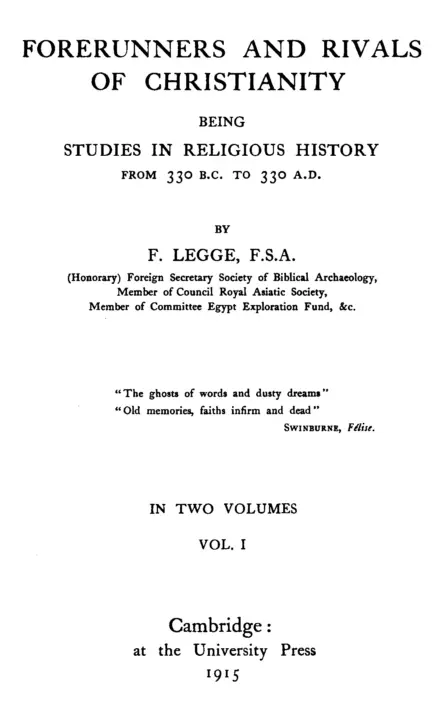
THE CLASSIC COLLECTION · 1915
"Forerunners and Rivals of Christianity: Being Studies in Religious History" by F. Legge is a scholarly historical account likely written in the early 20th century. The book explores documents crucial for understanding the origins and developments of Christianity, highlighting lesser-known religious movements and texts. Its focus is on the interplay between early Christianity and its contemporaries, including various Gnostic sects and Eastern religions. The opening of the work introduces the author's intent to compile and elucidate documents that, while previously translated, remain obscure and misunderstood in contemporary discourse. Legge expresses his desire to foster a clearer understanding of these religious fragments by providing context and commentary, which he believes will clarify their significance. He acknowledges the challenges presented by historical interpretations and notes his efforts to make these texts accessible to both scholars and the general public. Through his methodical approach, he aims to shed light on the diverse influences that shaped early Christianity.
Introduction adapted from the source catalogue; source summaries may be automatically generated.
Free to read · English · 99,528 words · No account needed
MAKE TIME FOR A GOOD BOOK
On by default. Untick to stop anonymous reading totals. Each page counts after 10 seconds in view. How this works.
Anonymous counting is on unless you have switched it off.
In the Catholic Church at this period the Eucharist was celebrated, if we may judge from the First Apology of Justin Martyr (c. LVI), in a very simple manner, but apparently in the presence of all the faithful. In that part of the Apostolical Constitutions (Bk VIII. c. 66), which is probably later in date than Justin, the catechumens, heterodox, and unbelievers are directed to be excluded before consecration (see Hatch, Hibbert Lectures, p. 301). It does not follow that the ceremonial was as simple with the Gnostics. Marcus is said by Irenaeus (Bk I. c. 6, pp. 116, 117, Harvey) to have made the mixture of wine and water in the cup to appear purple and to overflow into a larger vessel; while similar prodigies attend the celebration in the Pistis Sophia and the Bruce Papyrus, for which see Chap. X, infra. As such thaumaturgy was intended to astonish the onlookers, it is probable that the elements were displayed before the whole congregation. That the later form of the ritual of the Christian sacraments was taken from the Gnostics, see Hatch, Hibbert Lectures, pp. 295-305, and 307-309, and de Faye, Introduction à l’Ét. du Gnosticisme, Paris, 1903, pp. 106, 107.
Footnote 280:
Kenyon, Greek Papyri, p. 105. Sir Frederick Kenyon questions the theocrasia of Serapis and Esculapius, but see Bouché-Leclercq, Rev. Hist. Rel. 1902, p. 30.
Footnote 281:
Revillout, Rev. Égyptol. 1880, p. 172.
Footnote 282:
“The Names of Demons in the Magic Papyri,” P.S.B.A. 1901, pp. 41
sqq.
Footnote 283:
Lafaye, Culte, etc. p. 96, and inscriptions there quoted.
Footnote 284:
Budge, “Papyrus of Nesi-Amsu,” p. 442.
Footnote 285:
See “The Greek Worship of Serapis and Isis,” P.S.B.A. 1914, pp. 93,
94.
Footnote 286:
That the Trinitarian doctrine of the Creed of Nicaea evolved gradually will now, I suppose, be admitted by all. Mr Conybeare, Apology of Apollonius, 1894, p. 14, probably goes too far when he says that “the doctrine of the Trinity in Unity” is not met with till the end of the third century. So Guignebert, L’Évolution des Dogmes, Paris, 1910, pp. 293, 294, tells us how in his opinion the dogma followed “at some distance” the assertion of the Divinity of Christ. Harnack, Expansion of Christianity, Eng. ed. 1904, II. pp. 257, 258, seems to attribute the first formulation of the dogma to Tertullian who, according to him, owed something to the Gnostics. It is at any rate plain that neither Hermas, nor the Apologists, nor Irenaeus, nor Clement of Alexandria, nor Origen were in accord with later orthodoxy on the point. Monsignor Duchesne, Early History of the Christian Church, Eng. ed. 1909, p. 20, puts the matter very frankly when he suggests that the average Christian troubled himself very little about it. “This is the Christian doctrine of the Trinity,” he says after defining it, “not certainly as it was formulated later in opposition to transient heresies, but as it appeared to the general conscience of the early Christians.... The generality of Christians in the first century even in apostolic days stood here almost exactly at the same point as present-day Christians. Theologians knew, or at any rate said, far more about it.”
Your reading position is saved on this browser. Take it to another device with a library code. Reading pages adapt to text, rather than matching a printed edition.
BEHIND THE BOOK
This eBook is for the use of anyone anywhere in the United States and most other parts of the world at no cost and with almost no restrictions whatsoever. You may copy it, give it away or re-use it under the terms of the Project Gutenberg License included with this eBook or online at www.gutenberg.org. If you are not located in the United States, you will have to check the laws of the country where you are located before using this eBook. Read the source licence.
The original source file, including credits and licence, is retained by this library. Request an original-format copy at no charge. Please include the book title and Project Gutenberg identifier #71384.
KEEP YOUR CURIOSITY GOING
David Patterson (Spirit) Hatch

David Patterson (Spirit) Hatch

David Patterson (Spirit) Hatch
Cécile Tormay

Moritz Busch
John L. Ransom