
Last letters from the living dead man
David Patterson (Spirit) Hatch
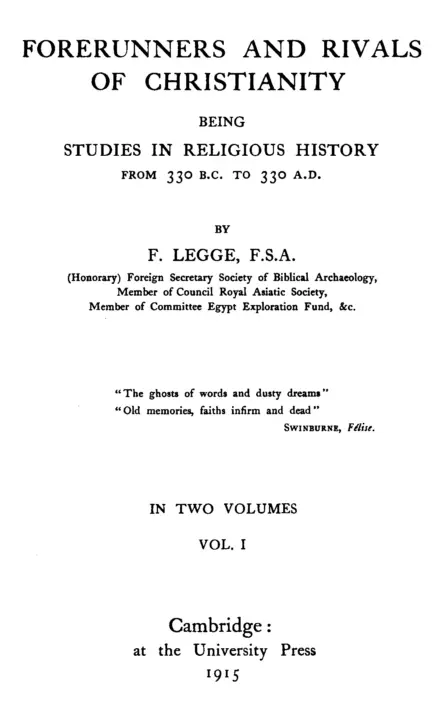
THE CLASSIC COLLECTION · 1915
"Forerunners and Rivals of Christianity: Being Studies in Religious History" by F. Legge is a scholarly historical account likely written in the early 20th century. The book explores documents crucial for understanding the origins and developments of Christianity, highlighting lesser-known religious movements and texts. Its focus is on the interplay between early Christianity and its contemporaries, including various Gnostic sects and Eastern religions. The opening of the work introduces the author's intent to compile and elucidate documents that, while previously translated, remain obscure and misunderstood in contemporary discourse. Legge expresses his desire to foster a clearer understanding of these religious fragments by providing context and commentary, which he believes will clarify their significance. He acknowledges the challenges presented by historical interpretations and notes his efforts to make these texts accessible to both scholars and the general public. Through his methodical approach, he aims to shed light on the diverse influences that shaped early Christianity.
Introduction adapted from the source catalogue; source summaries may be automatically generated.
Free to read · English · 99,528 words · No account needed
MAKE TIME FOR A GOOD BOOK
On by default. Untick to stop anonymous reading totals. Each page counts after 10 seconds in view. How this works.
Anonymous counting is on unless you have switched it off.
The bearers of the sacred Pastos (box or coffin?). He says elsewhere that this particular college dated from “the days of Sulla,” i.e. 87-84 B.C.
Footnote 247:
The reading has been contested, but is well established. Cf. the concluding words of the Mass: “Ite, missa est.”
Footnote 248:
“Una quae es omnia,” C.I.N. 3580. The stone was found at Capua.
Footnote 249:
Apuleius, Met. Bk XI. c. 5.
Footnote 250:
Plutarch, Aristides, c. V.
Footnote 251:
Apuleius, Met. cc. 21, 28, 30.
Footnote 252:
See p. 48, supra. Oracles given in dreams were, however, an old institution in Egypt. See the dream of Thothmes IV concerning the Sphinx, Breasted, History of Egypt, p. 325, and Ancient Records, Chicago 1906, vol. II. No. 815.
Footnote 253:
Tacitus, Hist. Bk IV. cc. 81, 82.
Footnote 254:
Asklepios or Esculapius was one of the gods absorbed by Serapis. It is most probable that the great statue by Bryaxis in the Alexandrian Serapeum was originally an Asklepios. See Bouché-Leclercq, Rev. de l’Hist. des Rel. 1902, pp. 26, 27, 28. There seems also to have been a chapel to him in the Greek Serapeum at Memphis. See Brunet de Presle, “Le Sérapéum de Memphis,” Paris, 1865, pp. 261-263. Cf. Forshall, Greek Papyri in the British Museum, 1839, p. 33, and note 1 p. 80, infra.
Footnote 255:
Josephus, Antiquities, Bk XVIII. cc. 3, 4.
Footnote 256:
Lovatelli, Il Culto d’Iside in Roma, Roma, 1891, p. 174; Ovid, Pontic. Epist. Bk I. Ep. I.
Footnote 257:
As M. Lafaye (Culte, etc. p. 132) points out, the hierophant in Apuleius calls the other priests “his company,” suus numerus (Met. c. 21).
Footnote 258:
For all these, see Lafaye, op. cit. chap. VII: Le Sacerdoce.
Footnote 259:
Lafaye, op. cit. p. 150.
Footnote 260:
These fragments are scattered among the different European museums. Some are in the Vatican Library and were published by Mgr. Angelo Mai in 1833 (Brunet de Presle, “Les Papyri Grecs du Louvre,” Mém. de l’Acad. des Inscript. XVIII. pt 2 (1865), p. 16), others in the Leyden Museum (Leemans, Papyri Graeci, I. pp. 6 sqq.), others in the Louvre (Brunet de Presle, op. cit. p. 22), and the largest number in the British Museum (Kenyon, Greek Papyri, p. 1). The whole story, so far as it has been ascertained, is told by Brunet de Presle, op. cit. pp. 261-263, and by Sir Frederic Kenyon, op. cit. pp. 1-5, and the questions arising out of it are admirably summed up by M. Bouché-Leclercq in his article, “Les Reclus du Sérapéum de Memphis” in Mélanges Perrot, Paris, 1903, p. 17.
Footnote 261:
Matth. xxiii. 11. Cf. the Pope’s title of “Servant of the Servants of God” (Servus servorum Dei).
Footnote 262:
Your reading position is saved on this browser. Take it to another device with a library code. Reading pages adapt to text, rather than matching a printed edition.
BEHIND THE BOOK
This eBook is for the use of anyone anywhere in the United States and most other parts of the world at no cost and with almost no restrictions whatsoever. You may copy it, give it away or re-use it under the terms of the Project Gutenberg License included with this eBook or online at www.gutenberg.org. If you are not located in the United States, you will have to check the laws of the country where you are located before using this eBook. Read the source licence.
The original source file, including credits and licence, is retained by this library. Request an original-format copy at no charge. Please include the book title and Project Gutenberg identifier #71384.
KEEP YOUR CURIOSITY GOING
David Patterson (Spirit) Hatch

David Patterson (Spirit) Hatch

David Patterson (Spirit) Hatch
Cécile Tormay

Moritz Busch
John L. Ransom