
Last letters from the living dead man
David Patterson (Spirit) Hatch
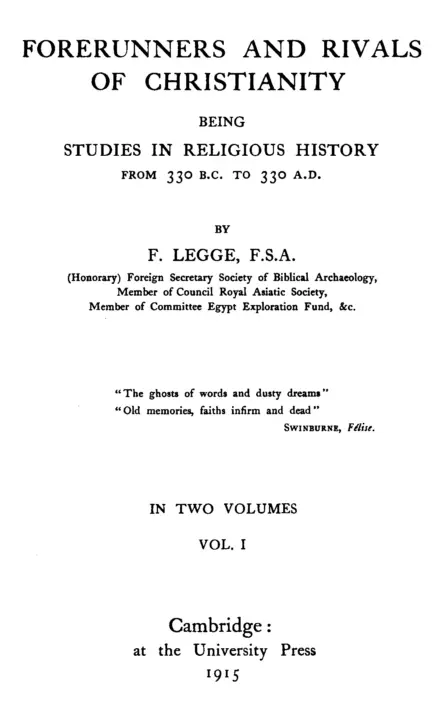
THE CLASSIC COLLECTION · 1915
"Forerunners and Rivals of Christianity: Being Studies in Religious History" by F. Legge is a scholarly historical account likely written in the early 20th century. The book explores documents crucial for understanding the origins and developments of Christianity, highlighting lesser-known religious movements and texts. Its focus is on the interplay between early Christianity and its contemporaries, including various Gnostic sects and Eastern religions. The opening of the work introduces the author's intent to compile and elucidate documents that, while previously translated, remain obscure and misunderstood in contemporary discourse. Legge expresses his desire to foster a clearer understanding of these religious fragments by providing context and commentary, which he believes will clarify their significance. He acknowledges the challenges presented by historical interpretations and notes his efforts to make these texts accessible to both scholars and the general public. Through his methodical approach, he aims to shed light on the diverse influences that shaped early Christianity.
Introduction adapted from the source catalogue; source summaries may be automatically generated.
Free to read · English · 99,528 words · No account needed
MAKE TIME FOR A GOOD BOOK
On by default. Untick to stop anonymous reading totals. Each page counts after 10 seconds in view. How this works.
Anonymous counting is on unless you have switched it off.
That this change had been brought about by the work of the Isiac priesthood, there can be little doubt. Between the foundation of the Alexandrian religion by Ptolemy and the date at which Apuleius wrote, a space of five centuries elapsed, and this must have seen many changes in the constitution of what may be called the Isiac Church. The Greeks always set their faces against anything like a priestly caste set apart from the rest of the community, and the priests of the Hellenic gods were for the most part elected, like modern mayors of towns, for a short term only, after which they fell back into the ranks of the laity with as little difficulty as do municipal officers at the present day. The Eleusinian Mysteries were indeed committed to certain families in whom their priesthood was hereditary; but no professional barriers existed between these families and the rest of the citizens; and we find Callias, the “torch-bearer” and one of the highest officials at the Mysteries, not only fighting in the ranks at Marathon, but distinguishing himself by his “cruelty and injustice” in retaining an unfair share of the plunder for himself[250]. The Eumolpidae and Lycomidae of Eleusis, also, were probably maintained not by any contribution from the state, but by the revenues of the temple lands and by the fee of a few obols levied from each initiate. But the Alexandrian Church in Egypt must from the first have been endowed and probably established as well. To judge from the analogous case of the dynastic cult or worship of the sovereign, which Ptolemy Soter set up, the “sublime religion” was in its native Egypt maintained by a tax on the revenues of those wakf or temple lands held in mortmain with which the native gods of Egypt were so richly provided from the earliest times. When the Alexandrian religion became a missionary faith and established itself in Athens and other parts of the Hellenic world, it no doubt depended in the first instance on the voluntary contributions of the associations of Sarapiasts or Isiaci founded for its maintenance. But we may be sure that politic princes like the first three Ptolemies, who were besides the richest and most opulent of all the Successors of Alexander, did not let these outposts of their empire languish for lack of funds, and we may guess that the subscriptions of their members were supplemented in case of need by large donations from the King of Egypt or from those who wished to stand well with him. When the faith passed into Western Europe and into territories directly under Roman sway, it had already attained such fame that a large entrance-fee could be demanded from the initiates, and Apuleius tells us more than once that the amount of this was in every case fixed by a special revelation of the goddess, and was no doubt only limited by the length of the aspirant’s purse and the strength of his vocation[251]. Like other Greek priests of the time, also, the ministers of the Alexandrian religion found a way of adding to their income by the practice of divination or foretelling the future, and the oracle of Serapis at Alexandria soon became as celebrated in the Hellenistic world as that of Delphi. There were probably more ways than one of consulting this; but the one which seems to have been specially its own, and which afterwards spread from Egypt into all the temples of the faith in other countries, was by the practice of incubatio which meant sleeping either personally or by deputy in the precinct of the god until the consultant had a dream in which the god’s answer was declared. Such a practice seems to date from the dream sent to Ptolemy Soter at the foundation of the religion, and doubtless formed a great source of revenue to its priesthood[252]. The highest personages in the Roman Empire deigned to resort to it, and Vespasian was vouchsafed a divine vision in the temple of Serapis when he consulted the god about “the affairs of the Empire[253].” Not unconnected with this were the miraculous cures with which Serapis, originally perhaps by confusion with Asklepios the Greek god of healing[254], was credited. The sick man was given a room in the temple precincts, where he doubtless lived the regular and orderly life of a modern hospital, and before long dreamed of a remedy for the malady on which his thoughts were concentrated. As the mind sometimes influences the body, and a belief in the healing power of the medicine is often of more importance than its nature, he very often recovered, and was no doubt expected to be generous in his offerings to the god who had intervened in his cure. Nor were worse means of raising money unknown to the Alexandrian priests, unless they have been greatly belied. They are said to have acted as panders and procurers for the rich, and it was the seduction of a noble Roman lady by a lover who assumed the garb of the god Anubis which led to their expulsion from the Pomoerium under Tiberius[255]. Astrology, too, which depended entirely on mathematical calculations and tables, was peculiarly an Alexandrian art, and the same Manetho who had been one of the persons consulted at the founding of the Alexandrian religion was said to have taught its principles to the Greeks. Whether this be so or not, it is certain that in Ovid’s time the Alexandrian priests used to beg in the streets of Rome after the fashion of the Buddhist monks from whom they may have indirectly borrowed the practice, and that it was thought “unlucky” to reject their importunities[256].
Your reading position is saved on this browser. Take it to another device with a library code. Reading pages adapt to text, rather than matching a printed edition.
BEHIND THE BOOK
This eBook is for the use of anyone anywhere in the United States and most other parts of the world at no cost and with almost no restrictions whatsoever. You may copy it, give it away or re-use it under the terms of the Project Gutenberg License included with this eBook or online at www.gutenberg.org. If you are not located in the United States, you will have to check the laws of the country where you are located before using this eBook. Read the source licence.
The original source file, including credits and licence, is retained by this library. Request an original-format copy at no charge. Please include the book title and Project Gutenberg identifier #71384.
KEEP YOUR CURIOSITY GOING
David Patterson (Spirit) Hatch

David Patterson (Spirit) Hatch

David Patterson (Spirit) Hatch
Cécile Tormay

Moritz Busch
John L. Ransom