
Last letters from the living dead man
David Patterson (Spirit) Hatch
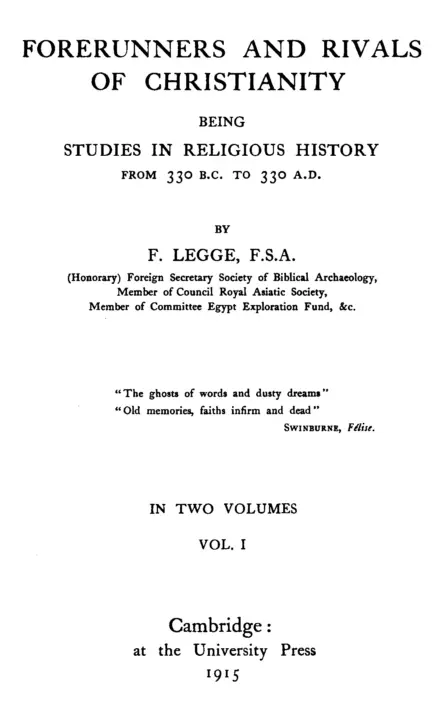
THE CLASSIC COLLECTION · 1915
"Forerunners and Rivals of Christianity: Being Studies in Religious History" by F. Legge is a scholarly historical account likely written in the early 20th century. The book explores documents crucial for understanding the origins and developments of Christianity, highlighting lesser-known religious movements and texts. Its focus is on the interplay between early Christianity and its contemporaries, including various Gnostic sects and Eastern religions. The opening of the work introduces the author's intent to compile and elucidate documents that, while previously translated, remain obscure and misunderstood in contemporary discourse. Legge expresses his desire to foster a clearer understanding of these religious fragments by providing context and commentary, which he believes will clarify their significance. He acknowledges the challenges presented by historical interpretations and notes his efforts to make these texts accessible to both scholars and the general public. Through his methodical approach, he aims to shed light on the diverse influences that shaped early Christianity.
Introduction adapted from the source catalogue; source summaries may be automatically generated.
Free to read · English · 99,528 words · No account needed
MAKE TIME FOR A GOOD BOOK
On by default. Untick to stop anonymous reading totals. Each page counts after 10 seconds in view. How this works.
Anonymous counting is on unless you have switched it off.
It was therefore natural that in this legend of Osiris, Ptolemy should find the desired point of contact between the religions of the Egyptians and the Greeks. The religious institution which commanded the most respect among the Greeks of his time was undoubtedly the Mysteries of Eleusis[128], which were yearly celebrated with a circumstance that drew upon them the attention of the whole Hellenic world. Messengers went forth every year from Eleusis to all countries where Athenians could be found, to proclaim the Sacred Truce that was to ensure peace during the celebration of the Mysteries. Then on the appointed day in September, enormous numbers of Greeks from all parts of the world gathered together in Athens for a festival that lasted for nearly two weeks. First came the assembly of the worshippers and the proclamation of the hierophant that none but those unpolluted by crime and of intelligible speech (i.e. not barbarians) might take part in the Mysteries. Then followed the solemn procession when the sacred objects, upon which none but the initiated might look, were brought from Eleusis under strong guard and lodged in the Eleusinion at the foot of the Acropolis, their arrival being formally notified to the priestess of Athena, the tutelary deity of the city. Next was made the proclamation of “To the sea, the initiates!” when all who were to take part in the ceremonies descended to the harbour of Phalerum[129] to wash themselves and the animals intended for sacrifice in the salt water, in the belief that, as Euripides said, “Sea-waves wash away all sin.” After a time spent in sacrificing and austerities very proper for bringing the worshippers into a receptive state of mind, there was formed the long procession which paced the Sacred Way, twelve miles long, from Athens to Eleusis, beguiling the road with hymns and choruses addressed to Iacchos, the infant Dionysos[130], who was supposed to lead the procession from his Athenian temple, the Iaccheion, with a pause at the bridge over the Cephisus, where the crowd exchanged coarse jokes and sarcasms in a manner peculiarly Attic. Then came the arrival by night of the procession at the Telesterion or Hall of Initiations at Eleusis, the sky above which was made light by the glare of the torches[131]. There, after more sacrifices, a sacred banquet, in which it is not impossible that the mystic cyceon or consecrated drink was partaken of, and sacrifices in the temples of Demeter, of Hades, and of Persephone with which the Hall was surrounded, the initiates were shown a sacred drama, like the mystery-plays of the Middle Ages, acted by the priests of the cult, whose office, contrary to the custom of Greek cults generally, was confined to two families in which it was hereditary and highly paid. This drama, the details of which were kept strictly secret and can only be gathered from hints appearing in writers of a comparatively late date, seems to have set forth the Rape of Persephone, daughter of Demeter the earth-goddess, who was known and worshipped throughout Greece and her colonies as the teacher of agriculture and giver of laws to mortals. The initiates saw “with their own eyes” the capture of Persephone, when playing with her companions in the sunny fields of Eleusis[132], by Hades or Pluto the king of the dead, who takes her to his own gloomy abode beneath the earth, and the wanderings of Demeter in search of her lost child. Then they were shown how Demeter came to the house of Celeus, king of Eleusis, how she became nurse to the king’s child Demophoon, and was detected by his mother attempting to burn away his mortal part in the way which the Egyptian legend attributed to Isis[133]. The next act, probably reserved for epopts or initiates of the second year only, exhibited the union of Zeus with Demeter[134], and the birth from the latter of a mysterious child in whom some see the Iacchos who conducted the procession from Athens to Eleusis, but who was certainly Dionysos in one or other of his forms[135]. We know also that the initiates took part in wanderings in dark passages and over obstacles and difficulties, which were supposed to give them an idea of the sufferings of the uninitiated dead in the next world, and that they were then restored to upper air in a blaze of brilliant light, were shown the mysterious objects brought with such care from Eleusis to Athens and back again, were given a glimpse of the beatitudes awaiting the dead who had been initiated in their lifetime, and were at the same time instructed in certain mysterious phrases or formulas which it seems fair to conclude they were to treasure as passwords through the realms of Hades[136]. It seems probable from this that the initiates were supposed to accompany Hermes the Psychopomp or “leader of souls” as the messenger of Zeus to the underworld, there to accomplish the deliverance of Persephone and to witness her restoration to the heavenly regions where she was again united to her sorrowing mother. Finally, there appeared Triptolemus, Celeus’ son and Demeter’s pupil, setting out in his car drawn by serpents to spread the knowledge of agriculture throughout the world, “an ear of corn reaped in silence” being, as we learn from a Christian writer, the “mighty and wonderful and most perfect mystery” exhibited to the highest degree of initiates[137].
Your reading position is saved on this browser. Take it to another device with a library code. Reading pages adapt to text, rather than matching a printed edition.
BEHIND THE BOOK
This eBook is for the use of anyone anywhere in the United States and most other parts of the world at no cost and with almost no restrictions whatsoever. You may copy it, give it away or re-use it under the terms of the Project Gutenberg License included with this eBook or online at www.gutenberg.org. If you are not located in the United States, you will have to check the laws of the country where you are located before using this eBook. Read the source licence.
The original source file, including credits and licence, is retained by this library. Request an original-format copy at no charge. Please include the book title and Project Gutenberg identifier #71384.
KEEP YOUR CURIOSITY GOING
David Patterson (Spirit) Hatch

David Patterson (Spirit) Hatch

David Patterson (Spirit) Hatch
Cécile Tormay

Moritz Busch
John L. Ransom