READ · DISCOVER · ENJOYClassic literature · Always free
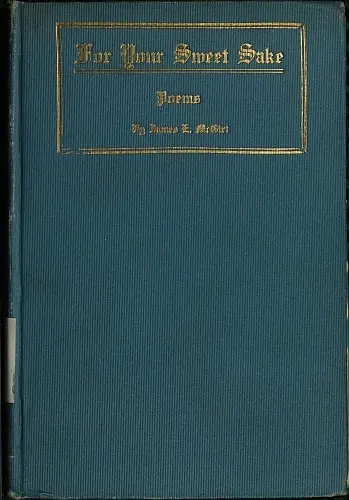
For Your Sweet Sake: Poems — digital edition cover

THE CLASSIC COLLECTION · 1906

For Your Sweet Sake: Poems

"For Your Sweet Sake: Poems by James E. McGirt" is a collection of poems authored by James E. McGirt, written in the early 20th century. The poems reflect a variety of themes, including love, nature, personal experiences, and social commentary, often capturing the essence of African American life during that period. The collection showcases McGirt's unique voice and lyrical style, inviting readers into a blend of heartfelt sentiment and cultural richness. In this volume, McGirt explores the complexities of love, the beauty of nature, and the struggles of human experience through vivid imagery and expressive language. Poems like "A Sailor's Departure" and "My Soul's at Rest" convey deep emotions of love and longing, while others, such as "The Siege of Manila," touch on themes of bravery and sacrifice. With its rhythmic cadence and heartfelt messages, "For Your Sweet Sake" offers readers a heartfelt glimpse into the thoughts and feelings of its author, celebrating both the challenges and joys of life.

Introduction adapted from the source catalogue; source summaries may be automatically generated.

Start reading ↓

Free to read · English · 10,002 words · No account needed

MAKE TIME FOR A GOOD BOOK

For Your Sweet Sake: Poems

On by default. Untick to stop anonymous reading totals. Each page counts after 10 seconds in view. How this works.

Anonymous counting is on unless you have switched it off.

For Your Sweet Sake: Poems

When I return, what e’er may be my treasure--
That happy day I pray God that we meet--
My life, my all, I’ll cast with pleasure
Down at your feet.

He said “Good-bye”--the tears were swiftly falling--
The ship moved off, she left alone to dwell;
The signal as they sounded pealing
Their last farewell.

A TEST OF LOVE.

The land of Avia, lovely is the scene, Clothed every evening in a silvery sheen; The rippling brook and birds make music clear, Wild flowers bloom in plenty all the year, And mistletoe’s the largest tree that’s found, It’s roots embedded firmly in the ground. In vales of mistle, ’long the Aztec shore, Stand board-roofed huts, numbering but a score; The largest one is Haggar’s--well in years; No happier man in all the place appears. His daughter, Alice, simple, pure and good, And loved by all in that fair neighborhood. Of all the youths that came to woo her love No voice but Ed’s could cause her heart to move. Ed Lassiters, son of a magistrate, Was loved by all, and no one could he hate; In peace and love he served the village long, And no one e’er complained he’d done them wrong; And Ed, his son, a steady, sober youth, Was famed throughout the village for his truth. Alice loved Ed; when children it was seen That Ed loved her and held her as his queen. Together they were always seen at play. What e’er she willed it pleased Ed to obey; “My doll, a house,” was all she had to speak, For sticks and bark at once Ed went to seek; To bake mud cakes more water she’ demand; Ed quickly brought and placed it at her hand. In all their play they were not seen to pout; Always in love there was no falling out. Each day to school they hand in hand would go, Her books and slate Ed carried to and fro; Each Sunday morn the chapel bell would chime, And Ed with Alice marched away on time; To church at night Alice alone he’d bring, And from one book both in the choir would sing. The childish love that bound them when at play To greater love soon yielded up its sway. Were children once, but ah, no children now; Ed was a farmer, master of the plow; Alice, a maid, how skilful at the loom, And all affairs pertaining to the home; Once close they lived, but now three miles apart; But miles cannot divide true heart from heart. The village lads loved well the maiden dear, But knew their love and would not interfere; So hand in hand through life they always went, So lovingly, so happy, so content. But, ah, if he had known the pain to come, He would have had her safely in his home. To Avia came a family seeking health; A noble family; great, too, was their wealth; A man and wife, a son, the darling joy; John his name, and handsome was the boy. He saw the maid, and love came at the sight; To win her love he sought with all his might. Soon she loved John and soon he loved the maid, So swift is love when gold can give it aid. And since that day the youth came from the north Ed’s cloak of love had keenly felt a moth. E’er on his face there dwelt a heavy frown; Each day he passed his head was hanging down. And all the village wondered as he passed What made the change, what made him so downcast. Each Sunday morn he strolled alone to church; We sympathized--we knew it grieved him much; As when the ivy from the oak we tear. It seemeth lonely, ah! it seemeth bare. So ’twas with Ed when they were seen apart, He seemed e’er sad, so withered was his heart. He loved her still, and each time he would call He plead in vain that she would love him all. Each night Ed called each night both lovers met; They’d try in vain each other to outset. When on her face Ed read her heart’s desire He’d ask his hat, reluctantly retire. Poor Ed, from youth could see her any time, Now once a week his visits were confined. Each youth desired the maid to be his bride; She loved them both, and how could she decide. Three months had passed--the choice she had not made; With bashful face she sought her mother’s aid. She hinted out the burden of her heart; Her loving mother knew the other part. “Oh, Ed and John,” she said, with trembling voice, “I love them both and cannot make a choice; Three months in vain the choice I’ve tried to make; It’s left with you mother, which one to take.” The mother thought awhile and slowly said: “I cannot choose the man for you to wed, For much is in the saying of the bard: ’Make your own bed and keep it if it’s hard;’ So make your choice; if he’s not what he seems On no one else can you well place the blame. Since I’m your ma, advice ’tis mine to give: With whom you choose through life pray try to live, For they who wed and quit without a cause Have broken o’er our Holy Father’s laws. Unless you can for him lay down your life Never, my child, consent to be his wife, For married life is greater than a dream, And all have found it greater than it seemed. To know the one whose love is pure and best, I think it right to bring him to a test. How can you judge from the word the greater love? Does rain tell all that it has seen above? What steed an empty wagon cannot pull? Ah, place him to a wagon that is full. The many words! but, ah, the simple few, Can have a great effect if spoken true. The sweetest words make not the greatest youth, Ah, he is great who sayest but the truth. The world to-day is so enrapt with sin, That it is right with women and with men, Before they be exalted in our sight, We must have great assurance they are right. So Ed and John seem good, I love them well; The one for you to choose I cannot tell. The way to find the one to suit you best, Put life at stake and give them both a test, For he who takes a maiden for his wife Should count it joy to give for her his life.” She knew that neither Ed nor John could swim; To try the deep would be a test for them. She thought how each of them enjoyed to row. She said: “Some day, while rowing, drop your oar, And tell him bring the oar you’ll be his bride; First let the oar ’neath the boat be tied; Engage them now, go quick and tie the oar.” One came at three, the other came at four. I feign to tell them what the mother said; So great the plot when by a woman made. She set the time, and John and Ed complied; The evening came and John was by her side. With John she goes, as though she loved him best, Out in the boat that she his love might test. From youth she knew the art to dive and swim; ’Twas all a secret, ’t was not known to him. They reached the deep where angry billows roar; She for a purpose dropped her only oar. Out from the boat the oar the waves did toss; The maid screamed out in anguish, “We are lost!” The oar was fairly whirling by a wave; The frightened maid knelt praying God to save. The coward youth sat trembling pale as death; His face had changed, it seemed he had no breath. The maid knelt still, pretending loud to weep. But through her fingers at the youth she’d peep. She saw the youth still fainting in dismay; She would have laughed, but thought she would betray. She raised her head, the oar again she spied; Beneath the boat the oar with cord was tied. She really cried, for lo! her face was red, “John, bring the oar, I’ll be your wife,” she said. But John sat still, for he could not obey; “I cannot swim,” was all she heard him say. She bade him think, she bade him count the cost; “Without the oar won’t both our lives be lost? If you sit here is death not sure?” she said. John knew it was, and cowardly dropped his head. With trembling voice she cried, imploring still: “Go, bring the oar; if you won’t, John, I will. What will you do?” She paused to give him time. He would not go; she leaped into the brine; She sank and rose, and loudly came a sound: “Pray come and help! quick! love, for soon I drown!” John saw his love the third time disappear; She cried in vain, for John refused to steer. Again she rose and quickly seized the oar, Towards the boat the oar she swiftly bore. Soon in the boat, dripping, she took her seat, As John sat cowardly gazing at her feet; Then to the shore she quickly made her way; She reached the shore, to him was heard to say: “The oar wasn’t lost; by this thread it was tied; My life to you I’m thinking to confide.” And this she said: “I did it just to prove Whether or not you’re worthy of my love.” She told him all, and said: “John can’t you see That you are false and do not care for me.” And John stood crying, begging not to tell; She vowed she’d not, and said to him farewell. He went his way and she sat on the beach-- I’ll tell you why before the end is reached-- ’Twas nearly four, and Ed, her other beau, Had promised then to meet her for a row. The hour had come, the village clock was heard; Ah! Ed was there; he always kept his word. Up from the beach she rose, her friend to greet; She had not heard the tramping of his feet. Soon in the boat they both sat face to face; She took the oar as though out for a race; Then with the oar she gave the sea a sweep, And soon the boat was sailing on the deep; “Here comes a ship; look, Ed, I see the top.” He turned his head, the oar she did let drop. “Dear Ed,” she cried, “pray take me to my home; I dropped the oar and death is sure our doom.” He gazed at her and saw her faint away. “Don’t cry, my dear,” she softly heard him say; He raised her head, consoling words he speaks, Brushed back her hair and kissed her rosy cheeks; Pretended she unconscious of a kiss; Yet still her soul was thrilled with holy bliss. He raised her gently in a fond embrace, And gently wipes her tear-stained, blushing face, The tears upon her rosy cheek repose Appeared like sparkling dewdrops on a rose. As men in hurrying pressed for want of time, Can find a moment still to sip the wine, So hurried Ed, for fear the oar he’d miss, Yet still found time, yea, thrice, her lips to kiss; Just as a man is moved by sparkling drinks Performs an act before of danger thinks. The kiss affected Ed as strongest wine; He could not swim, yet did not fear the brine; He did not stop for once to count the cost, Nor thought he once that either would be lost. He said, unless his queen should reach the shore, Out of his arm he would have made an oar; Then from the boat he leaped, and could not swim; An angry wave came quick and covered him. Strangled he rose, though struggling for his life, He cried aloud: “O, God, pray, save my wife!” He did not drown, for she well knew the art, And leaped and bore him speechless to her heart. Hold of the cord the oar she quickly drew; Yet, brought the oar she said he never knew; He really thought he saved his lover’s life. He woke and cried aloud: “You are my wife.” For when he sank he was a senseless elf; To-day he thinks he brought the oar himself. And when she saw how artless was his love The love within her heart was felt to move; Where there is love much love it doth inspire, Thus blazed her love and set his soul on fire. It seemed as love her heart would ’sunder rent, Unless by hasty means could give it vent; For when love’s heart is free from doubt and fear It sayeth much that love would feign to hear. Thus went the time until the glowing west Was telling that the sun had gone to rest. They reached the shore, though he was soaking wet, Before they left, the wedding day was set. Three weeks passed on, the blessed eve drew near, The wedding bells were chiming loud and clear. That night they vowed to love and serve through life; There never lived a happier man and wife. In Mistle still to-day there can be seen A thatch-roofed house, twined round with ivy green; Upon the lawn a boy and girl at play-- This is the home where Ed and Alice stay.

Your reading position is saved on this browser. Take it to another device with a library code. Reading pages adapt to text, rather than matching a printed edition.

BEHIND THE WORDS

About James E. (James Ephraim) McGirt

James E. (James Ephraim) McGirt (1874–1930). Explore For Your Sweet Sake: Poems in this collection. These books span poetry.

Explore this author’s books →

THE READERS’ VERDICT

How did this story stay with you?

Not rated yet
Your rating for For Your Sweet Sake: Poems

Be the first to share your verdict.

One rating per browser, which you can change or remove. A necessary browser identifier remembers your vote. How ratings work

A GOOD STORY DESERVES COMPANY

Pass this book along.

A great read is even better when it’s shared.

SEND A LITTLE INSPIRATION

Share this book

BEHIND THE BOOK

Edition & source details.

Title
For Your Sweet Sake: Poems
Author
James E. (James Ephraim) McGirt
Publication year
1906
Digital edition publisher
Project Gutenberg
Gutenberg release date
2016-10-27
Language
English
Source edition imprint
Not stated in source catalogue
Source identifier
Project Gutenberg #53385
Contributors
No additional named contributors in source metadata

Public-domain source & licence

This eBook is for the use of anyone anywhere in the United States and most other parts of the world at no cost and with almost no restrictions whatsoever. You may copy it, give it away or re-use it under the terms of the Project Gutenberg License included with this eBook or online at www.gutenberg.org. If you are not located in the United States, you will have to check the laws of the country where you are located before using this eBook. Read the source licence.

Full source licence and obtaining an original copy

The original source file, including credits and licence, is retained by this library. Request an original-format copy at no charge. Please include the book title and Project Gutenberg identifier #53385.

the full Project Gutenberg License must appear
prominently whenever any copy of a Project Gutenberg work (any work
on which the phrase “Project Gutenberg” appears, or with which the
phrase “Project Gutenberg” is associated) is accessed, displayed,
performed, viewed, copied or distributed:

This eBook is for the use of anyone anywhere in the United States and most
other parts of the world at no cost and with almost no restrictions
whatsoever. You may copy it, give it away or re-use it under the terms
of the Project Gutenberg™ License included with this eBook or online
at www.gutenberg.org. If you
are not located in the United States, you will have to check the laws
of the country where you are located before using this eBook.

1.E.2. If an individual Project Gutenberg electronic work is
derived from texts not protected by U.S. copyright law (does not
contain a notice indicating that it is posted with permission of the
copyright holder), the work can be copied and distributed to anyone in
the United States without paying any fees or charges. If you are
redistributing or providing access to a work with the phrase “Project
Gutenberg” associated with or appearing on the work, you must comply
either with the requirements of paragraphs 1.E.1 through 1.E.7 or
obtain permission for the use of the work and the Project Gutenberg
trademark as set forth in paragraphs 1.E.8 or 1.E.9.

1.E.3. If an individual Project Gutenberg electronic work is posted
with the permission of the copyright holder, your use and distribution
must comply with both paragraphs 1.E.1 through 1.E.7 and any
additional terms imposed by the copyright holder. Additional terms
will be linked to the Project Gutenberg License for all works
posted with the permission of the copyright holder found at the
beginning of this work.

1.E.4. Do not unlink or detach or remove the full Project Gutenberg
License terms from this work, or any files containing a part of this
work or any other work associated with Project Gutenberg.

1.E.5. Do not copy, display, perform, distribute or redistribute this
electronic work, or any part of this electronic work, without
prominently displaying the sentence set forth in paragraph 1.E.1 with
active links or immediate access to the full terms of the Project
Gutenberg License.

1.E.6. You may convert to and distribute this work in any binary,
compressed, marked up, nonproprietary or proprietary form, including
any word processing or hypertext form. However, if you provide access
to or distribute copies of a Project Gutenberg work in a format
other than “Plain Vanilla ASCII” or other format used in the official
version posted on the official Project Gutenberg website
(www.gutenberg.org), you must, at no additional cost, fee or expense
to the user, provide a copy, a means of exporting a copy, or a means
of obtaining a copy upon request, of the work in its original “Plain
Vanilla ASCII” or other form. Any alternate format must include the
full Project Gutenberg License as specified in paragraph 1.E.1.

1.E.7. Do not charge a fee for access to, viewing, displaying,
performing, copying or distributing any Project Gutenberg works
unless you comply with paragraph 1.E.8 or 1.E.9.

1.E.8. You may charge a reasonable fee for copies of or providing
access to or distributing Project Gutenberg electronic works
provided that:

• You pay a royalty fee of 20% of the gross profits you derive from
the use of Project Gutenberg works calculated using the method
you already use to calculate your applicable taxes. The fee is owed
to the owner of the Project Gutenberg trademark, but he has
agreed to donate royalties under this paragraph to the Project
Gutenberg Literary Archive Foundation. Royalty payments must be paid
within 60 days following each date on which you prepare (or are
legally required to prepare) your periodic tax returns. Royalty
payments should be clearly marked as such and sent to the Project
Gutenberg Literary Archive Foundation at the address specified in
Section 4, “Information about donations to the Project Gutenberg
Literary Archive Foundation.”

• You provide a full refund of any money paid by a user who notifies
you in writing (or by e-mail) within 30 days of receipt that s/he
does not agree to the terms of the full Project Gutenberg™
License. You must require such a user to return or destroy all
copies of the works possessed in a physical medium and discontinue
all use of and all access to other copies of Project Gutenberg™
works.

• You provide, in accordance with paragraph 1.F.3, a full refund of
any money paid for a work or a replacement copy, if a defect in the
electronic work is discovered and reported to you within 90 days of
receipt of the work.

• You comply with all other terms of this agreement for free
distribution of Project Gutenberg™ works.


1.E.9. If you wish to charge a fee or distribute a Project
Gutenberg™ electronic work or group of works on different terms than
are set forth in this agreement, you must obtain permission in writing
from the Project Gutenberg Literary Archive Foundation, the manager of
the Project Gutenberg™ trademark. Contact the Foundation as set
forth in Section 3 below.

1.F.

1.F.1. Project Gutenberg volunteers and employees expend considerable
effort to identify, do copyright research on, transcribe and proofread
works not protected by U.S. copyright law in creating the Project
Gutenberg™ collection. Despite these efforts, Project Gutenberg™
electronic works, and the medium on which they may be stored, may
contain “Defects,” such as, but not limited to, incomplete, inaccurate
or corrupt data, transcription errors, a copyright or other
intellectual property infringement, a defective or damaged disk or
other medium, a computer virus, or computer codes that damage or
cannot be read by your equipment.

1.F.2. LIMITED WARRANTY, DISCLAIMER OF DAMAGES - Except for the “Right
of Replacement or Refund” described in paragraph 1.F.3, the Project
Gutenberg Literary Archive Foundation, the owner of the Project
Gutenberg™ trademark, and any other party distributing a Project
Gutenberg™ electronic work under this agreement, disclaim all
liability to you for damages, costs and expenses, including legal
fees. YOU AGREE THAT YOU HAVE NO REMEDIES FOR NEGLIGENCE, STRICT
LIABILITY, BREACH OF WARRANTY OR BREACH OF CONTRACT EXCEPT THOSE
PROVIDED IN PARAGRAPH 1.F.3. YOU AGREE THAT THE FOUNDATION, THE
TRADEMARK OWNER, AND ANY DISTRIBUTOR UNDER THIS AGREEMENT WILL NOT BE
LIABLE TO YOU FOR ACTUAL, DIRECT, INDIRECT, CONSEQUENTIAL, PUNITIVE OR
INCIDENTAL DAMAGES EVEN IF YOU GIVE NOTICE OF THE POSSIBILITY OF SUCH
DAMAGE.

1.F.3. LIMITED RIGHT OF REPLACEMENT OR REFUND - If you discover a
defect in this electronic work within 90 days of receiving it, you can
receive a refund of the money (if any) you paid for it by sending a
written explanation to the person you received the work from. If you
received the work on a physical medium, you must return the medium
with your written explanation. The person or entity that provided you
with the defective work may elect to provide a replacement copy in
lieu of a refund. If you received the work electronically, the person
or entity providing it to you may choose to give you a second
opportunity to receive the work electronically in lieu of a refund. If
the second copy is also defective, you may demand a refund in writing
without further opportunities to fix the problem.

1.F.4. Except for the limited right of replacement or refund set forth
in paragraph 1.F.3, this work is provided to you ‘AS-IS’, WITH NO
OTHER WARRANTIES OF ANY KIND, EXPRESS OR IMPLIED, INCLUDING BUT NOT
LIMITED TO WARRANTIES OF MERCHANTABILITY OR FITNESS FOR ANY PURPOSE.

1.F.5. Some states do not allow disclaimers of certain implied
warranties or the exclusion or limitation of certain types of
damages. If any disclaimer or limitation set forth in this agreement
violates the law of the state applicable to this agreement, the
agreement shall be interpreted to make the maximum disclaimer or
limitation permitted by the applicable state law. The invalidity or
unenforceability of any provision of this agreement shall not void the
remaining provisions.

1.F.6. INDEMNITY - You agree to indemnify and hold the Foundation, the
trademark owner, any agent or employee of the Foundation, anyone
providing copies of Project Gutenberg™ electronic works in
accordance with this agreement, and any volunteers associated with the
production, promotion and distribution of Project Gutenberg™
electronic works, harmless from all liability, costs and expenses,
including legal fees, that arise directly or indirectly from any of
the following which you do or cause to occur: (a) distribution of this
or any Project Gutenberg work, (b) alteration, modification, or
additions or deletions to any Project Gutenberg work, and (c) any
Defect you cause.

Section 2. Information about the Mission of Project Gutenberg

Project Gutenberg is synonymous with the free distribution of
electronic works in formats readable by the widest variety of
computers including obsolete, old, middle-aged and new computers. It
exists because of the efforts of hundreds of volunteers and donations
from people in all walks of life.

Volunteers and financial support to provide volunteers with the
assistance they need are critical to reaching Project Gutenberg’s
goals and ensuring that the Project Gutenberg collection will
remain freely available for generations to come. In 2001, the Project
Gutenberg Literary Archive Foundation was created to provide a secure
and permanent future for Project Gutenberg and future
generations. To learn more about the Project Gutenberg Literary
Archive Foundation and how your efforts and donations can help, see
Sections 3 and 4 and the Foundation information page at www.gutenberg.org.

Section 3. Information about the Project Gutenberg Literary Archive Foundation

The Project Gutenberg Literary Archive Foundation is a non-profit
501(c)(3) educational corporation organized under the laws of the
state of Mississippi and granted tax exempt status by the Internal
Revenue Service. The Foundation’s EIN or federal tax identification
number is 64-6221541. Contributions to the Project Gutenberg Literary
Archive Foundation are tax deductible to the full extent permitted by
U.S. federal laws and your state’s laws.

The Foundation’s business office is located at 41 Watchung Plaza #516,
Montclair NJ 07042, USA, +1 (862) 621-9288. Email contact links and up
to date contact information can be found at the Foundation’s website
and official page at www.gutenberg.org/contact

Section 4. Information about Donations to the Project Gutenberg
Literary Archive Foundation

Project Gutenberg™ depends upon and cannot survive without widespread
public support and donations to carry out its mission of
increasing the number of public domain and licensed works that can be
freely distributed in machine-readable form accessible by the widest
array of equipment including outdated equipment. Many small donations
($1 to $5,000) are particularly important to maintaining tax exempt
status with the IRS.

The Foundation is committed to complying with the laws regulating
charities and charitable donations in all 50 states of the United
States. Compliance requirements are not uniform and it takes a
considerable effort, much paperwork and many fees to meet and keep up
with these requirements. We do not solicit donations in locations
where we have not received written confirmation of compliance. To SEND
DONATIONS or determine the status of compliance for any particular state
visit www.gutenberg.org/donate.

While we cannot and do not solicit contributions from states where we
have not met the solicitation requirements, we know of no prohibition
against accepting unsolicited donations from donors in such states who
approach us with offers to donate.

International donations are gratefully accepted, but we cannot make
any statements concerning tax treatment of donations received from
outside the United States. U.S. laws alone swamp our small staff.

Please check the Project Gutenberg web pages for current donation
methods and addresses. Donations are accepted in a number of other
ways including checks, online payments and credit card donations. To
donate, please visit: www.gutenberg.org/donate.

Section 5. General Information About Project Gutenberg electronic works

Professor Michael S. Hart was the originator of the Project
Gutenberg concept of a library of electronic works that could be
freely shared with anyone. For forty years, he produced and
distributed Project Gutenberg eBooks with only a loose network of
volunteer support.

Project Gutenberg eBooks are often created from several printed
editions, all of which are confirmed as not protected by copyright in
the U.S. unless a copyright notice is included. Thus, we do not
necessarily keep eBooks in compliance with any particular paper
edition.

Most people start at our website which has the main PG search
facility: www.gutenberg.org.

This website includes information about Project Gutenberg,
including how to make donations to the Project Gutenberg Literary
Archive Foundation, how to help produce our new eBooks, and how to
subscribe to our email newsletter to hear about new eBooks.


KEEP YOUR CURIOSITY GOING

Your next chapter awaits.