
The lost dirigible
Ralph Henry Barbour
THE CLASSIC COLLECTION · 1900
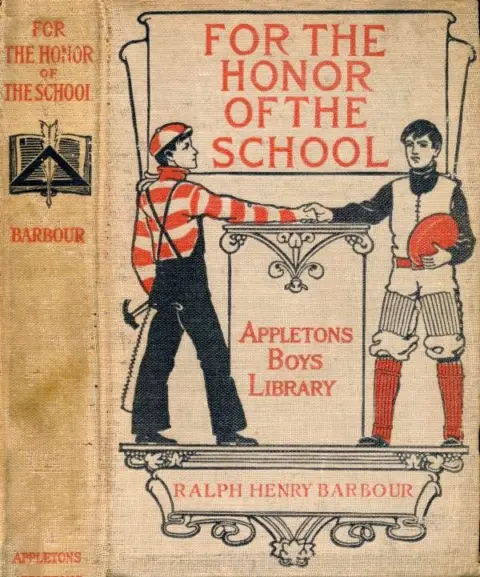
"For the Honor of the School: A Story of School Life and Interscholastic Sport" by Ralph Henry Barbour is a novel likely written in the early 20th century. The story revolves around the experiences of students at Hillton Academy, particularly focusing on athletics and the competitive spirit surrounding interscholastic sports. The main characters include Donald Cunningham, the captain of the cross-country team, and the novice Wayne Gordon, who learns lessons about teamwork, determination, and personal growth throughout the narrative. The opening of the book introduces the excitement and tension of a cross-country race, along with the meticulous preparations of the Hillton Academy team. Through the interactions between the boys, we see Donald offering encouragement and strategies to his friend Wayne, who is uncertain about his abilities. The atmosphere is charged with competitiveness as they face their rivals from St. Eustace and Shrewsburg High Schools. Wayne's initial reluctance to compete due to a lack of experience contrasts with Donald's confidence, setting the stage for themes of friendship, rivalry, and personal development that unfold as the story progresses. The introduction establishes both the physical challenges of the race and the emotional weight behind the desire to win for the honor of their school.
Introduction adapted from the source catalogue; source summaries may be automatically generated.
Free to read · English · 59,873 words · No account needed
MAKE TIME FOR A GOOD BOOK
On by default. Untick to stop anonymous reading totals. Each page counts after 10 seconds in view. How this works.
Anonymous counting is on unless you have switched it off.
“Well, I’m awfully glad,” said Wayne, “and I hope you will. Does Don
know?”
“No; he and Beck went off together just before.”
“Let’s go up to the room; perhaps he’s there.”
They had finished their dressing by this time, and they piled upstairs and across the green to Bradley. Don was sitting at the table with a litter of papers before him, all the gas burning, and the afternoon twilight streaming in through the windows.
“Well, what----” began Wayne.
“Figuring our chances, my boy,” answered Don, rumpling his hair with
nervous fingers.
“How are they?” asked Dave eagerly.
“Slim, mighty slim. I can’t see anything but defeat and a second place
on the ticket.”
“Let me see.” Dave took up a sheet of foolscap and cast his eyes over
it.
“Read it out,” said Wayne.
“Well, let’s see; here we are: Hillton, 4 firsts, 5 seconds, 1 third, total 36 points; St. Eustace, 6 firsts, 5 seconds, 1 third, total 46 points; others, 2 firsts, 2 seconds, 9 thirds, total 26 points. You seem to be fond of 6’s, Don.”
“What counts what?” asked Wayne.
“First counts 5, second 3, third 1. There are twelve events and 108 points,” answered Don. “I’ve given Hillton everything she can win, and one first that is doubtful. Of course, St. Eustace may be stronger or weaker than I think. But, pshaw! the whole thing’s just guess work; we may not score 20 points, or we may possibly get 40; you can never tell. But Beck wanted a guess at it.”
“Well, I’ll tell you where you can get five points more,” said Dave. “You’ve credited us with second place in the hammer throw and St. Eustace with first. You can give us first and second both.”
“How’s that?” asked Don.
“Why, I’ve just thrown over one hundred and forty-six feet, and I can better it by two more in a couple of days.” And Dave retold his story. Don bit the end of his pencil thoughtfully; then he referred to a sheet of figures before him.
“I guess you’re right, Dave. By Jove, I am glad! Trowbridge, of Northern Collegiate, threw one hundred and forty-eight feet five inches last year; Sumner, of St. Eustace, one hundred and forty-seven even. If you can throw two feet better than you did to-day, Dave, we’ll stand a chance to beat St. Eustace, at least. Give me that list. There, that makes it--why, it makes St. Eustace and us each forty-one points!”
“Well, that’s more than a fighting chance.”
“Yes. But what’s the good of figuring on track meetings? Any one of those other five schools might upset this whole table of figures.”
Your reading position is saved on this browser. Take it to another device with a library code. Reading pages adapt to text, rather than matching a printed edition.
Ralph Henry Barbour
Ralph Henry Barbour

Ralph Henry Barbour

Ralph Henry Barbour
BEHIND THE BOOK
This eBook is for the use of anyone anywhere in the United States and most other parts of the world at no cost and with almost no restrictions whatsoever. You may copy it, give it away or re-use it under the terms of the Project Gutenberg License included with this eBook or online at www.gutenberg.org. If you are not located in the United States, you will have to check the laws of the country where you are located before using this eBook. Read the source licence.
The original source file, including credits and licence, is retained by this library. Request an original-format copy at no charge. Please include the book title and Project Gutenberg identifier #47974.
KEEP YOUR CURIOSITY GOING
Coulson Kernahan

Maurice Baring
Frances Wright
Cécile Tormay

Frederic Jesup Stimson

W. H. P. (William Henry Pope) Jarvis