
The lost dirigible
Ralph Henry Barbour
THE CLASSIC COLLECTION · 1923
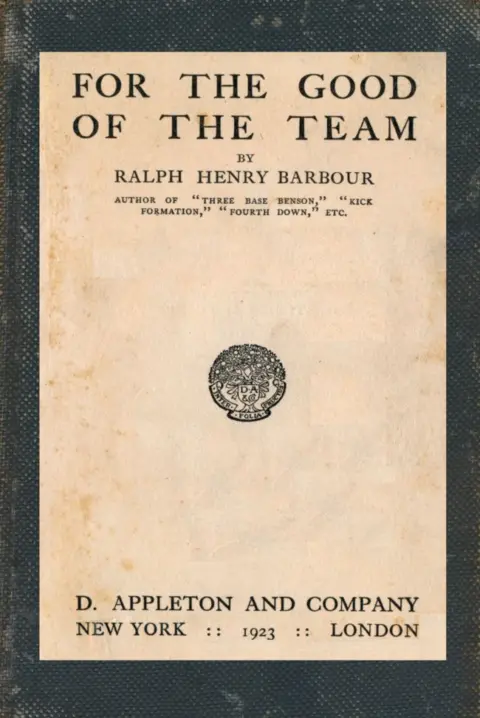
"For the Good of the Team" by Ralph Henry Barbour is a novel written in the early 20th century. The story revolves around the dynamics of high school football, focusing on the relationships and challenges faced by the team members, particularly the main character, Stuart Harven, who is the youngest captain in the school's history. The novel delves into themes of teamwork, leadership, and the clash between tradition and new methods of coaching. At the start of the book, we meet Stuart Harven and his friend Jack Brewton as they travel back to Safford for the new school year. Their conversation hints at a looming transition with a new football coach, Mr. Haynes, whose unconventional methods create tension among the team. Readers are introduced to the setting at Manning School, the formation of friendships, and the challenges they will face during the football season, particularly as they prepare to defend their reputation against rival schools. The beginning effectively sets the stage for a narrative that will explore the importance of unity and perseverance in the face of adversity, both on and off the field.
Introduction adapted from the source catalogue; source summaries may be automatically generated.
Free to read · English · 59,640 words · No account needed
MAKE TIME FOR A GOOD BOOK
On by default. Untick to stop anonymous reading totals. Each page counts after 10 seconds in view. How this works.
Anonymous counting is on unless you have switched it off.
“Amenability?” repeated the instructor. “It means several things. For one, it means the quality of being open-minded, of willingness to be governed. We speak of a person as being amenable to reason, which usually means that the person has taken our advice, or, at least, listened to it.”
“Sounds as though he was calling me pigheaded,” said Stuart.
“Hardly as bad as that,” laughed the other; “he was probably trying to convey the idea, and convey it as politely as possible, that you are likely to rely too implicitly on your own judgment and are slightly contemptuous of others’. Isn’t that more likely to be it?”
“Then it means cocksure,” grunted Stuart. “I don’t think I am. Do you,
sir?”
Mr. Moffit smiled, his blue eyes twinkling. “You and I have been pretty good friends for two years, Harven,” he answered, “and we’ll probably remain so as long as we don’t ask each other questions like that.”
Stuart grinned. “But seriously, Mr. Moffit, am I like he says? I don’t
mean to be.”
“I’m sure you don’t, my boy. To be frank, there’s something in Brewton’s indictment, I fancy, but not enough to trouble about. I’d prefer to call it self-dependence, which, up to a point, is an admirable attribute of youth.”
“Well, he’s always getting off something like that,” said Stuart. “I don’t mind him.”
“I wouldn’t. I’d just make certain that his charge is incorrect,
Harven.”
“Yes, sir.” Then: “Gosh, I was almost forgetting what I came to see you about! You know Neil Orr, Mr. Moffit. He’s eligible for a society this year, and I’d like mightily to get him into Lyceum. I’m pretty sure he can make Manning if he wants to, but I’d rather have him with us, and I guess he’d rather, too.”
“Orr is a splendid fellow in my judgment,” answered Mr. Moffit, “and I’d be glad to have him in Lyceum, but you know, Harven, I’m only the faculty director and have no vote.”
“Yes, sir, I know that, but I thought you might speak a good word for him when the time comes. I’m going to put him up right off.”
“Gladly, if my opinion is asked, but I can’t promise more than that, my boy. You wouldn’t want me to, I’m sure.”
“No, sir, of course not.” Stuart agreed, but not very fervently. After a moment he added, “I think some of the fellows won’t want him on account of his being like he is, and I don’t think that’s fair.”
Your reading position is saved on this browser. Take it to another device with a library code. Reading pages adapt to text, rather than matching a printed edition.
Ralph Henry Barbour
Ralph Henry Barbour

Ralph Henry Barbour

Ralph Henry Barbour
BEHIND THE BOOK
This eBook is for the use of anyone anywhere in the United States and most other parts of the world at no cost and with almost no restrictions whatsoever. You may copy it, give it away or re-use it under the terms of the Project Gutenberg License included with this eBook or online at www.gutenberg.org. If you are not located in the United States, you will have to check the laws of the country where you are located before using this eBook. Read the source licence.
The original source file, including credits and licence, is retained by this library. Request an original-format copy at no charge. Please include the book title and Project Gutenberg identifier #70829.
KEEP YOUR CURIOSITY GOING
Coulson Kernahan

Maurice Baring
Frances Wright
Cécile Tormay

Frederic Jesup Stimson

W. H. P. (William Henry Pope) Jarvis