THE CLASSIC COLLECTION✦The Disappearing EyeCLASSIC FREE BOOKS
The Disappearing Eye
Fergus Hume
THE CLASSIC COLLECTION · 1897
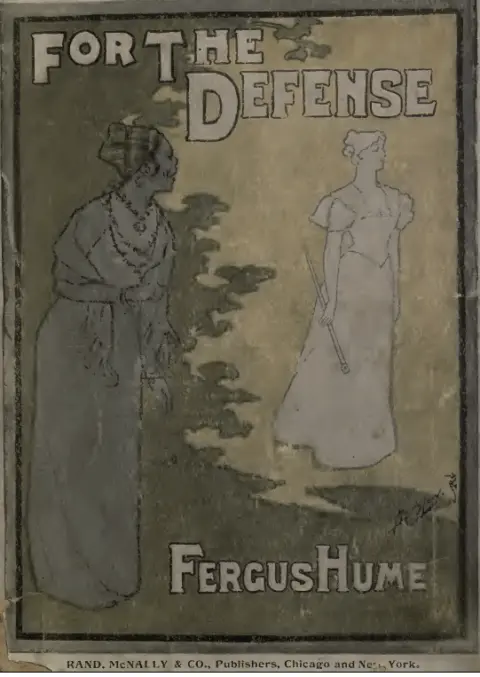
"For the Defence" by Fergus Hume is a novel written in the late 19th century. The story centers around retired Major Laurence Jen, who has adopted two boys, Maurice and David, and their complicated lives, particularly revolving around their affections for the same woman, Isabella Dallas. As the plot unfolds, tensions arise between the young men due to their competing desires for Isabella, set against a backdrop of superstition and colonial influences from characters like the ominous Dr. Etwald and the enigmatic Dido. The opening of the novel introduces us to the Major's household and hints at underlying tensions. Major Jen's background as a soldier influences the dynamics at his estate, Ashantee, where he has raised the boys with affection and care. However, the peace of their lives is disrupted when both young men declare their love for Isabella, leading to jealousy and conflict. Simultaneously, the presence of the mysterious Dr. Etwald foreshadows darker elements in the narrative, notably regarding palmistry and life-and-death prophecies. Additionally, the introduction of Dido, a woman steeped in the local superstitions of her West Indian heritage, raises questions about the intersection of love, power, and fate, hinting at further complications to come as the characters navigate their intertwined fates.
Introduction adapted from the source catalogue; source summaries may be automatically generated.
Free to read · English · 56,280 words · No account needed
MAKE TIME FOR A GOOD BOOK
On by default. Untick to stop anonymous reading totals. Each page counts after 10 seconds in view. How this works.
Anonymous counting is on unless you have switched it off.
"I am sure of that," remarked Jen, taking the devil-stick off the table. "And you stole this, I'll be bound."
"I didn't. I found it."
"Oh!" said the major, in a satirical tone. "You found it? Where?"
"At Missus Dallas' place."
Jen started, and looked sharply at the old man, who, to all appearances, was answering his questions with all possible candor.
"Be more explicit, man," he said sternly. "What do you mean by Mrs. Dallas' place? The house or the grounds?"
"The groun's, near the gate."
"When did you find it?"
"The day arter th' young gen'man was killed."
"And why didn't you give it up to the police?"
Battersea scowled.
"I wanted money for it, I did," he said huskily, "an' they wouldn't give no tin to me fur findin' it. She," pointing to Lady Meg, "is fond of pretty things, so I guv it her for five shillin'; but she didn't pay me for it."
"No," said Lady Meg, speaking for the first time, "because I did not know if you had come by it honestly."
"I tell 'ee I found it, I did," growled Battersea, becoming restive under the constant questioning. "Found it near the gate of Missus Dallas' place."
"Inside the gate," asked Jen, "or outside, on the road?"
"Inside; jus' among the grass. I was comin' up to get some food from missy, and I sowr that 'andle shinin' in the sun. I goes an' I looks, an' I fin's it. I knowed as the perlice wanted it, 'cause I 'eard talk of it doin' murder; but as perlice wouldn't give me tin, I wouldn't guv it to they," added Battersea, cunningly, "so I keeps it for 'er, but she ain't paid me yit," he concluded, with the whine of a mendicant.
For the moment Major Jen did not ask any more questions, for the very simple reason that he did not exactly know what course to take. Undoubtedly the tramp was telling the truth. He had no reason to conceal it; for in his own mind Jen quite acquitted him of any complicity in the crime. That so feeble and elderly a creature, debauched by intemperance, weak from insufficient food, should attack a vigorous young athlete like Maurice, was out of the question, even though he had the advantage of possessing the devil-stick. But here the question of the dried-up poison occurred to Jen. If the poison had evaporated by the lapse of time, the devil-stick must have been innocuous and incapable of inflicting death. Therefore, upon the evidence of the saturated handkerchief, the bag concealed in the turquoise-studded handle must have been refilled by Dido!--Dido, for the significant reason that she, inheriting the traditions of her Ashantee grandmother, alone must have been capable of manufacturing the deadly drug. To prove this assumption, a feasible one, the devil-stick was close at hand.
Your reading position is saved on this browser. Take it to another device with a library code. Reading pages adapt to text, rather than matching a printed edition.
Fergus Hume

Fergus Hume

Fergus Hume
Fergus Hume
BEHIND THE BOOK
This eBook is for the use of anyone anywhere in the United States and most other parts of the world at no cost and with almost no restrictions whatsoever. You may copy it, give it away or re-use it under the terms of the Project Gutenberg License included with this eBook or online at www.gutenberg.org. If you are not located in the United States, you will have to check the laws of the country where you are located before using this eBook. Read the source licence.
The original source file, including credits and licence, is retained by this library. Request an original-format copy at no charge. Please include the book title and Project Gutenberg identifier #55420.
KEEP YOUR CURIOSITY GOING
Coulson Kernahan

Maurice Baring
Frances Wright
Cécile Tormay

Frederic Jesup Stimson

W. H. P. (William Henry Pope) Jarvis