THE CLASSIC COLLECTION✦The Disappearing EyeCLASSIC FREE BOOKS
The Disappearing Eye
Fergus Hume
THE CLASSIC COLLECTION · 1897
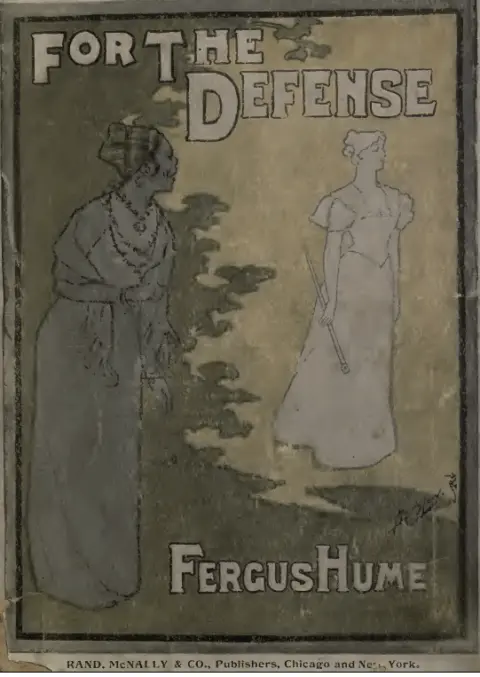
"For the Defence" by Fergus Hume is a novel written in the late 19th century. The story centers around retired Major Laurence Jen, who has adopted two boys, Maurice and David, and their complicated lives, particularly revolving around their affections for the same woman, Isabella Dallas. As the plot unfolds, tensions arise between the young men due to their competing desires for Isabella, set against a backdrop of superstition and colonial influences from characters like the ominous Dr. Etwald and the enigmatic Dido. The opening of the novel introduces us to the Major's household and hints at underlying tensions. Major Jen's background as a soldier influences the dynamics at his estate, Ashantee, where he has raised the boys with affection and care. However, the peace of their lives is disrupted when both young men declare their love for Isabella, leading to jealousy and conflict. Simultaneously, the presence of the mysterious Dr. Etwald foreshadows darker elements in the narrative, notably regarding palmistry and life-and-death prophecies. Additionally, the introduction of Dido, a woman steeped in the local superstitions of her West Indian heritage, raises questions about the intersection of love, power, and fate, hinting at further complications to come as the characters navigate their intertwined fates.
Introduction adapted from the source catalogue; source summaries may be automatically generated.
Free to read · English · 56,280 words · No account needed
MAKE TIME FOR A GOOD BOOK
On by default. Untick to stop anonymous reading totals. Each page counts after 10 seconds in view. How this works.
Anonymous counting is on unless you have switched it off.
"Good-morning, doctor," she said, as he replaced his hat; "I suppose you have come to see my mother."
"Partly, Miss Dallas, and partly to see you; also this gentleman."
"To see me!" said Maurice, looking at his rival. "Then why did you not
go to 'Ashantee?'"
Etwald shrugged his shoulders.
"I never give myself unnecessary trouble," he answered, calmly, "and, of course, I knew that I should find you here."
"By what right do you say that?" demanded Maurice, sharply.
"By the right of our conversation last night, Mr. Alymer. You have forestalled me, I see. No matter," added Etwald, with a sneer. "To-day to you; to-morrow to me."
All this was quite unintelligible to Isabella, who looked from one to the other of her companions in bewilderment, not guessing for the moment that she was the bone of contention between them. She saw the suppressed mockery on Etwald's face, and noted also that Maurice, roused by the quiet insistence of the doctor, had much difficulty in keeping his temper. Knowing how her lover disliked Etwald, and fearing lest there should be a quarrel between the two men, she cut the Gordian knot by hastily proposing that they should go up to the house.
At the same time she was afraid lest further trouble should occur therein, for it seemed to her that Etwald had paid this visit for the express purpose of making himself disagreeable.
However, he did not say anything further at the moment, but walked beside Isabella toward The Wigwam. Behind them Maurice strolled slowly, fuming and fretting at the attitude assumed by Etwald by the side of Isabella. She cast a backward glance at his frowning face, and to avert possible trouble she began hastily to question the doctor about the strange conduct of Dido.
"What was the matter with my nurse, doctor?" she asked. "What have you
been doing to her?"
"She was agitated, my dear young lady, and I have calmed that
agitation."
"After having previously caused it," said Maurice, in a significant
tone.
The doctor looked at the young man calmly.
"What possible reason have you to make such an accusation?" he
demanded.
"I think it is my fault," said Isabella, hastily. "I remarked that Dido was always agitated when you came to this house."
"I can explain that in a measure, Miss Dallas. If you remember I cured Dido of a bad nervous headache by hypnotic suggestion. Her mind, therefore, became habituated in responding to mine, and doubtless she feels a kind of impression which tells her that I am near."
"In other words," said Maurice, pointedly, "you have obtained an
influence over her."
Your reading position is saved on this browser. Take it to another device with a library code. Reading pages adapt to text, rather than matching a printed edition.
Fergus Hume

Fergus Hume

Fergus Hume
Fergus Hume
BEHIND THE BOOK
This eBook is for the use of anyone anywhere in the United States and most other parts of the world at no cost and with almost no restrictions whatsoever. You may copy it, give it away or re-use it under the terms of the Project Gutenberg License included with this eBook or online at www.gutenberg.org. If you are not located in the United States, you will have to check the laws of the country where you are located before using this eBook. Read the source licence.
The original source file, including credits and licence, is retained by this library. Request an original-format copy at no charge. Please include the book title and Project Gutenberg identifier #55420.
KEEP YOUR CURIOSITY GOING
Coulson Kernahan

Maurice Baring
Frances Wright
Cécile Tormay

Frederic Jesup Stimson

W. H. P. (William Henry Pope) Jarvis