THE CLASSIC COLLECTION✦The Disappearing EyeCLASSIC FREE BOOKS
The Disappearing Eye
Fergus Hume
THE CLASSIC COLLECTION · 1897
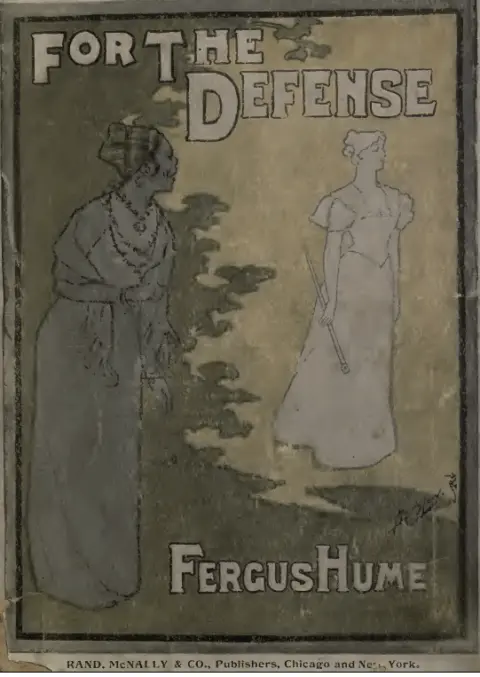
"For the Defence" by Fergus Hume is a novel written in the late 19th century. The story centers around retired Major Laurence Jen, who has adopted two boys, Maurice and David, and their complicated lives, particularly revolving around their affections for the same woman, Isabella Dallas. As the plot unfolds, tensions arise between the young men due to their competing desires for Isabella, set against a backdrop of superstition and colonial influences from characters like the ominous Dr. Etwald and the enigmatic Dido. The opening of the novel introduces us to the Major's household and hints at underlying tensions. Major Jen's background as a soldier influences the dynamics at his estate, Ashantee, where he has raised the boys with affection and care. However, the peace of their lives is disrupted when both young men declare their love for Isabella, leading to jealousy and conflict. Simultaneously, the presence of the mysterious Dr. Etwald foreshadows darker elements in the narrative, notably regarding palmistry and life-and-death prophecies. Additionally, the introduction of Dido, a woman steeped in the local superstitions of her West Indian heritage, raises questions about the intersection of love, power, and fate, hinting at further complications to come as the characters navigate their intertwined fates.
Introduction adapted from the source catalogue; source summaries may be automatically generated.
Free to read · English · 56,280 words · No account needed
MAKE TIME FOR A GOOD BOOK
On by default. Untick to stop anonymous reading totals. Each page counts after 10 seconds in view. How this works.
Anonymous counting is on unless you have switched it off.
"Ah," said Isabella, clasping her hands, "I am sure that it was that terrible man who made David kill Maurice. Oh, if I had only met Maurice on that night, I might have prevented the quarrel."
"Did you not meet Maurice, my dear?"
"Of course not," replied Isabella, in the most truthful manner. "I did not leave the house, and Dido was with me all the time. I expect Maurice was waiting for me, and that David saw him. No doubt they quarreled, and then the death took place."
From this speech it was quite evident that the girl was absolutely ignorant of the part which she had played in the affair. Still, to make certain, Jen asked why she had not kept the appointment.
"I had a nervous headache," she said, quickly, "and Dido hypnotized me. When I woke up it was too late to see Maurice."
This remark put the matter beyond all doubt. The girl, by her own admission, had been hypnotized by the negress, and, while in the trance state, with her will at the mercy of the other woman, she had killed her lover. Morally speaking, it was Dido, in the person of Isabella, who was the assassin. However, the major had learned all that he wished to know, and not wishing to pursue the subject, turned the conversation by explaining that Etwald was coming in a few minutes. Mrs. Dallas rose up in a cold fury.
"Did you ask me here to insult me, major?"
"I asked you here at the particular request of Dr. Etwald."
"Why? What can he have to say to my mother?" cried Isabella, in
surprise.
"Miss Dallas, I know no more than you do; but he evidently desires to make a clean breast of this whole miserable business."
"I have heard quite enough about it," said Mrs. Dallas, marching toward the door, "and I refuse to meet that monster of iniquity!"
But she was too late, for, before she could escape from the room, Dr. Etwald--as smiling and composed as ever--entered the door. He placed himself quietly before the enraged Mrs. Dallas.
"Do not go, madam," said he, quietly. "I have something to show you."
"What is it?" asked Mrs. Dallas, her curiosity--like that of the major--getting the better of her rage.
"You will see in a few minutes. Miss Dallas, you look pale. I hope soon to bring back the roses to your cheeks. Major--"
"Don't speak to me, you scoundrel, until you tell me what you have done with the body of my boy."
"You shall know in a few minutes, major. Indeed, I think it is about time that this comedy should end!"
Your reading position is saved on this browser. Take it to another device with a library code. Reading pages adapt to text, rather than matching a printed edition.
Fergus Hume

Fergus Hume

Fergus Hume
Fergus Hume
BEHIND THE BOOK
This eBook is for the use of anyone anywhere in the United States and most other parts of the world at no cost and with almost no restrictions whatsoever. You may copy it, give it away or re-use it under the terms of the Project Gutenberg License included with this eBook or online at www.gutenberg.org. If you are not located in the United States, you will have to check the laws of the country where you are located before using this eBook. Read the source licence.
The original source file, including credits and licence, is retained by this library. Request an original-format copy at no charge. Please include the book title and Project Gutenberg identifier #55420.
KEEP YOUR CURIOSITY GOING
Coulson Kernahan

Maurice Baring
Frances Wright
Cécile Tormay

Frederic Jesup Stimson

W. H. P. (William Henry Pope) Jarvis