THE CLASSIC COLLECTION✦The Disappearing EyeCLASSIC FREE BOOKS
The Disappearing Eye
Fergus Hume
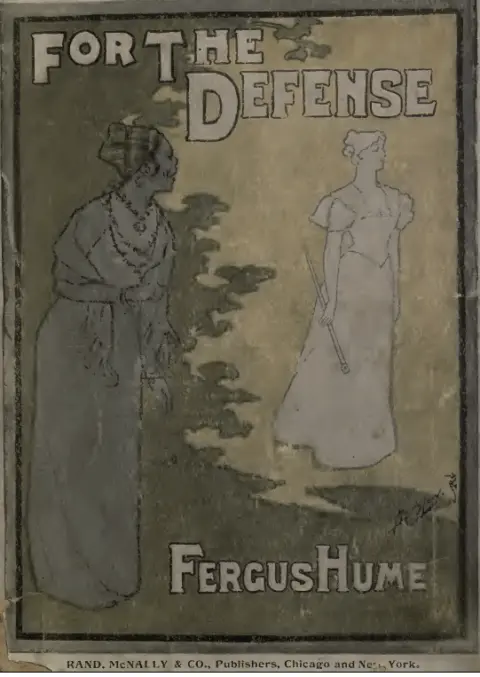
THE CLASSIC COLLECTION · 1897
"For the Defence" by Fergus Hume is a novel written in the late 19th century. The story centers around retired Major Laurence Jen, who has adopted two boys, Maurice and David, and their complicated lives, particularly revolving around their affections for the same woman, Isabella Dallas. As the plot unfolds, tensions arise between the young men due to their competing desires for Isabella, set against a backdrop of superstition and colonial influences from characters like the ominous Dr. Etwald and the enigmatic Dido. The opening of the novel introduces us to the Major's household and hints at underlying tensions. Major Jen's background as a soldier influences the dynamics at his estate, Ashantee, where he has raised the boys with affection and care. However, the peace of their lives is disrupted when both young men declare their love for Isabella, leading to jealousy and conflict. Simultaneously, the presence of the mysterious Dr. Etwald foreshadows darker elements in the narrative, notably regarding palmistry and life-and-death prophecies. Additionally, the introduction of Dido, a woman steeped in the local superstitions of her West Indian heritage, raises questions about the intersection of love, power, and fate, hinting at further complications to come as the characters navigate their intertwined fates.
Introduction adapted from the source catalogue; source summaries may be automatically generated.
Free to read · English · 56,280 words · No account needed
MAKE TIME FOR A GOOD BOOK
On by default. Untick to stop anonymous reading totals. Each page counts after 10 seconds in view. How this works.
Anonymous counting is on unless you have switched it off.
"She has left me in the most ungrateful manner. Since she obtained the Voodoo stone and gave evidence at the trial she has not been seen. I believe," added Mrs. Dallas, in a confidential manner, "that Dido has gone to Barbadoes also."
"To be queen of the black witches of Obi, no doubt. Faugh!"
"I am disgusted with her, too," said Mrs. Dallas, indorsing the
major's exclamation.
"So you ought to be, Mrs. Dallas, for Dido has been your evil genius. If you had not submitted to her will, she would not have dared to hypnotize you. If you had not been hypnotized on that night, you would not have taken the devil-stick, consequently both David and Maurice would still be alive. Your negress has been a perfect Até, Mrs. Dallas."
"Major, major! Do not be too hard on me. I suffer--oh, how I suffer!"
"And I also. Both my boys are dead, one by the hand of the other, and that other by his own hand. It is you and your daughter and Dido who have brought about these things. Go to Barbadoes, Mrs. Dallas, by all means. You and yours have done quite sufficient mischief in England."
Just as Jen ended his speech and Mrs. Dallas was about to reply, the door opened to admit--Dr. Etwald. Both the major and the Creole stared at him in surprise, as neither for the moment could grasp the idea that he had been bold enough to present himself before those whom he had so deeply wronged.
"Ah," said Etwald, as complacently as ever, "I thought I should find you here, major, but I hardly expected to see Mrs. Dallas."
"You villain!" cried that lady, starting from her seat. "Do you think I want to see you after all the misery you have caused? Why, I refuse even to remain in the same room with you." And with a furious gesture the Creole swept past Etwald and out of the door, which she banged loudly. Etwald looked at the door, shrugged his shoulders, and turned politely to the major.
"It is just as well she is gone," said he, quietly. "It is better that our conversation should be private."
"I wish to hold no conversation with a scoundrel, sir," cried Jen, purple with rage. "Follow the example of Mrs. Dallas, if you please."
Etwald looked round for a chair, selected the most comfortable, and sat down with great deliberation.
"I never follow any one's example, major," he said, dryly. "It is always my custom to act independently."
"I'll have you turned out of the house."
"In that case you'll never hear what I have come to tell you."
Your reading position is saved on this browser. Take it to another device with a library code. Reading pages adapt to text, rather than matching a printed edition.
Fergus Hume

Fergus Hume

Fergus Hume
Fergus Hume
BEHIND THE BOOK
This eBook is for the use of anyone anywhere in the United States and most other parts of the world at no cost and with almost no restrictions whatsoever. You may copy it, give it away or re-use it under the terms of the Project Gutenberg License included with this eBook or online at www.gutenberg.org. If you are not located in the United States, you will have to check the laws of the country where you are located before using this eBook. Read the source licence.
The original source file, including credits and licence, is retained by this library. Request an original-format copy at no charge. Please include the book title and Project Gutenberg identifier #55420.
KEEP YOUR CURIOSITY GOING
Coulson Kernahan

Maurice Baring
Frances Wright
Cécile Tormay

Frederic Jesup Stimson

W. H. P. (William Henry Pope) Jarvis