THE CLASSIC COLLECTION✦The Disappearing EyeCLASSIC FREE BOOKS
The Disappearing Eye
Fergus Hume
THE CLASSIC COLLECTION · 1897
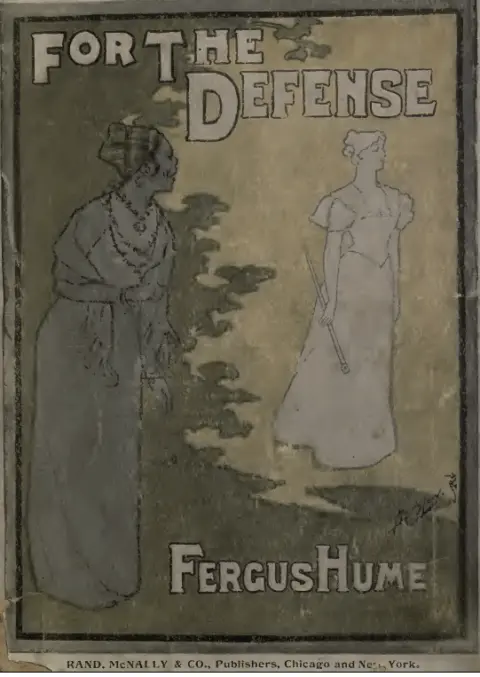
"For the Defence" by Fergus Hume is a novel written in the late 19th century. The story centers around retired Major Laurence Jen, who has adopted two boys, Maurice and David, and their complicated lives, particularly revolving around their affections for the same woman, Isabella Dallas. As the plot unfolds, tensions arise between the young men due to their competing desires for Isabella, set against a backdrop of superstition and colonial influences from characters like the ominous Dr. Etwald and the enigmatic Dido. The opening of the novel introduces us to the Major's household and hints at underlying tensions. Major Jen's background as a soldier influences the dynamics at his estate, Ashantee, where he has raised the boys with affection and care. However, the peace of their lives is disrupted when both young men declare their love for Isabella, leading to jealousy and conflict. Simultaneously, the presence of the mysterious Dr. Etwald foreshadows darker elements in the narrative, notably regarding palmistry and life-and-death prophecies. Additionally, the introduction of Dido, a woman steeped in the local superstitions of her West Indian heritage, raises questions about the intersection of love, power, and fate, hinting at further complications to come as the characters navigate their intertwined fates.
Introduction adapted from the source catalogue; source summaries may be automatically generated.
Free to read · English · 56,280 words · No account needed
MAKE TIME FOR A GOOD BOOK
On by default. Untick to stop anonymous reading totals. Each page counts after 10 seconds in view. How this works.
Anonymous counting is on unless you have switched it off.
"He did not see it taken out of the house," explained Arkel, referring to some notes which he held in his hand, "but he saw it put into the carriage."
"A carriage?"
"Yes, which was waiting in the winding lane at the foot of your grounds. Two people carried the body between them--a man and a woman--but Battersea cannot give me their names."
"I can, however," said Jen, grimly. "Oh, it is just as I thought."
"What are the names, major?" asked Arkel, anxiously.
"I'll give you the names later on, Mr. Inspector. In the meantime, be good enough to conclude your report of Battersea's confession. It interests me deeply."
"I thought it would," replied Arkel, with a look of satisfaction.
"Well, Battersea wondered at the body being put into the
carriage--"
"Did he know that it was Alymer's corpse?" interrupted Jen, sharply.
"He guessed as much from the circumstance that the body was carried through your grounds to the lane where the carriage was waiting. You know, major, that this tramp is rather stupid, and it is not an easy thing for him to put two and two together."
"On this occasion, however, he discovered that they made four," replied the major, dryly. "Well, the man and the woman put the body into the carriage--a closed carriage, I suppose?"
"Yes," assented Arkel, with a nod, "a brougham."
"A doctor's brougham?"
"What," cried the inspector, with a look of surprise, "has the scamp
told you?"
"He has told me nothing. Please go on."
"Well," said Arkel, making his invariable beginning, "when the body was placed in the carriage and the door closed, the woman went away."
"In what direction?"
"She returned through your grounds, but where she went Battersea does
not know."
"I do, however," muttered Jen, divining that Dido had taken the usual route back to "The Wigwam."
"And the man?"
"He mounted the carriage-box and drove off. It appears that there was
no coachman."
"I don't wonder at that," rejoined the major. "This precious pair were afraid to trust their infernal secret to a third party. No doubt the horse, being quiet, was left to stand in the deep shadow of the lane, while the robbers stole the corpse. However, I understand. The woman went away, the man mounted the box, and I suppose, drove off with the corpse."
"Also with Battersea," added Arkel, with a significant smile. "It seems that the tramp wished to see the end of this singular adventure, or, no doubt, he wished to make money out of it."
"By blackmailing? I see. I suppose he hung on behind."
Your reading position is saved on this browser. Take it to another device with a library code. Reading pages adapt to text, rather than matching a printed edition.
Fergus Hume

Fergus Hume

Fergus Hume
Fergus Hume
BEHIND THE BOOK
This eBook is for the use of anyone anywhere in the United States and most other parts of the world at no cost and with almost no restrictions whatsoever. You may copy it, give it away or re-use it under the terms of the Project Gutenberg License included with this eBook or online at www.gutenberg.org. If you are not located in the United States, you will have to check the laws of the country where you are located before using this eBook. Read the source licence.
The original source file, including credits and licence, is retained by this library. Request an original-format copy at no charge. Please include the book title and Project Gutenberg identifier #55420.
KEEP YOUR CURIOSITY GOING
Coulson Kernahan

Maurice Baring
Frances Wright
Cécile Tormay

Frederic Jesup Stimson

W. H. P. (William Henry Pope) Jarvis