THE CLASSIC COLLECTION✦My diaries, being a personal narrative of events 1888-1914, Part 2 (1900-1914)CLASSIC FREE BOOKS
My diaries, being a personal narrative of events 1888-1914, Part 2 (1900-1914)
Wilfrid Scawen Blunt
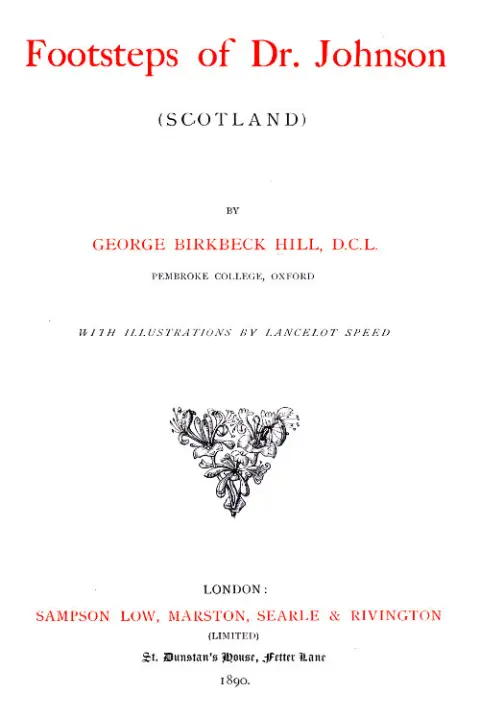
THE CLASSIC COLLECTION · 1890
"Footsteps of Dr. Johnson (Scotland)" by George Birkbeck Hill is a historical account written in the late 19th century. The work focuses on the journey of Dr. Samuel Johnson through Scotland, detailing the various places he visited and the cultural nuances he observed during his travels. The author aims to bring to light the Scotland that Johnson experienced, emphasizing the social customs and traditions rather than the scenic beauty of the landscape. At the start of the book, the author explains his motivation for writing, sparked by his desire to document the sites associated with Johnson's travels as described in his letters and travel journals. Hill notes the existence of multiple accounts of Johnson's journey, including those by Boswell, and expresses his intention to weave these narratives into a cohesive account that honors the daily life and customs of the people Johnson encountered. The opening also hints at the fondness Johnson had for anecdotes and the rich traditions surrounding his legacy in Scotland, establishing a groundwork for exploring both Johnson's perspectives and the landscape he traversed.
Introduction adapted from the source catalogue; source summaries may be automatically generated.
Free to read · English · 123,782 words · No account needed
MAKE TIME FOR A GOOD BOOK
On by default. Untick to stop anonymous reading totals. Each page counts after 10 seconds in view. How this works.
Anonymous counting is on unless you have switched it off.
The burgess-ticket or parchment on which the freedom was inscribed, after being read aloud in the hall, was made into a roll, and, with the appending seal, was tied on to the new citizen’s hat with red riband. “I wore,” wrote Johnson, “my patent of freedom pro more in my hat from the new town to the old, about a mile.” In his narrative he states that it is worn for the whole day. In a town of 16,000 inhabitants—for Aberdeen had no more at that time[518]—it might be supposed that the face of the youngest freeman would thus become known to most of his brother-burgesses. But the population at the present day is seven or eight times as large, and the old custom has died out, perhaps because its use was lost. On those rare occasions when the honour is conferred the diploma is still tied to the hat. The new citizen covers himself for a moment, and then bares his head while he returns thanks. He might, I was told, perhaps wear his ticket for a short distance to his hotel or a club, but certainly not farther. The entry of Johnson’s freedom in its good Latin still remains in the City Register. I read it with much interest.
[Sidenote: THE CHAPEL AT ABERDEEN.]
Our travellers, as they passed a Sunday in Aberdeen, went to the English chapel. The word chapel, as my friend Dr. Murray has clearly pointed out in his learned Dictionary, which in England was generally used of the places of worship of the Nonconformists, and in Ireland of those of the Roman Catholics, in Scotland was properly and universally applied to the English churches. It is the term used both by Boswell and Johnson. Mrs. Carlyle in one of her early letters describes a certain Haddington Episcopalian as “a man without an arm, who sits in the chapel.”[519] “We found,” says Boswell, “a respectable congregation and an admirable organ.” By respectable he meant what would a little later have been described as genteel. “The congregation,” wrote Johnson, “was numerous and splendid.” The volunteer who accompanied the Duke of Cumberland’s army in 1747 described the chapel as the finest he had seen in Scotland. “The handsomest young ladies,” he adds, “are generally attendants of those meeting-houses (as they call them here), and are generally esteemed as Jacobites by the staunch Whigs.”[520] Wesley, who had attended the service here a year earlier than Johnson, “could not but admire the exemplary decency of the congregation. This was the more remarkable,” he adds, “because so miserable a reader I never heard before. Listening with all attention I understood but one single word, Balak, in the First Lesson, and one more, begat, was all I could possibly distinguish in the Second.”[521] The Aberdeen chapel was no doubt one of those licensed ones “served by clergymen of English or Irish ordination,” where alone in Scotland the form of worship of the Church of England could be legally practised. [Sidenote: THE NONJURING CLERGY] At St. Andrews Boswell recorded that he had seen “in one of its streets a remarkable proof of liberal toleration; a nonjuring clergyman strutting about in his canonicals, with a jolly countenance, and a round belly, like a well-fed monk.” By an Act of Parliament passed in 1747, a heavy and cruel blow had been struck at the Scotch nonjurors as a punishment for the support which many of them had given to the young Pretender. Under severe penalties all clergymen were forbidden to officiate who had received their ordination from a nonjuring bishop, even though they took the oaths. They had now to undergo some of the suffering which in their day of triumph they had inflicted on the Covenanters. They in their turn sought the shelter of woods and moors. We read of one of them at Muthill, in Perthshire, “baptising a child under the cover of the trees in one of Lord Rollo’s parks to prevent being discovered.”[522] Two years later one Mr. John Skinner had been sent to Aberdeen jail for six months for officiating contrary to law. He survived this persecution fifty-five years, and so was contemporary with persons still living.[523] By another act all episcopal clergymen were required, whenever they celebrated worship before five people, to pray for the King and the members of the Royal Family by name, under the penalty of six months’ imprisonment for the first offence, and of banishment to America for life for the second. Many under this act were thrown into jail, and so late as 1755 one unhappy man was banished for life.[524] Others complied with the law at the expense of their lungs. An English lady who visited Scotland about the year 1778, says: “I have heard a reverend old divine say that he has read the English liturgy so repeatedly over to only four that frequently by evening he has scarce been able to speak to be heard.”[525] The persecutions had come to an end by the time of Johnson’s visit. The nonjuring ministers were, he says, “by tacit connivance quietly permitted in separate congregations.” On the death of the young Pretender on January 31st, 1788, the nonjuring bishops met at Aberdeen and directed that, beginning with Sunday, May 25th, King George should be prayed for by name. His Majesty was graciously pleased to notify his approbation.[526] Even a tutor or “pedagogue” in a gentleman’s family was required to take the oaths. This difficulty, however, was easily surmounted. They could be engaged “under the name of factor, or clerk, or comrade,” as the Bishop of Moray pointed out in a letter written in 1754.[527]
Your reading position is saved on this browser. Take it to another device with a library code. Reading pages adapt to text, rather than matching a printed edition.
BEHIND THE BOOK
This eBook is for the use of anyone anywhere in the United States and most other parts of the world at no cost and with almost no restrictions whatsoever. You may copy it, give it away or re-use it under the terms of the Project Gutenberg License included with this eBook or online at www.gutenberg.org. If you are not located in the United States, you will have to check the laws of the country where you are located before using this eBook. Read the source licence.
The original source file, including credits and licence, is retained by this library. Request an original-format copy at no charge. Please include the book title and Project Gutenberg identifier #57715.
KEEP YOUR CURIOSITY GOING
Wilfrid Scawen Blunt
Wilfrid Scawen Blunt

E. W. (Edgar Watson) Howe
Cécile Tormay

Moritz Busch
John L. Ransom