THE CLASSIC COLLECTION✦My diaries, being a personal narrative of events 1888-1914, Part 2 (1900-1914)CLASSIC FREE BOOKS
My diaries, being a personal narrative of events 1888-1914, Part 2 (1900-1914)
Wilfrid Scawen Blunt
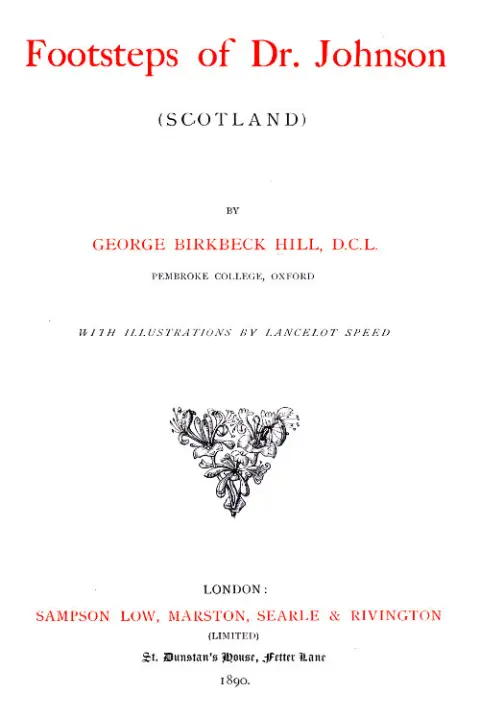
THE CLASSIC COLLECTION · 1890
"Footsteps of Dr. Johnson (Scotland)" by George Birkbeck Hill is a historical account written in the late 19th century. The work focuses on the journey of Dr. Samuel Johnson through Scotland, detailing the various places he visited and the cultural nuances he observed during his travels. The author aims to bring to light the Scotland that Johnson experienced, emphasizing the social customs and traditions rather than the scenic beauty of the landscape. At the start of the book, the author explains his motivation for writing, sparked by his desire to document the sites associated with Johnson's travels as described in his letters and travel journals. Hill notes the existence of multiple accounts of Johnson's journey, including those by Boswell, and expresses his intention to weave these narratives into a cohesive account that honors the daily life and customs of the people Johnson encountered. The opening also hints at the fondness Johnson had for anecdotes and the rich traditions surrounding his legacy in Scotland, establishing a groundwork for exploring both Johnson's perspectives and the landscape he traversed.
Introduction adapted from the source catalogue; source summaries may be automatically generated.
Free to read · English · 123,782 words · No account needed
MAKE TIME FOR A GOOD BOOK
On by default. Untick to stop anonymous reading totals. Each page counts after 10 seconds in view. How this works.
Anonymous counting is on unless you have switched it off.
[Sidenote: THE PROFESSORS’ DINNER.]
While the travellers were strolling about “dinner was mentioned. ‘Ay, ay,’ said Johnson. ‘Amidst all these sorrowful scenes I have no objection to dinner.’” They were to be the guests of the professors, who entertained them at one of the inns.
“An ill-natured story was circulated (says Boswell) that, after grace was said in English, Johnson, with the greatest marks of contempt, as if he had held it to be no grace in an university, would not sit down till he had said grace aloud, in Latin. This would have been an insult indeed to the gentlemen who were entertaining us. But the truth was precisely thus. In the course of conversation at dinner, Dr. Johnson, in very good humour, said, ‘I should have expected to have heard a Latin grace, among so many learned men: we had always a Latin grace at Oxford. I believe I can repeat it.’”
This grace had been written by the learned Camden for Pembroke College, “to which,” to use Johnson’s own words, “the zeal or gratitude of those that love it most can wish little better than that it may long proceed as it began.”
In the afternoon they went to see the monument to Archbishop Sharpe. His great granddaughter they met at supper. Saint-Fond, confounding him with Cardinal Beaton, says: “Il parâit que les parens du Cardinal Beaton n’ont pas voulu déguiser la paternité du saint archevêque, puisque sa fille est représentée toute en pleurs, les bras tendus vers son père.”[467]
The two colleges which formed the University greatly interested Johnson. The natural advantages of St. Andrews for a seat of learning had been pointed out by an earlier traveller, who maintained that it had the best situation he had ever seen for an University, “being out of all common roads, and having fine downs or links, as they call them, for exercising the scholars.”[468] The golfers who now throng the links and boast that when professors by their learning could not save the ancient city from sinking into decay, they by their idleness have lifted it into prosperity, must have been numerous even in Johnson’s time. Of all the old manufactures, that of golf-balls alone was left, and it maintained, or rather helped to destroy, several people. “The trade,” says Pennant, “is commonly fatal to the artists, for the balls are made by stuffing a great quantity of feathers into a leathern case, by help of an iron rod with a wooden handle pressed against the breast, which seldom fails to bring on a consumption.”[469] To Johnson, though he makes no mention of the Links, “St. Andrews seemed to be a place eminently adapted to study and education.” [Sidenote: A DECLINING UNIVERSITY.] Nevertheless, he had to grieve over a declining university. The fault was not, he said, in the professors; the expenses of the students, moreover, were very moderate. For about fifteen pounds, board, lodging, and instruction were provided for the session of seven months for students of the highest class. Those of lower rank were charged less than ten. Percival Stockdale, who was there in 1756, says that “for a good bedroom, coals, and the attendance of a servant, he paid one shilling a week.”[470] At this period an Oxford commoner, Johnson says, required a hundred a year and a petty scholarship “to live with great ease.”[471] To anyone who could pay for what he bought in ready money, living was made cheaper by the system of giving a discount of a shilling in the pound. A Scotch gentleman who resided much in England finding that this was not done in that country, “was in the habit when he purchased anything of putting the cash in a piece of paper, on which he wrote what it was to pay. This he kept in his desk twelve months, saying that the English traders are a set of rascals.”[472] The poorer Scotch students, however, had to bear great privations. “The miserable holes which some of them inhabit,” writes a young English traveller, “their abstemiousness and parsimony, their constant attendance to study, their indefatigable industry, border on romance.”[473] At St. Andrews they often were too poor to buy candles, and had to study by fire-light.[474] In spite of the extraordinary cheapness of the life their numbers were dwindling. They did not at this time exceed a hundred, says Johnson. Three years later Wesley was told that there were only about seventy.[475] “To the sight of archiepiscopal ruins,” Johnson was reconciled, he said, by the remoteness of the calamity which had befallen them. “Had the University been destroyed two centuries ago we should not have regretted it; but to see it pining in decay and struggling for life fills the mind with mournful images and ineffectual wishes.” Some improvement, nevertheless, had of late been made. [Sidenote: ST. SALVATOR’S COLLEGE.] Defoe, in the year 1727, had described the whole building of St. Salvator’s College “as looking into its grave.”[476] The account given by Boswell of the fabric is much more cheerful. “The rooms for students,” he writes, “seemed very commodious, and Dr. Johnson said the chapel was the neatest place of worship he had seen.” Nevertheless, at the beginning of this century some of the lecture-rooms were described as being places “in which a gentleman would be ashamed to lodge his hacks or his terriers.”[477] It was fortunate for the reputation of the College that our two travellers had not visited it earlier in the summer, otherwise they would have had to report a disgraceful sight which three years later shocked John Wesley. It was soon after the beginning of the Long Vacation that he was there, before the glaziers had repaired the wreck which marked the end of the yearly course. It was the custom, he was told, for the students to break all the windows before they left. “Where,” asks Wesley, indignantly, “are their blessed Governors in the mean time? Are they all fast asleep?”[478] The young Etonian, Bishop Berkeley’s grandson, had the merit of putting an end to this bad practice. [Sidenote: “WINDOW-CROONS.”] On entrance he was required to deposit a crown for window-money; when, model of virtue as he was, he objected that he had never yet broken a window in his life, and was not likely to begin, he was assured that he would before he left St. Andrews. The College porter, who collected “these window-croons,” told him of a poor student who had shed tears on being called on to pay. His father, a cottar, had sold one of his three cows to find money for his education at the university, and had sent him up with a large tub of oatmeal, a pot of salted butter, and five shillings in his pocket. Sixpence of this money had already been spent, and the rest the porter took.[479] When the window-breaking time came on, and Berkeley was summoned to take his part in the riot, he refused. As a boy at Eton, he said, though sometimes with more wine in his head than was good for him, he had never performed such a valiant feat, and he was not therefore going to begin as a young man. His comrades yielded to his remonstrances, and the windows were no longer broken.[480]
Your reading position is saved on this browser. Take it to another device with a library code. Reading pages adapt to text, rather than matching a printed edition.
BEHIND THE BOOK
This eBook is for the use of anyone anywhere in the United States and most other parts of the world at no cost and with almost no restrictions whatsoever. You may copy it, give it away or re-use it under the terms of the Project Gutenberg License included with this eBook or online at www.gutenberg.org. If you are not located in the United States, you will have to check the laws of the country where you are located before using this eBook. Read the source licence.
The original source file, including credits and licence, is retained by this library. Request an original-format copy at no charge. Please include the book title and Project Gutenberg identifier #57715.
KEEP YOUR CURIOSITY GOING
Wilfrid Scawen Blunt
Wilfrid Scawen Blunt

E. W. (Edgar Watson) Howe
Cécile Tormay

Moritz Busch
John L. Ransom