THE CLASSIC COLLECTION✦My diaries, being a personal narrative of events 1888-1914, Part 2 (1900-1914)CLASSIC FREE BOOKS
My diaries, being a personal narrative of events 1888-1914, Part 2 (1900-1914)
Wilfrid Scawen Blunt
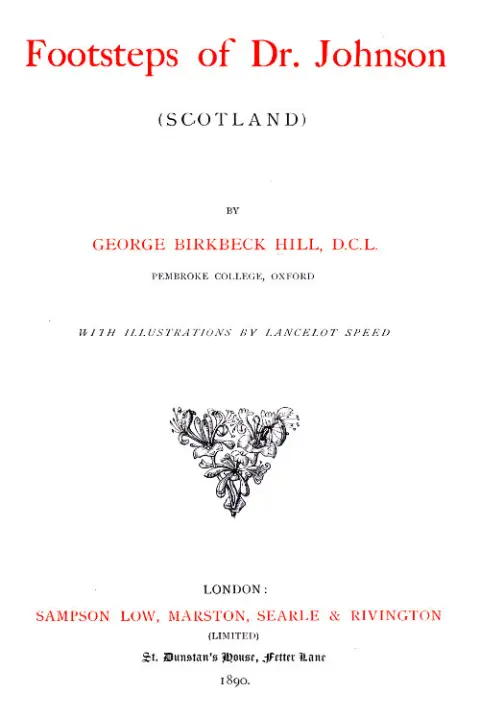
THE CLASSIC COLLECTION · 1890
"Footsteps of Dr. Johnson (Scotland)" by George Birkbeck Hill is a historical account written in the late 19th century. The work focuses on the journey of Dr. Samuel Johnson through Scotland, detailing the various places he visited and the cultural nuances he observed during his travels. The author aims to bring to light the Scotland that Johnson experienced, emphasizing the social customs and traditions rather than the scenic beauty of the landscape. At the start of the book, the author explains his motivation for writing, sparked by his desire to document the sites associated with Johnson's travels as described in his letters and travel journals. Hill notes the existence of multiple accounts of Johnson's journey, including those by Boswell, and expresses his intention to weave these narratives into a cohesive account that honors the daily life and customs of the people Johnson encountered. The opening also hints at the fondness Johnson had for anecdotes and the rich traditions surrounding his legacy in Scotland, establishing a groundwork for exploring both Johnson's perspectives and the landscape he traversed.
Introduction adapted from the source catalogue; source summaries may be automatically generated.
Free to read · English · 123,782 words · No account needed
MAKE TIME FOR A GOOD BOOK
On by default. Untick to stop anonymous reading totals. Each page counts after 10 seconds in view. How this works.
Anonymous counting is on unless you have switched it off.
The exact spot where he was so comfortably lodged is doubtful. In the Hebrides some of the chambers in which he slept are still known. In a University, where the traditions of a scholar should surely linger long, the very house has been forgotten. It is believed, however, that Dr. Watson occupied that part of the ancient building which had once been Buchanan’s residence. Some portion of that great scholar’s study still remains, having outlived both time and change. Yet that Johnson should not have been informed of a fact which to him would have been so interesting, or that being informed he should not have mentioned it, is indeed surprising. His admiration for Buchanan’s genius seems almost unbounded. If the city attracted him because it had once been archiepiscopal, so did the University, because in it Buchanan had once taught philosophy. “His name,” he adds, “has as fair a claim to immortality as can be conferred by modern latinity, and perhaps a fairer than the instability of vernacular languages admits.” Sir Walter Scott loved him almost as much as Johnson. “He was his favourite Latin poet as well as historian.”[455]
Our travellers rose “much refreshed” from their fatigue, and to the enjoyment of a very fine day. They went forth to view the ruins not only of a cathedral, but almost of a city and a University. That it had once flourished as a city was shown by history: its ancient magnificence as the seat of a great archbishopric was witnessed by “the mournful memorials” which had escaped the hands of the devastator. Of its three Colleges only two were standing. It was “the skeleton of a venerable city,” said Smollett.[456] Many years earlier a traveller, applying to it Lord Rochester’s words, had described it as being “in its full perfection of decay.” Pennant, who visited it only the year before Johnson, on entering the West Port, saw a well-built street, straight, and of a vast length and breadth, lying before him; but it was so grass-grown, and so dreary a solitude, that it seemed as if it had been laid waste by pestilence.[457] Another traveller, who came a little later, praised “the noble wide street,” but lamented that most of the houses were “disfigured by what is termed a fore-stair—that is, an open staircase on the outside, carried in a zigzag manner across the front of the house.” Before most of them was heaped up a huge dunghill.[458] A young English student fresh from Eton, the grandson of Bishop Berkeley, who entered the University about the year 1778, on seeing “this dreary deserted city, wept to think that he was to remain there three long years.” So fond nevertheless did he become of the place that “he shed more tears at leaving than at entering.”[459] Saint-Fond saw grass growing in all the streets: “Tout y est triste, silencieux; le peuple, y vivant dans l’ignorance des arts et du commerce, offre l’image de l’insouciance et de la langueur.”[460] [Sidenote: GRASS-GROWN STREETS.] I was told by an old inhabitant that not a single new house was built till after the year 1851, and that not long before that time sheep might be seen feeding in the grass-grown streets. Our travellers were touched by the general gloom. “It was,” said Boswell, “somewhat dispiriting to see this ancient archiepiscopal city now sadly deserted.” “One of its streets,” wrote Johnson, “is now lost; and in those that remain there is the silence and solitude of inactive indigence and gloomy depopulation.” This loss of a street seems to have been imaginary. He was speaking, no doubt, of the road known under the name of The Scores, which runs in front of the Castle, and follows the line of the coast. But along its course neither pavements nor foundations have ever been discovered.[461] Nevertheless the desolation was very great. [Sidenote: THE CASTLE.] Over one ruin, however, a good man might have justly exulted. In the archbishops’ castle on the edge of the sea is shown the dreadful pit in which the unhappy prisoner, far below the level of the ground, spent his weary days in wretchedness and darkness, listening to the beating of the waves. Here ofttimes he waited for the hour to come when he should be raised by a rope to the surface, as if he were a bucket of water, and not a man, and dragged off to die before the people. Sometimes those poor eyes, grown weak by a darkness which was never broken, of a sudden had to face, not only the light of day, but the blaze of the torch which was to kindle the martyr’s pile. Thinking on all this—on Patrick Hamilton, on Henry Forrest, on George Wishart, and on Walter Milne, who for their faith suffered death by fire at St. Andrews—who does not rejoice that this dismal den was shattered to pieces, and that where once “an atheous priest” made the good tremble by his frown, now on the pleasant sward innocent children play about, and strangers from afar idly dream an hour away?
Your reading position is saved on this browser. Take it to another device with a library code. Reading pages adapt to text, rather than matching a printed edition.
BEHIND THE BOOK
This eBook is for the use of anyone anywhere in the United States and most other parts of the world at no cost and with almost no restrictions whatsoever. You may copy it, give it away or re-use it under the terms of the Project Gutenberg License included with this eBook or online at www.gutenberg.org. If you are not located in the United States, you will have to check the laws of the country where you are located before using this eBook. Read the source licence.
The original source file, including credits and licence, is retained by this library. Request an original-format copy at no charge. Please include the book title and Project Gutenberg identifier #57715.
KEEP YOUR CURIOSITY GOING
Wilfrid Scawen Blunt
Wilfrid Scawen Blunt

E. W. (Edgar Watson) Howe
Cécile Tormay

Moritz Busch
John L. Ransom