THE CLASSIC COLLECTION✦My diaries, being a personal narrative of events 1888-1914, Part 2 (1900-1914)CLASSIC FREE BOOKS
My diaries, being a personal narrative of events 1888-1914, Part 2 (1900-1914)
Wilfrid Scawen Blunt
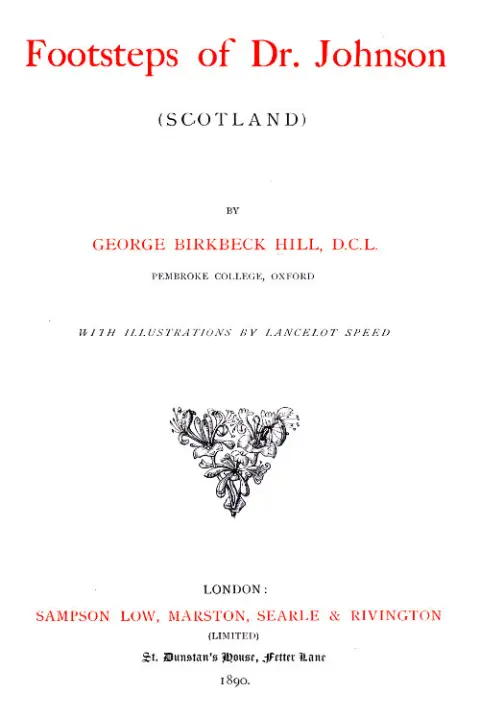
THE CLASSIC COLLECTION · 1890
"Footsteps of Dr. Johnson (Scotland)" by George Birkbeck Hill is a historical account written in the late 19th century. The work focuses on the journey of Dr. Samuel Johnson through Scotland, detailing the various places he visited and the cultural nuances he observed during his travels. The author aims to bring to light the Scotland that Johnson experienced, emphasizing the social customs and traditions rather than the scenic beauty of the landscape. At the start of the book, the author explains his motivation for writing, sparked by his desire to document the sites associated with Johnson's travels as described in his letters and travel journals. Hill notes the existence of multiple accounts of Johnson's journey, including those by Boswell, and expresses his intention to weave these narratives into a cohesive account that honors the daily life and customs of the people Johnson encountered. The opening also hints at the fondness Johnson had for anecdotes and the rich traditions surrounding his legacy in Scotland, establishing a groundwork for exploring both Johnson's perspectives and the landscape he traversed.
Introduction adapted from the source catalogue; source summaries may be automatically generated.
Free to read · English · 123,782 words · No account needed
MAKE TIME FOR A GOOD BOOK
On by default. Untick to stop anonymous reading totals. Each page counts after 10 seconds in view. How this works.
Anonymous counting is on unless you have switched it off.
In the same great pile of buildings as the Law Courts is the Advocates’ Library, “of which Dr. Johnson took a cursory view.” He, no doubt, “respectfully remembered” there its former librarian, Thomas Ruddiman, “that excellent man and eminent scholar,” just as he remembered him a few days later at Laurencekirk, the scene of his labours as a schoolmaster. Perhaps a second time he “regretted that his farewell letter to the Faculty of Advocates when he resigned the office of their Librarian, was not, as it should have been, in Latin.” According to Ruddiman’s successor, David Hume, it was but “a petty office of forty or fifty guineas a year,” yet “a genteel one” too. When that great writer came to write his letter of resignation, he used the curtest of English, and took care to express his contempt for the Curators. Two or three years earlier they had censured him for buying some French books, which they accounted “indecent and unworthy of a place in a learned library,” and he had not forgiven them.[420] It was in the Laigh (or Under) Parliament House beneath, in which at this time were deposited the records of Scotland, that Johnson, “rolling about in this old magazine of antiquities,” uttered those memorable words which have overcome the reluctance or the indolence of many an author: “A man may write at any time if he will set himself doggedly to it.”
[Sidenote: ST. GILES’S CHURCH.]
It was but a step from the Parliament House to the great church of St. Giles. Perhaps Johnson went round by the eastern end, and mourned over the fate which had befallen Dunedin’s Cross less than twenty years before. A full century and more was to pass away before “the work of the Vandals” was undone, as far as it could be undone, by the pious affection of one of the greatest of Scotchmen.[421] Perhaps he turned to the west, and passed, little recking it, over the grave of John Knox. Even Boswell, Edinburgh-born though he was, did not know where the great Reformer lay buried, and a few days later asked where the spot was. “‘I hope in the highway,’ Dr. Johnson burst out.” In the pavement of Parliament Close, a “way of common trade,” a small stone inscribed “I. K. 1572,” marks where he rests. St. Giles’ was at this time “divided into four places of Presbyterian worship. ‘Come,’ said Johnson jocularly to Dr. Robertson, ‘let me see what was once a church.’” Writing to Mrs. Thrale the next day he said: “I told Robertson I wished to see the cathedral because it had once been a church.” Its “original magnificence,” the loss of which Boswell justly lamented, has been partly restored by the lavish changes of late years. Nevertheless, the student of history may in his turn lament that in this restoration there has of necessity disappeared much that was interesting. “There was swept away, with as much indifference as if it had been of yesterday, that plain, square, galleried apartment,” which, as the meeting-place of the General Assembly, “had beheld the best exertions of the best men in the Kingdom ever since the year 1640.”[422] Jenny Geddes and her stool, moreover, are reluctant to answer the summons of the imagination in a scene which she herself would scarcely have recognized. Johnson went into only one of the four divisions, the New, or the High Church, as it was beginning to be called. Here Blair was preaching those sermons which passed through editions almost innumerable, and now can be bought in their calf binding for a few pence at almost any bookstall. [Sidenote: SCOTCH CHURCHES.] The New Church was formed out of the ancient choir. In it were ranged the seats of the King, the judges, and the magistrates of the city. When Johnson saw it, “it was shamefully dirty. He said nothing at the time; but when he came to the great door of the Royal Infirmary, where upon a board was this inscription, ‘Clean your feet,’ he turned about slily and said, ‘There is no occasion for putting this at the doors of your churches.’” Pennant also had noticed “the slovenly and indecent manner in which Presbytery kept the houses of God. In many parts of Scotland,” he said, “our Lord seems still to be worshipped in a stable, and often in a very wretched one.”[423] Nevertheless, it seemed likely that some improvement would soon be made, and that orthodoxy and dirt would not be held inseparable companions. In one or two highly favoured spots the broom and scrubbing-brush had, perhaps, already made their appearance; for according to Smollett “the good people of Edinburgh no longer thought dirt and cobwebs essential to the house of God.”[424] It might still have been impossible “for the united rhetoric of mankind to prevail with Jack to make himself clean;”[425] yet example must at last have an effect. Scotchmen had travelled and had returned from their travels, and no doubt had brought back a certain love for decency and cleanliness even in churches. In one respect, it was noticed, they surpassed their neighbours. Their conduct during service was more becoming. “They did not make their bows and cringes in the middle of their very prayers as was done in England.” They always waited till the sermon was over and the blessing given before they looked round and made their civilities to their friends and persons of distinction.[426]
Your reading position is saved on this browser. Take it to another device with a library code. Reading pages adapt to text, rather than matching a printed edition.
BEHIND THE BOOK
This eBook is for the use of anyone anywhere in the United States and most other parts of the world at no cost and with almost no restrictions whatsoever. You may copy it, give it away or re-use it under the terms of the Project Gutenberg License included with this eBook or online at www.gutenberg.org. If you are not located in the United States, you will have to check the laws of the country where you are located before using this eBook. Read the source licence.
The original source file, including credits and licence, is retained by this library. Request an original-format copy at no charge. Please include the book title and Project Gutenberg identifier #57715.
KEEP YOUR CURIOSITY GOING
Wilfrid Scawen Blunt
Wilfrid Scawen Blunt

E. W. (Edgar Watson) Howe
Cécile Tormay

Moritz Busch
John L. Ransom