THE CLASSIC COLLECTION✦My diaries, being a personal narrative of events 1888-1914, Part 2 (1900-1914)CLASSIC FREE BOOKS
My diaries, being a personal narrative of events 1888-1914, Part 2 (1900-1914)
Wilfrid Scawen Blunt
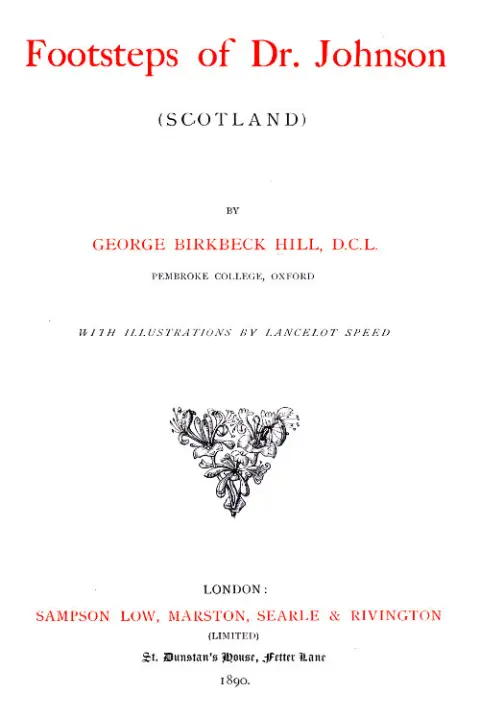
THE CLASSIC COLLECTION · 1890
"Footsteps of Dr. Johnson (Scotland)" by George Birkbeck Hill is a historical account written in the late 19th century. The work focuses on the journey of Dr. Samuel Johnson through Scotland, detailing the various places he visited and the cultural nuances he observed during his travels. The author aims to bring to light the Scotland that Johnson experienced, emphasizing the social customs and traditions rather than the scenic beauty of the landscape. At the start of the book, the author explains his motivation for writing, sparked by his desire to document the sites associated with Johnson's travels as described in his letters and travel journals. Hill notes the existence of multiple accounts of Johnson's journey, including those by Boswell, and expresses his intention to weave these narratives into a cohesive account that honors the daily life and customs of the people Johnson encountered. The opening also hints at the fondness Johnson had for anecdotes and the rich traditions surrounding his legacy in Scotland, establishing a groundwork for exploring both Johnson's perspectives and the landscape he traversed.
Introduction adapted from the source catalogue; source summaries may be automatically generated.
Free to read · English · 123,782 words · No account needed
MAKE TIME FOR A GOOD BOOK
On by default. Untick to stop anonymous reading totals. Each page counts after 10 seconds in view. How this works.
Anonymous counting is on unless you have switched it off.
It was in good company that Johnson, on the morning of Monday, August 16, “walked out to see some of the things which they had to show in Edinburgh,” for he was under the guidance of the historian of Scotland. “I love Robertson,” Johnson had said a few years earlier, “and I won’t talk of his book.” If Boswell had reported any part of this saying we may hope that it was only the first half, for he who neglects the author makes but a poor recompense by loving the man. At all events, Robertson was not troubled with diffidence, for at Holyrood “he fluently harangued” his companion on the scenes described in his History. No doubt he told many of those anecdotes for which Johnson that morning had declared his love as they breakfasted together, and took care not to attempt “to weave them into a system.” [Sidenote: THE LAWNMARKET.] As they passed into the Lawnmarket they had not before them that wide expanse which in the present day makes so noble an end to the High Street. The view was obstructed by the Weigh House, the Luckenbooths, the Tolbooth, and the Guard House.[411] At the Weigh House the boast, perhaps, was made that so great was the trade of the town that the public weighing-machine which was there kept brought in no less than a sum of £500 every year. At the Tolbooth and the Guard House, that “long low ugly building,” which looked like “a black snail crawling up the High Street,”[412] something, perhaps, was said of the Porteous riots. But the real story of the Heart of Mid-Lothian could only have been told them by that little child of scarce two years in the College Wynd, how the wild mob on that September night, seven-and-thirty years before, burnt down the massive gate of the jail, and dragged their wretched prisoner by torchlight to the gallows, and how Jeanie Deans could not tell a lie even to save her sister from a shameful death. There was no one but this bright-eyed boy who could have even pointed out in the Luckenbooths the stall where poor Peter Peebles and Paul Plainstanes had for years carried on “that great line of business as mercers and linendrapers,” which in the end led to a lawsuit that is famous all the world over. [Sidenote: PARLIAMENT HOUSE.] Having no one to tell them of all this they passed on through Parliament Close, “which new-fangled affectation has termed a square,”[413] to the Parliament House, which still showed “the grave grey hue that had been breathed over it by one hundred and fifty years,” and which was still free from the disgrace of “bright freestone and contemptible decorations.” The “sorrow and indignation,” which the restorer’s wanton changes aroused troubled a later generation.[414] Here it was that the Court of Session sat, the High Court of Justice of Scotland. It was in these August days empty of lawyers, for the Vacation had just begun; but Johnson on his return saw it also in term time, and thought “the pleading too vehement and too much addressed to the passions of the judges. It was not the Areopagus,” he said. Here Henry Erskine, the brother of the famous Chancellor, slipped a shilling into Boswell’s hands, who had introduced him to Johnson, saying that it was for the sight of his bear, and here Lord Auchinleck, seeing the great man enter, whispered to one of his brethren on the Bench that it was Ursa Major. In the Outer Hall had once sat the ancient Parliament of Scotland. Here it was that Lord Belhaven, at perhaps its last meeting, made that pathetic speech which drew tears from the audience. Here every day during term time there was a very Babel of a Court of Justice. Like Westminster Hall of old it was the tribunal of many judges, as well as the gathering ground of advocates, solicitors, suitors, witnesses, and idlers in general. Here it was that “the Macer shouted with all his well-remembered brazen strength of lungs: “Poor Peter Peebles versus Plainstanes, per Dumtoustie et Tough:—Maister Da-a-niel Dumtoustie.”” Here it was that a famous but portly wag of later days, “Peter” Robinson, seeing Scott with his tall conical white head passing through, called out to the briefless crowd about the fire-place, “Hush, boys, here comes old Peveril—I see the Peak.” Scott looked round and replied, “Ay, ay, my man, as weel Peveril o’ the Peak ony day as Peter o’ the Painch” (paunch).[415] Here Thomas Carlyle, a student of the University, not yet fourteen years old, on the afternoon of the November day on which he first saw Edinburgh, “was dragged in to a scene” which he never forgot:
Your reading position is saved on this browser. Take it to another device with a library code. Reading pages adapt to text, rather than matching a printed edition.
BEHIND THE BOOK
This eBook is for the use of anyone anywhere in the United States and most other parts of the world at no cost and with almost no restrictions whatsoever. You may copy it, give it away or re-use it under the terms of the Project Gutenberg License included with this eBook or online at www.gutenberg.org. If you are not located in the United States, you will have to check the laws of the country where you are located before using this eBook. Read the source licence.
The original source file, including credits and licence, is retained by this library. Request an original-format copy at no charge. Please include the book title and Project Gutenberg identifier #57715.
KEEP YOUR CURIOSITY GOING
Wilfrid Scawen Blunt
Wilfrid Scawen Blunt

E. W. (Edgar Watson) Howe
Cécile Tormay

Moritz Busch
John L. Ransom