THE CLASSIC COLLECTION✦My diaries, being a personal narrative of events 1888-1914, Part 2 (1900-1914)CLASSIC FREE BOOKS
My diaries, being a personal narrative of events 1888-1914, Part 2 (1900-1914)
Wilfrid Scawen Blunt
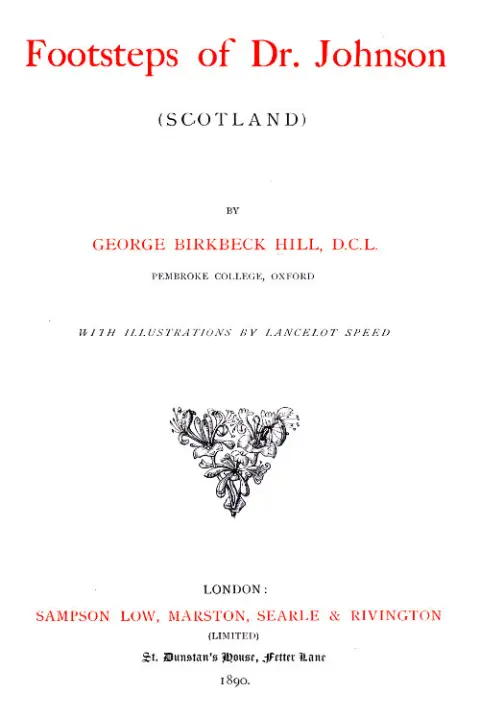
THE CLASSIC COLLECTION · 1890
"Footsteps of Dr. Johnson (Scotland)" by George Birkbeck Hill is a historical account written in the late 19th century. The work focuses on the journey of Dr. Samuel Johnson through Scotland, detailing the various places he visited and the cultural nuances he observed during his travels. The author aims to bring to light the Scotland that Johnson experienced, emphasizing the social customs and traditions rather than the scenic beauty of the landscape. At the start of the book, the author explains his motivation for writing, sparked by his desire to document the sites associated with Johnson's travels as described in his letters and travel journals. Hill notes the existence of multiple accounts of Johnson's journey, including those by Boswell, and expresses his intention to weave these narratives into a cohesive account that honors the daily life and customs of the people Johnson encountered. The opening also hints at the fondness Johnson had for anecdotes and the rich traditions surrounding his legacy in Scotland, establishing a groundwork for exploring both Johnson's perspectives and the landscape he traversed.
Introduction adapted from the source catalogue; source summaries may be automatically generated.
Free to read · English · 123,782 words · No account needed
MAKE TIME FOR A GOOD BOOK
On by default. Untick to stop anonymous reading totals. Each page counts after 10 seconds in view. How this works.
Anonymous counting is on unless you have switched it off.
Hume and Boswell had for a short time been very near neighbours, as it was in the same block of buildings[407] that they lived. If the elder man had entertained the American patriot, Franklin, the younger had entertained the Corsican patriot, Pascal Paoli. He could boast, moreover, of the distinguished guests who thronged his house during Johnson’s two visits, both at his first coming and on his return from the Hebrides. Judges, and advocates who were destined one day to sit on the bench, the Deputy Commander-in-Chief, men and women of high birth, authors, divines, physicians, all came to see and hear the famous Englishman. We can picture to ourselves the sedan-chairs passing in under the low gateway, bearing the fine ladies and gentlemen who came to attend “the levée which he held from ten o’clock in the morning till one or two.” The echo of the strong loud voice with the slow deliberate utterance still almost seems to sound in our ears as we wander about in this dreary spot. “I could not attend him,” writes Boswell, “being obliged to be in the Court of Session; but my wife was so good as to devote the greater part of the morning to the endless task of pouring out tea for my friend and his visitors.”
More than one caller, as he gazed on the huge frame, the scarred face, and the awkward strange movements of the man of whom they had heard so much, might have exclaimed with Lord Elibank, that “hardly anything seemed more improbable than to see Dr. Johnson in Scotland.” What Edinburgh said and thought of him we should greatly like to know. But no letters recording his visit seem to be extant. Even the very house has disappeared. Time, which has spared everything else in this old Court, has not spared it. More than thirty years ago it was burnt to the ground. We should have liked to wander about the rooms, and wonder which was the bedchamber that Mrs. Boswell, “to show all respect to the Sage,” so politely resigned to him; and where it was that Veronica, that precocious babe of four months, by wishing “to be held close to him, gave a proof from simple nature that his figure was not horrid.” Where, we should have asked, was the dinner given him at which Mrs. Boswell did her best “to aid wisdom and wit by administering agreeable sensations to the palate”? Where, too, were the carpets spread on which he let the wax of the candles drop, by turning them with their heads downwards when they did not burn bright enough? In what closet did Boswell keep his books, whence on Sunday, with pious purpose, Johnson took down Ogden’s Sermons, and retired with them to his own room? They did not, however, detain him long, and he soon rejoined the company. Which was the breakfast-room where Sir William Forbes introduced to him the blind scholar and poet, Dr. Blacklock? “Dear Dr. Blacklock, I am glad to see you,” he said, with a most humane complacency. “I looked on him with reverence,” he wrote to Mrs. Thrale. It has all utterly passed away; Forbes himself has been Sir Walter Scott’s “lamented Forbes”[408] for more than fourscore years. All has passed away; not only the talk about Burke, and Garrick, and Hume, and Whitefield, and genius, and witchcraft, and the comparative difficulty of verse-making and dictionary-making; but even the very walls which might have caught it in its echoes. Where this famous old house once stood now stands a modern bank, contrasting but ill in its more elaborate architecture with the severe, and even stern, simplicity of the ancient buildings. Nevertheless we are at no loss to picture to ourselves the home of Hume and Boswell. Their land occupied one half of the northern side of the Court; the other half, which no doubt corresponded with it in almost every respect, happily escaped the flames. It is so solidly built that if it is spared by the rage of fire and of modern improvement, it has little to fear from time. Its situation, looking down as it does with its northern front on the Mound, and the pleasant gardens in the valley below, has kept it from sinking in public estimation so much as most of the neighbouring buildings. It has indeed seen better days, but it has not lost all the outward signs of respectability; its panes are neither broken nor patched. The ground-floor, which was, we may assume, on the same plan as Boswell’s house, is occupied by a bookbinder,[409] who courteously showed me all over it. There were traces left in this busy workshop of past splendour, and I could see how handsome and spacious the rooms had once been. In the windows were deep recesses, where it must have been pleasant enough on a bright summer’s day to sit in the cool shade and look out over the heads of the elm trees waving below, across the sparkling waters of the Forth, on the hills of Fife in the far distance. A stone staircase, furnished with iron gates, led down from the level of the Court to the street four storeys below, where the foundations of this lofty pile are laid in the rock. The staircase had its occupant, for at one of the windows a mat-maker was busy at his trade.[410]
Your reading position is saved on this browser. Take it to another device with a library code. Reading pages adapt to text, rather than matching a printed edition.
BEHIND THE BOOK
This eBook is for the use of anyone anywhere in the United States and most other parts of the world at no cost and with almost no restrictions whatsoever. You may copy it, give it away or re-use it under the terms of the Project Gutenberg License included with this eBook or online at www.gutenberg.org. If you are not located in the United States, you will have to check the laws of the country where you are located before using this eBook. Read the source licence.
The original source file, including credits and licence, is retained by this library. Request an original-format copy at no charge. Please include the book title and Project Gutenberg identifier #57715.
KEEP YOUR CURIOSITY GOING
Wilfrid Scawen Blunt
Wilfrid Scawen Blunt

E. W. (Edgar Watson) Howe
Cécile Tormay

Moritz Busch
John L. Ransom