THE CLASSIC COLLECTION✦My diaries, being a personal narrative of events 1888-1914, Part 2 (1900-1914)CLASSIC FREE BOOKS
My diaries, being a personal narrative of events 1888-1914, Part 2 (1900-1914)
Wilfrid Scawen Blunt
THE CLASSIC COLLECTION · 1890
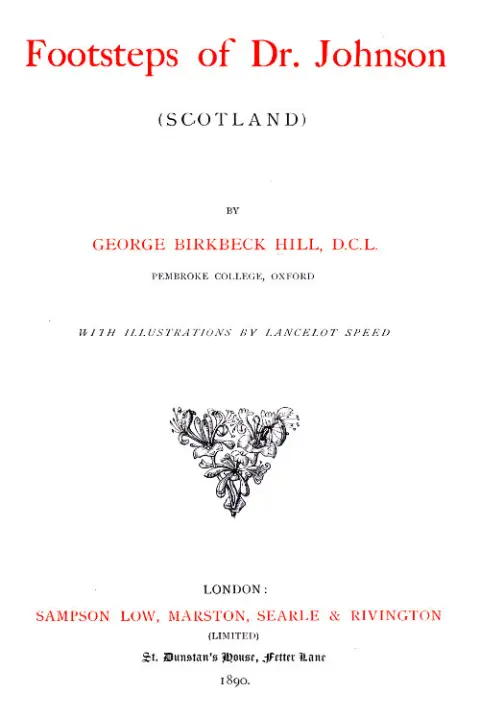
"Footsteps of Dr. Johnson (Scotland)" by George Birkbeck Hill is a historical account written in the late 19th century. The work focuses on the journey of Dr. Samuel Johnson through Scotland, detailing the various places he visited and the cultural nuances he observed during his travels. The author aims to bring to light the Scotland that Johnson experienced, emphasizing the social customs and traditions rather than the scenic beauty of the landscape. At the start of the book, the author explains his motivation for writing, sparked by his desire to document the sites associated with Johnson's travels as described in his letters and travel journals. Hill notes the existence of multiple accounts of Johnson's journey, including those by Boswell, and expresses his intention to weave these narratives into a cohesive account that honors the daily life and customs of the people Johnson encountered. The opening also hints at the fondness Johnson had for anecdotes and the rich traditions surrounding his legacy in Scotland, establishing a groundwork for exploring both Johnson's perspectives and the landscape he traversed.
Introduction adapted from the source catalogue; source summaries may be automatically generated.
Free to read · English · 123,782 words · No account needed
MAKE TIME FOR A GOOD BOOK
On by default. Untick to stop anonymous reading totals. Each page counts after 10 seconds in view. How this works.
Anonymous counting is on unless you have switched it off.
The age which I am attempting to describe was looked upon by Lord Cockburn as “the last purely Scotch age that Scotland was destined to see. The whole country had not begun to be absorbed in the ocean of London.”[331] The distance between the two capitals as measured by time, fatigue, and money was little less than the distance in the present day between Liverpool and New York. Johnson, who travelled in post-chaises, and therefore in great comfort, was nine days on the road. “He purposed,” he wrote, “not to loiter much by the way;”[332] but he did not journey by night, and he indulged in two days’ rest at Newcastle. Hume, three years later, travelling by easy stages on account of his failing health, took two days longer.[333] Had Johnson gone by the public conveyance, the “Newcastle Fly” would have brought him in three days as far as that town at a charge of £3 6s. On the panels of the “Fly” was painted the motto, Sat cito si sat bene. Thence he would have continued his journey by the “Edinburgh Fly,” which traversed the whole remaining distance in a single day in summer, and in a day and a half in winter. The charge for this was £1 11s. 6d. In these sums were not included the payments to the drivers and guards. The “Newcastle Fly” ran six times a week, starting from London an hour after midnight. The “Edinburgh Fly” ran only on Tuesdays, Thursdays, and Saturdays. A traveller then who lost no time on the road, leaving London at one o’clock on Sunday night, would in the summer-time reach Edinburgh by Thursday evening, and in the winter after mid-day on Friday.[334] Even the mail which was carried on horse-back, and went five times a week, took in good weather about 82 hours.[335] The news of the battle of Culloden, though it was forwarded by an express, was seven days all but two or three hours in reaching London.[336] There were men living in 1824 who recollected when the mail came down with only one single letter for Edinburgh.[337] By 1793 a great acceleration had been effected in the coach-service. It was possible, so the proud boast ran, to leave Edinburgh after morning service on Sunday, spend a whole day in London, and be back again by six o’clock on Saturday morning.[338] The weary traveller would have had to pass every night in the coach. By the year 1800 the journey was done from London to Edinburgh in fifty-eight hours, and from Edinburgh to London in sixty and a half.[339] But such annihilation of time and space, as no doubt this rapid rate of travelling was then called, was not dreamed of in Johnson’s day. The capitals of England and Scotland still stood widely apart. It was wholly “a Scotch scene” which the English traveller saw, and “independent tastes and ideas and pursuits” caught his attention.[340] Nevertheless in one respect Edinburgh, as I have already said, felt strongly the influence of England. In its literature and its language it was laboriously forming itself on the English model. There had been a long period during which neither learning nor literature had shone in Scotland with any brightness of light. Since the days of the great classical scholars not a single famous author had been seen. There had been “farthing candles” from time to time, but no “northern lights.”[341] The two countries were under the same sovereign, but there was no Age of Queen Anne north of the Tweed. There was indeed that general diffusion of learning which was conspicuously wanting in England. An English traveller noticed with surprise how rare it was to find “a man of any rank but the lowest who had not some tincture of learning. It was the pride and delight of every father to give his son a liberal education.”[342] Nevertheless it had been “with their learning as with provisions in a besieged town, every man had a mouthful and no one a bellyful.”[343] That there was a foundation for Johnson’s pointed saying was many years later candidly admitted by Sir Walter Scott.[344] So great had been the dearth of literature that the printer’s art had fallen into decay. About the year 1740 there were but four printing-houses in Edinburgh, which found scanty employment in producing school-books, law-papers, newspapers, sermons, and Bibles. By 1779 the number had risen from four to seven and twenty.[345] This rapid growth was by no means wholly due to an increase in Scotch authors. Edinburgh might have become “a hot-bed of genius,” but such productiveness even in a hot-bed would have been unparalleled. The booksellers in late years, in defiance of the supposed law of copyright, had begun to reprint the works of standard English writers, and after a long litigation had been confirmed in what they were doing by a decision given in the House of Lords.[346]
Your reading position is saved on this browser. Take it to another device with a library code. Reading pages adapt to text, rather than matching a printed edition.
BEHIND THE BOOK
This eBook is for the use of anyone anywhere in the United States and most other parts of the world at no cost and with almost no restrictions whatsoever. You may copy it, give it away or re-use it under the terms of the Project Gutenberg License included with this eBook or online at www.gutenberg.org. If you are not located in the United States, you will have to check the laws of the country where you are located before using this eBook. Read the source licence.
The original source file, including credits and licence, is retained by this library. Request an original-format copy at no charge. Please include the book title and Project Gutenberg identifier #57715.
KEEP YOUR CURIOSITY GOING
Wilfrid Scawen Blunt
Wilfrid Scawen Blunt

E. W. (Edgar Watson) Howe
Cécile Tormay

Moritz Busch
John L. Ransom