THE CLASSIC COLLECTION✦My diaries, being a personal narrative of events 1888-1914, Part 2 (1900-1914)CLASSIC FREE BOOKS
My diaries, being a personal narrative of events 1888-1914, Part 2 (1900-1914)
Wilfrid Scawen Blunt
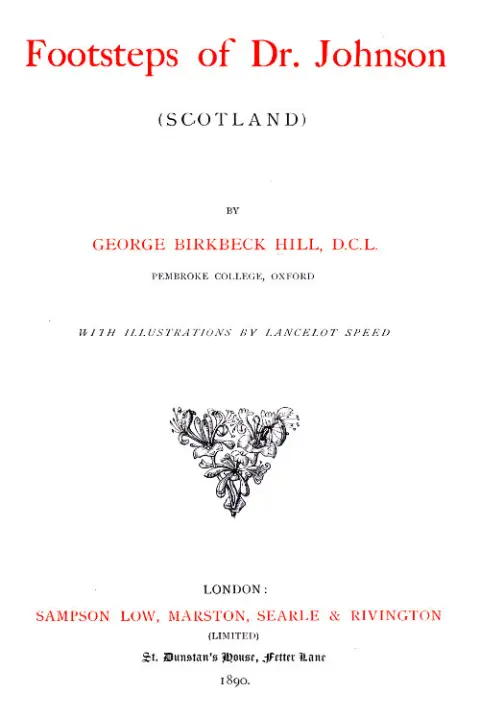
THE CLASSIC COLLECTION · 1890
"Footsteps of Dr. Johnson (Scotland)" by George Birkbeck Hill is a historical account written in the late 19th century. The work focuses on the journey of Dr. Samuel Johnson through Scotland, detailing the various places he visited and the cultural nuances he observed during his travels. The author aims to bring to light the Scotland that Johnson experienced, emphasizing the social customs and traditions rather than the scenic beauty of the landscape. At the start of the book, the author explains his motivation for writing, sparked by his desire to document the sites associated with Johnson's travels as described in his letters and travel journals. Hill notes the existence of multiple accounts of Johnson's journey, including those by Boswell, and expresses his intention to weave these narratives into a cohesive account that honors the daily life and customs of the people Johnson encountered. The opening also hints at the fondness Johnson had for anecdotes and the rich traditions surrounding his legacy in Scotland, establishing a groundwork for exploring both Johnson's perspectives and the landscape he traversed.
Introduction adapted from the source catalogue; source summaries may be automatically generated.
Free to read · English · 123,782 words · No account needed
MAKE TIME FOR A GOOD BOOK
On by default. Untick to stop anonymous reading totals. Each page counts after 10 seconds in view. How this works.
Anonymous counting is on unless you have switched it off.
Smollett, who in national prejudice did not yield even to him, has strongly upheld the opposite opinion. In his History he describes Lord Belhaven’s speech against the Union in the last parliament which sat in Scotland—a speech “so pathetic that it drew tears from the audience. It is,” he adds, “at this day looked upon as a prophecy by great part of the Scottish nation.”[213] The towns on the Firth of Forth, he maintained, through the loss of the trade with France, had been falling to decay ever since the two countries were united.[214] In these views he was not supported by the two great writers who were his countrymen and his contemporaries. It was chiefly to the Union that Adam Smith attributed the great improvements in agriculture which had been made in the eighteenth century.[215] It was to the Union that Hume attributed the blessing “of a government perfectly regular, and exempt from all violence and injustice.”[216] Many years later Thomas Carlyle, in whom glowed the perfervidum ingenium Scotorum as it has glowed in few, owned that “the Union was one of Scotland’s chief blessings,” though it was due to Wallace and to men like him “that it was not the chief curse.”[217]
It must never be forgotten that in this Union England was no less blessed than Scotland; that if she gave wealth to Scotland, Scotland nobly repaid the gift in men. In the sixteenth and seventeenth centuries the English stock had been quickened and strengthened and ennobled by fugitives seeking refuge on her shores from the persecutions of priests and kings, which passed over the coward and the base, and fell only on the brave and the upright. To the Fleming and the Huguenot was now added the Scot. In philosophy, in history, in law, in science, in poetry, in romance, in the arts of life, in trade, in government, in war, in the spread of our dominions, in the consolidation of our Empire, glorious has been the part which Scotland has played. Her poet’s prayer has been answered, and in “bright succession” have been raised men to adorn and guard not only herself but the country which belongs to Englishmen and Scotchmen alike. Little of this was seen, still less foreseen by Johnson. The change which was going on in Scotland was rapid and conspicuous; the change which she was working outside her borders was slow, and as yet almost imperceptible. What was seen raised not admiration, but jealousy of the vigorous race which was everywhere so rapidly “making its way to employment, riches, and distinction.” That Johnson should exult in the good which Scotland had derived from England through the Union was natural. Scarcely less natural that he should point out how much remained to be done before the Scotch attained the English level, not only in the comforts and refinements, but even in the decencies of life. One great peculiarity in their civilization struck him deeply. “They had attained the liberal without the manual arts, and excelled in ornamental knowledge while they wanted the conveniences of common life.”[218] [Sidenote: A DISPUTATIOUS PEASANTRY.] Even the peasantry were able to dispute with wonderful sagacity upon the articles of their faith, though they were content to live in huts which had not a single chimney to carry off the smoke.[219] Wesley, each time that he crossed the Borders, found a far harder task awaiting him than when he was upbraiding, denouncing, and exhorting an English congregation. To the Scotch, cradled as they had been in the Shorter Catechism, and trained as they were from their youth up in theology, his preaching, like Paul’s to the Greeks, was too often foolishness. He spoke to a people, as he complained, “who heard much, knew everything, and felt nothing.”[220] Though “you use the most cutting words still they hear, but feel no more than the seats they sit upon.”[221] Nowhere did he speak more roughly than in Scotland. No one there was offended at plain dealing. “In this respect they were a pattern to all mankind.” But yet “they hear and hear, and are just what they were before.”[222] He was fresh from the Kelso people and was preaching to a meeting in Northumberland when he wrote: “Oh! what a difference is there between these living stones, and the dead unfeeling multitudes in Scotland.”[223] “The misfortune of a Scotch congregation,” he recorded on another occasion, “is they know everything; so they learn nothing.”[224]
Your reading position is saved on this browser. Take it to another device with a library code. Reading pages adapt to text, rather than matching a printed edition.
BEHIND THE BOOK
This eBook is for the use of anyone anywhere in the United States and most other parts of the world at no cost and with almost no restrictions whatsoever. You may copy it, give it away or re-use it under the terms of the Project Gutenberg License included with this eBook or online at www.gutenberg.org. If you are not located in the United States, you will have to check the laws of the country where you are located before using this eBook. Read the source licence.
The original source file, including credits and licence, is retained by this library. Request an original-format copy at no charge. Please include the book title and Project Gutenberg identifier #57715.
KEEP YOUR CURIOSITY GOING
Wilfrid Scawen Blunt
Wilfrid Scawen Blunt

E. W. (Edgar Watson) Howe
Cécile Tormay

Moritz Busch
John L. Ransom