THE CLASSIC COLLECTION✦My diaries, being a personal narrative of events 1888-1914, Part 2 (1900-1914)CLASSIC FREE BOOKS
My diaries, being a personal narrative of events 1888-1914, Part 2 (1900-1914)
Wilfrid Scawen Blunt
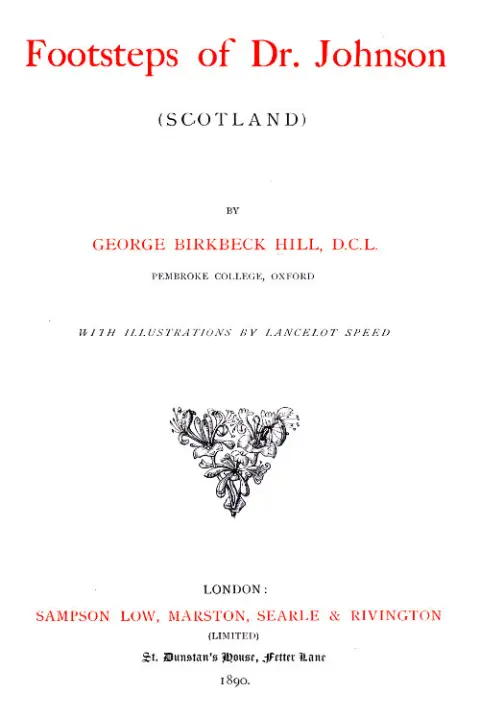
THE CLASSIC COLLECTION · 1890
"Footsteps of Dr. Johnson (Scotland)" by George Birkbeck Hill is a historical account written in the late 19th century. The work focuses on the journey of Dr. Samuel Johnson through Scotland, detailing the various places he visited and the cultural nuances he observed during his travels. The author aims to bring to light the Scotland that Johnson experienced, emphasizing the social customs and traditions rather than the scenic beauty of the landscape. At the start of the book, the author explains his motivation for writing, sparked by his desire to document the sites associated with Johnson's travels as described in his letters and travel journals. Hill notes the existence of multiple accounts of Johnson's journey, including those by Boswell, and expresses his intention to weave these narratives into a cohesive account that honors the daily life and customs of the people Johnson encountered. The opening also hints at the fondness Johnson had for anecdotes and the rich traditions surrounding his legacy in Scotland, establishing a groundwork for exploring both Johnson's perspectives and the landscape he traversed.
Introduction adapted from the source catalogue; source summaries may be automatically generated.
Free to read · English · 123,782 words · No account needed
MAKE TIME FOR A GOOD BOOK
On by default. Untick to stop anonymous reading totals. Each page counts after 10 seconds in view. How this works.
Anonymous counting is on unless you have switched it off.
[402] Humphry Clinker, ii. 224. Lodging-house keepers are entered in the Edinburgh Directory as Room-Setters and Boarders. Some were both, others only Room-Setters.
[403] Johnson repeated these lines with great emotion at the excellent inn at Chapel-House in Oxfordshire. Boswell’s Johnson, ii. 452.
[404] Since writing the above I have learnt with great pleasure that this interesting but ruinous old building will not only be preserved, but preserved to good uses. It has been purchased by Dr. A. H. F. Barbour and his sister Mrs. Whyte, and by them presented to the Edinburgh Social Union. It will be put into a state of thorough repair, and let out to poor tenants on the plan followed by Miss Octavia Hill in London. I am informed that the two sides of the Close had been repaired by the Social Union before my visit, and that the pleasant outside staircases and open galleries which caught my eye were its work.
[405] Chambers’s Traditions of Edinburgh, p. 68.
[406] Pringle seems to have kept on a house in Edinburgh though he was for the most part living at this time in London. See Hume’s Letters to Strahan, p. 117.
[407] The Scotch called each set of rooms on every floor a house, and each block a land. Thus Hume had once lived in Jack’s Land, in the Canongate. A land of thirteen stories, such as was shown to Johnson at the foot of the Post-house Stairs would contain twenty-six houses—two on every floor.
[408] Marmion. Introduction to Canto iv.
[409] Mr. Alexander Grieve. I find a bookbinder of the same name living in Bell’s Wynd in 1773. Edinburgh Directory for 1773-4, Appendix, p. 5.
[410] For my authorities for some of the statements in this note see my Letters of David Hume to William Strahan, pp. 116-9.
[411] See ante, p. 52.
[412] Heart of Mid-Lothian, ed. 1860, i. 247.
[413] Redgauntlet, ed. 1860, i. 253.
[414] Cockburn’s Memorials, p. 106, and Heart of Mid-Lothian, ii.
117.
[415] Lockhart’s Scott, vii. 124.
[416] Reminiscences, by Thomas Carlyle, ii. 5.
[417] Cockburn’s Memorials, p. 69.
[418] Court and City Register for 1769, p. 142.
[419] From 1808 the judges began to sit in two separate chambers. Cockburn’s Memorials, pp. 100, 244.
[420] Hume’s Letters to Strahan, p. xxvi.
[421] Mr. Gladstone restored it in 1885.
[422] Cockburn’s Life of Lord Jeffrey, i. 182.
[423] Tour in Scotland, i. 233.
[424] Humphry Clinker, iii. 5.
[425] The Tale of a Tub, section xi.
[426] Defoe’s Tour through Great Britain: Account of Scotland, iii. 43, and Pennant’s Tour in Scotland, ii. 249.
[427] Chambers, quoted in Croker’s Boswell, p. 276.
[428] Lockhart’s Scott, iii. 269. The quotation no doubt was, “Superfluous lags the veteran on the stage;” the line with which Scott concluded the brief Appendix to Castle Dangerous.
[429] Scots Magazine, 1768, p. 113; 1789, pp. 521-5.
[430] J. Macky’s Journey through Scotland, p. 69.
Your reading position is saved on this browser. Take it to another device with a library code. Reading pages adapt to text, rather than matching a printed edition.
BEHIND THE BOOK
This eBook is for the use of anyone anywhere in the United States and most other parts of the world at no cost and with almost no restrictions whatsoever. You may copy it, give it away or re-use it under the terms of the Project Gutenberg License included with this eBook or online at www.gutenberg.org. If you are not located in the United States, you will have to check the laws of the country where you are located before using this eBook. Read the source licence.
The original source file, including credits and licence, is retained by this library. Request an original-format copy at no charge. Please include the book title and Project Gutenberg identifier #57715.
KEEP YOUR CURIOSITY GOING
Wilfrid Scawen Blunt
Wilfrid Scawen Blunt

E. W. (Edgar Watson) Howe
Cécile Tormay

Moritz Busch
John L. Ransom