THE CLASSIC COLLECTION✦My diaries, being a personal narrative of events 1888-1914, Part 2 (1900-1914)CLASSIC FREE BOOKS
My diaries, being a personal narrative of events 1888-1914, Part 2 (1900-1914)
Wilfrid Scawen Blunt
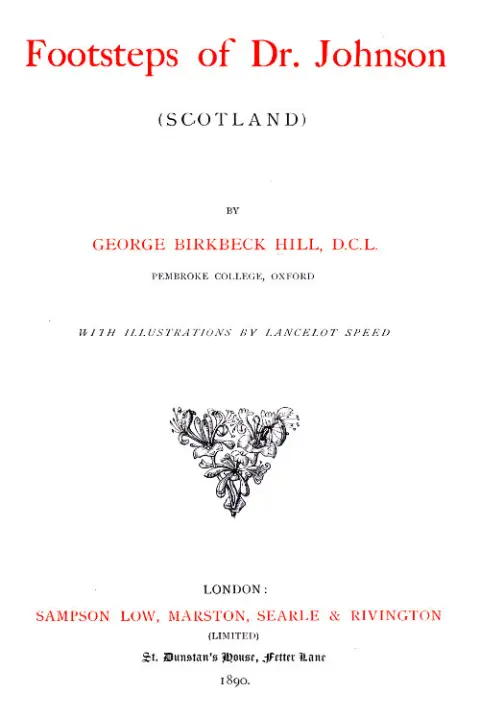
THE CLASSIC COLLECTION · 1890
"Footsteps of Dr. Johnson (Scotland)" by George Birkbeck Hill is a historical account written in the late 19th century. The work focuses on the journey of Dr. Samuel Johnson through Scotland, detailing the various places he visited and the cultural nuances he observed during his travels. The author aims to bring to light the Scotland that Johnson experienced, emphasizing the social customs and traditions rather than the scenic beauty of the landscape. At the start of the book, the author explains his motivation for writing, sparked by his desire to document the sites associated with Johnson's travels as described in his letters and travel journals. Hill notes the existence of multiple accounts of Johnson's journey, including those by Boswell, and expresses his intention to weave these narratives into a cohesive account that honors the daily life and customs of the people Johnson encountered. The opening also hints at the fondness Johnson had for anecdotes and the rich traditions surrounding his legacy in Scotland, establishing a groundwork for exploring both Johnson's perspectives and the landscape he traversed.
Introduction adapted from the source catalogue; source summaries may be automatically generated.
Free to read · English · 123,782 words · No account needed
MAKE TIME FOR A GOOD BOOK
On by default. Untick to stop anonymous reading totals. Each page counts after 10 seconds in view. How this works.
Anonymous counting is on unless you have switched it off.
[251] Boswell’s Johnson, v. 172. There are inns in the Hebrides where the same deficiency is still found.
[252] Gray calls Geneva “neat,” and the repast which was set before him at the “Grande Chartreuse” “extremely neat.” Gray’s Works, ed. 1858, ii. 62, 63.
[253] Humphry Clinker, ii. 221, and Arnot’s History of Edinburgh,
p. 241.
[254] Reekiana, by Robert Chambers, p. 227: “The house was situated at the head of Dickson’s Close, a few doors below Niddry Street.” I have found all these names, except Stirling’s, in the recent interesting reprint of the Edinburgh Directory for 1773-4, published by William Brown, Edinburgh, 1889.
[255] “Stenchel. An iron bar for a window.” Jamieson’s Scottish
Dictionary.
[256] Tirlesing is not given by Jamieson.
[257] The City Cleaned and Country Improven, Edinburgh, 1760, p. 5.
[258] The City Cleaned and Country Improven, pp. 6, 8.
[259] Humphry Clinker, ii. 227. Gardy loo is a corruption of gardez l’eau, a cry which, like so many other Scotch customs and words, bears witness to the close connection which of old existed between Scotland and France.
[260] Burt’s Letters from a Gentleman, etc., i. 21.
[261] Topham’s Letters from Edinburgh, p. 152.
[262] Humphry Clinker, ii. 221.
[263] Wesley’s Journal, iii. 54.
[264] Wright’s Life of General Wolfe, p. 137.
[265] Gray’s Works, iv. 52.
[266] Ib. p. 61.
[267] This arrangement is still not uncommon in country places.
[268] Johnson’s Works, ix. 18.
[269] Boswell’s Johnson, v. 306.
[270] Letters from Edinburgh, p. 141.
[271] Works, ix. 18.
[272] Lockhart’s Life of Scott, i. 108.
[273] Boswell’s Johnson, ii. 78. Sheridan, in his Life of Swift, records an earlier abolition of vails in Ireland (Swift’s Works, ii. 108).
[274] Thicknesse’s Observations on the Customs and Manners of the
French, 1766, p. 106.
[275] Lord Hervey’s Memoirs, ii. 50.
[276] Arnot’s History of Edinburgh, p. 376.
[277] Edinburgh Chronicle for 1760, p. 495.
[278] Ib. pp. 503, 518, 583, 623. The Scots Hunters were, I suppose, the same as the Royal Hunters—a body of gentlemen volunteers who were raised at the time of the Rebellion of 1745, and served under General Oglethorpe.
[279] Walpole’s Memoirs of the Reign of George III., ii. 3, and Letters of the First Earl of Malmesbury, i. 108-9.
[280] Boswell’s Johnson, ii. 452.
[281] Wesley’s Journal, ii. 228, 285.
[282] Present State of Polite Learning, ch. xii.
[283] Arnot’s History of Edinburgh, p. 658.
[284] Ib. pp. 352-4.
[285] Humphry Clinker, ii. 214.
[286] Letters from Edinburgh, p. 18.
[287] “The Pleasance consists of one mean street; through it lies the principal road to London.”—Arnot’s History of Edinburgh, p. 328.
[288] Arnot’s History of Edinburgh, p. 353.
[289] Voyage en Angleterre, etc., i. 200, 229, ii. 309.
[290] Boswell’s Johnson, v. 23.
[291] Piozzi Letters, i. 109.
[292] Works, ix. 18.
[293] Wesley’s Journal, ii. 228.
[294] Defoe’s Tour through Great Britain; Account of Scotland (ed.
1727), iii. 29, 30, 33.
[295] J. Macky’s Journey through Scotland, p. 65.
[296] Letters from Edinburgh, p. 8.
[297] Humphry Clinker, ii. 220.
[298] Tour in Scotland, i. 52.
[299] Carlyle’s Reminiscences, ii. 5.
Your reading position is saved on this browser. Take it to another device with a library code. Reading pages adapt to text, rather than matching a printed edition.
BEHIND THE BOOK
This eBook is for the use of anyone anywhere in the United States and most other parts of the world at no cost and with almost no restrictions whatsoever. You may copy it, give it away or re-use it under the terms of the Project Gutenberg License included with this eBook or online at www.gutenberg.org. If you are not located in the United States, you will have to check the laws of the country where you are located before using this eBook. Read the source licence.
The original source file, including credits and licence, is retained by this library. Request an original-format copy at no charge. Please include the book title and Project Gutenberg identifier #57715.
KEEP YOUR CURIOSITY GOING
Wilfrid Scawen Blunt
Wilfrid Scawen Blunt

E. W. (Edgar Watson) Howe
Cécile Tormay

Moritz Busch
John L. Ransom