THE CLASSIC COLLECTION✦My diaries, being a personal narrative of events 1888-1914, Part 2 (1900-1914)CLASSIC FREE BOOKS
My diaries, being a personal narrative of events 1888-1914, Part 2 (1900-1914)
Wilfrid Scawen Blunt
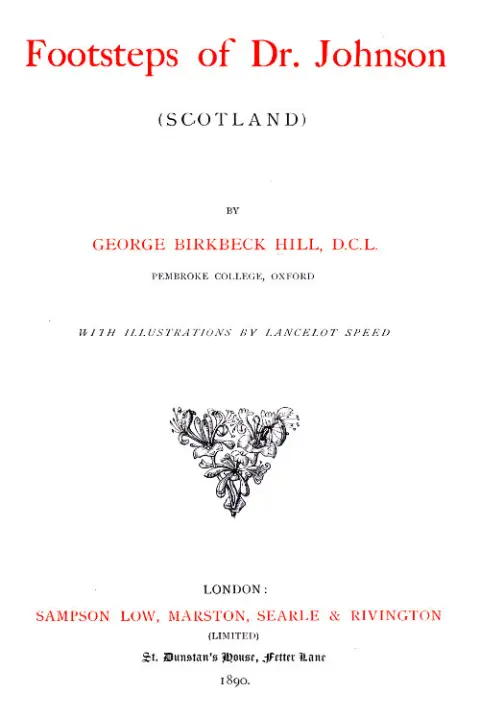
THE CLASSIC COLLECTION · 1890
"Footsteps of Dr. Johnson (Scotland)" by George Birkbeck Hill is a historical account written in the late 19th century. The work focuses on the journey of Dr. Samuel Johnson through Scotland, detailing the various places he visited and the cultural nuances he observed during his travels. The author aims to bring to light the Scotland that Johnson experienced, emphasizing the social customs and traditions rather than the scenic beauty of the landscape. At the start of the book, the author explains his motivation for writing, sparked by his desire to document the sites associated with Johnson's travels as described in his letters and travel journals. Hill notes the existence of multiple accounts of Johnson's journey, including those by Boswell, and expresses his intention to weave these narratives into a cohesive account that honors the daily life and customs of the people Johnson encountered. The opening also hints at the fondness Johnson had for anecdotes and the rich traditions surrounding his legacy in Scotland, establishing a groundwork for exploring both Johnson's perspectives and the landscape he traversed.
Introduction adapted from the source catalogue; source summaries may be automatically generated.
Free to read · English · 123,782 words · No account needed
MAKE TIME FOR A GOOD BOOK
On by default. Untick to stop anonymous reading totals. Each page counts after 10 seconds in view. How this works.
Anonymous counting is on unless you have switched it off.
One day he and Dr. Robertson called on Johnson at Boswell’s house, and the talk turned on the Rebellion. Lord Elibank, addressing the historian, said: “Mr. Robertson, the first thing that gave me a high opinion of you was your saying in the Select Society, while parties ran high, soon after the year 1745, that you did not think worse of a man’s moral character for his having been in rebellion. This was venturing to utter a liberal sentiment, while both sides had a detestation of each other.” Such a sentiment must have been particularly comforting to a man who perhaps was still plotting treason. The Select Society had been founded in 1754 by Allan Ramsay the painter, aided by Robertson, Hume, and Adam Smith. “It rubbed off all corners by collision,” says Dr. Carlyle, “and made the literati of Edinburgh less captious and pedantic than they were elsewhere.”[844] If collision always rubbed off corners, there was enough between Elibank and Hume to have produced the greatest smoothness and even polish. The historian, in the fifth volume of his History of England, speaks of him as “a person that has writ an Enquiry historical and critical into the evidence against Mary Queen of Scots.” He goes on to accuse him with having “almost directly called him a liar,” and charges him in his turn with being guilty of “scandalous artifices.” He concludes with that well-known passage, in which he maintains that “there are indeed three events in our history which may be regarded as touchstones of party-men. An English Whig, who asserts the reality of the Popish Plot, an Irish Catholic, who denies the massacre in 1641, and a Scotch Jacobite, who maintains the innocence of Queen Mary, must be considered as men beyond the reach of argument or reason, and must be left to their prejudices.”[845] In a letter to Robertson, written some years earlier than this note, Hume says: “I desire my compliments to Lord Elibank. I hope his lordship has forgot his vow of answering us, and of washing Queen Mary white. I am afraid that is impossible; but his lordship is very well qualified to gild her.”[846] Hume, with all his good nature, was not a little touchy, and perhaps took offence where no offence was meant. Lord Elibank had been “the early patron of Robertson and Home, the tragick poet, who when they were ministers of country parishes, lived near his seat. He told me,” continues Boswell, “‘I saw these lads had talents, and they were much with me.’ I hope they will pay a grateful tribute to his memory.” According to Dr. Carlyle, they found a far better way of showing their gratitude, for “they cured him of his contempt for the Presbyterian clergy, made him change or soften down many of his original opinions, and prepared him for becoming a most agreeable member of the Literary Society of Edinburgh, among whom he lived during the remainder of his life, admiring and admired.”[847] Besides his Enquiry, he published several other “small pieces of distinguished merit,” according to Boswell. National Debts and the Currency were among the subjects of which he treated.[848] Dr. Carlyle describes him as “rather a humourist than a man of humour; one who defended paradoxes and uncommon opinions with a copiousness and ingenuity that was surprising.” This part of his character would have endeared him to Johnson, who liked a tavern because, as he said, “wine there prompts me to free conversation, and an interchange of discourse with those whom I most love; I dogmatise and am contradicted, and in this conflict of opinions and sentiments I find delight.”[849] Though Johnson was fond of his society, and once said “that he was never in his company without learning something,” yet speaking of him on another occasion he said, “Sir, there is nothing conclusive in his talk.” Lord Elibank’s admiration of Johnson was very high. Yet he need not have gone so far as to flatter him at the expense of his own country. Having missed seeing him on his first visit to Edinburgh, he wrote to Boswell: “I could not persuade myself there was anything in Scotland worthy to have a summer of Samuel Johnson bestowed on it; but since he has done us that compliment, for heaven’s sake inform me of your motions. I will attend them most religiously, and though I should regret to let Mr. Johnson go a mile out of his way on my account, old as I am, I shall be glad to go five hundred miles to enjoy a day of his company.” Johnson, in his plain truthfulness, on the very day on which Lord Elibank wrote this extravagant letter, said that “he would go two miles out of his way to see Lord Monboddo.” As five hundred to two, so perhaps was Johnson’s accuracy of talk to Lord Elibank’s. To the mean way in which his lordship spoke of Scotland, as if it were beneath the great Englishman’s notice, I much prefer the spirit of his countryman, who, according to Boswell, “would say of Dr. Johnson, ‘Damned rascal! to talk as he does of the Scotch!’” However, he had none of that smallness of mind common enough among the high-born, which would not let him enjoy Johnson’s strong talk. He was “one of the great who sought his society. He well observed that if a great man procured an interview with him, and did not wish to see him more, it showed a mere idle curiosity, and a wretched want of relish for extraordinary powers of mind.” Such an idle curiosity and such a wretched want of relish were shown by George III.
Your reading position is saved on this browser. Take it to another device with a library code. Reading pages adapt to text, rather than matching a printed edition.
BEHIND THE BOOK
This eBook is for the use of anyone anywhere in the United States and most other parts of the world at no cost and with almost no restrictions whatsoever. You may copy it, give it away or re-use it under the terms of the Project Gutenberg License included with this eBook or online at www.gutenberg.org. If you are not located in the United States, you will have to check the laws of the country where you are located before using this eBook. Read the source licence.
The original source file, including credits and licence, is retained by this library. Request an original-format copy at no charge. Please include the book title and Project Gutenberg identifier #57715.
KEEP YOUR CURIOSITY GOING
Wilfrid Scawen Blunt
Wilfrid Scawen Blunt

E. W. (Edgar Watson) Howe
Cécile Tormay

Moritz Busch
John L. Ransom