THE CLASSIC COLLECTION✦My diaries, being a personal narrative of events 1888-1914, Part 2 (1900-1914)CLASSIC FREE BOOKS
My diaries, being a personal narrative of events 1888-1914, Part 2 (1900-1914)
Wilfrid Scawen Blunt
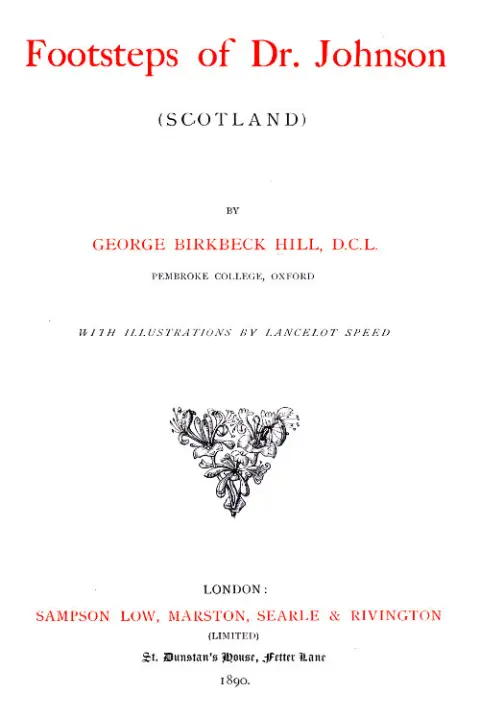
THE CLASSIC COLLECTION · 1890
"Footsteps of Dr. Johnson (Scotland)" by George Birkbeck Hill is a historical account written in the late 19th century. The work focuses on the journey of Dr. Samuel Johnson through Scotland, detailing the various places he visited and the cultural nuances he observed during his travels. The author aims to bring to light the Scotland that Johnson experienced, emphasizing the social customs and traditions rather than the scenic beauty of the landscape. At the start of the book, the author explains his motivation for writing, sparked by his desire to document the sites associated with Johnson's travels as described in his letters and travel journals. Hill notes the existence of multiple accounts of Johnson's journey, including those by Boswell, and expresses his intention to weave these narratives into a cohesive account that honors the daily life and customs of the people Johnson encountered. The opening also hints at the fondness Johnson had for anecdotes and the rich traditions surrounding his legacy in Scotland, establishing a groundwork for exploring both Johnson's perspectives and the landscape he traversed.
Introduction adapted from the source catalogue; source summaries may be automatically generated.
Free to read · English · 123,782 words · No account needed
MAKE TIME FOR A GOOD BOOK
On by default. Untick to stop anonymous reading totals. Each page counts after 10 seconds in view. How this works.
Anonymous counting is on unless you have switched it off.
“Old Lord Auchinleck (he writes) was an able lawyer, a good scholar, after the manner of Scotland, and highly valued his own advantages as a man of good estate and ancient family; and, moreover, he was a strict Presbyterian and Whig of the old Scottish cast. This did not prevent his being a terribly proud aristocrat; and great was the contempt he entertained and expressed for his son James, for the nature of his friendships and the character of the personages of whom he was engoué one after another. ‘There’s nae hope for Jamie, mon,’ he said to a friend. ‘Jamie is gaen clean gyte.[790] What do you think, mon? He’s done wi’ Paoli—he’s off wi’ the land-louping[791] scoundrel of a Corsican; and whose tail do you think he has pinned himself to now, mon?’ Here the old judge summoned up a sneer of most sovereign contempt. ‘A dominie, mon—an auld dominie: he keeped a schŭle, and cau’d it an acaadamy.”
[Sidenote: SCOTCH DOMINIES.]
The full force of Lord Auchinleck’s contempt is only seen when we understand the position of a dominie. The character of a schoolmaster, generally, according to Johnson, was less honourable in Scotland than in England.[792] But the dominie, or tutor in a family, was still less esteemed. “He was raised,” writes Sir Walter Scott, “from a humble class to a society where, whatever his personal attainments might be, he found himself placed at a humiliating distance from anything like a footing of equality. His remuneration was scanty in the extreme, and consisting (as if to fill up the measure of his dependence) not entirely of a fixed salary, but partly of the precarious prospect of future preferment in the Church. The Scotch dominie was assuredly one of the most pitiable of human beings.”[793] It is a curious and perhaps a somewhat suspicious fact, that a very few years before Sir Walter supplied Mr. Croker with this amusing story about the old judge, he had put on record in the pages of the Quarterly Review the following anecdote: “When the old Scots judge Lord Auchinleck first heard of Johnson’s coming to visit him at his rural castellum, he held up his hands in astonishment, and cried out, ‘Our Jeemy’s clean aff the hooks now! would ony body believe it? he’s bringing down a dominie wi’ him—an auld dominie.’”[794] This looks like a different version of the same story. Moreover, Boswell tells us that his father had desired him to invite him to his house. When Johnson called his school at Lichfield an academy, he does not seem to have used the term pretentiously, for in his Dictionary he defines the word under one of its meanings as “a place of education in contradistinction to the universities or public schools.” It does not seem likely, moreover, that Lord Auchinleck had any feeling of contempt for Pascal Paoli, a man of good family, who for years had headed a rebellion against the tyranny first of Genoa and afterwards of France. He had visited Auchinleck two years before Johnson, and had been well received. Boswell, writing to Garrick on September 18, 1771, said: “I have just been enjoying the very great happiness of a visit from my illustrious friend, Pascal Paoli. He was two nights at Auchinleck, and you may figure the joy of my worthy father and me at seeing the Corsican hero in our romantic groves. Count Burgynski, the Polish ambassador, accompanied him.”[795] Poland’s days of sending ambassadors had nearly drawn to an end, for the first partition of the country was made in the following year. It was a strange chance which brought the last Corsican patriot and the last Polish ambassador to this Ayrshire mansion. One thing only was wanting. Would that Burns that day had played truant and had wandered up “Lugar’s winding stream” as far as Auchinleck! It would, indeed, have formed an interesting group—the stiff old Scotch judge and his famous son, the great Corsican patriot and the Pole, with the peasant-lad gazing at them with his eyes full of beauty and wonder. Paoli’s name is well-nigh forgotten now, but he and his Corsicans deeply stirred the hearts of our forefathers. Boswell, by a private subscription in Scotland, had sent out to him in one week £700 worth of ordnance—“a tolerable train of artillery.”[796] His account of his tour in that island had been widely read. Even his father “was rather fond of it. ‘James,’ he said, ‘had taken a tout on a new horn.’”[797] Whether Lord Auchinleck abused Paoli “as a land-louping scoundrel of a Corsican,” or admired him as he admired other great patriots, the rest of Sir Walter Scott’s account of the great altercation may be true enough:
Your reading position is saved on this browser. Take it to another device with a library code. Reading pages adapt to text, rather than matching a printed edition.
BEHIND THE BOOK
This eBook is for the use of anyone anywhere in the United States and most other parts of the world at no cost and with almost no restrictions whatsoever. You may copy it, give it away or re-use it under the terms of the Project Gutenberg License included with this eBook or online at www.gutenberg.org. If you are not located in the United States, you will have to check the laws of the country where you are located before using this eBook. Read the source licence.
The original source file, including credits and licence, is retained by this library. Request an original-format copy at no charge. Please include the book title and Project Gutenberg identifier #57715.
KEEP YOUR CURIOSITY GOING
Wilfrid Scawen Blunt
Wilfrid Scawen Blunt

E. W. (Edgar Watson) Howe
Cécile Tormay

Moritz Busch
John L. Ransom