THE CLASSIC COLLECTION✦My diaries, being a personal narrative of events 1888-1914, Part 2 (1900-1914)CLASSIC FREE BOOKS
My diaries, being a personal narrative of events 1888-1914, Part 2 (1900-1914)
Wilfrid Scawen Blunt
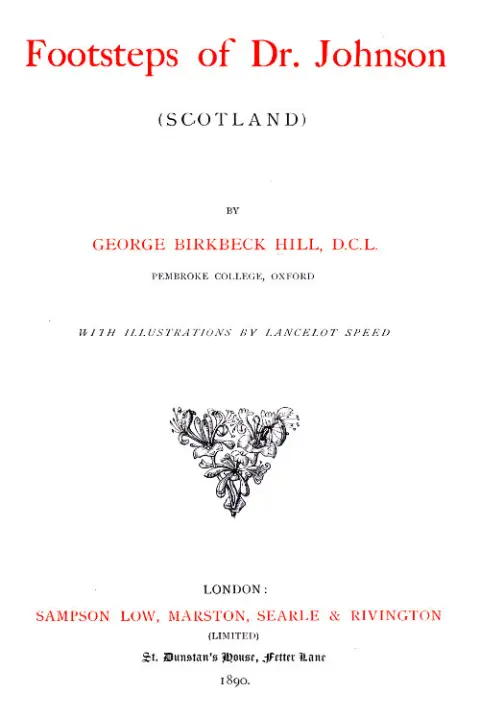
THE CLASSIC COLLECTION · 1890
"Footsteps of Dr. Johnson (Scotland)" by George Birkbeck Hill is a historical account written in the late 19th century. The work focuses on the journey of Dr. Samuel Johnson through Scotland, detailing the various places he visited and the cultural nuances he observed during his travels. The author aims to bring to light the Scotland that Johnson experienced, emphasizing the social customs and traditions rather than the scenic beauty of the landscape. At the start of the book, the author explains his motivation for writing, sparked by his desire to document the sites associated with Johnson's travels as described in his letters and travel journals. Hill notes the existence of multiple accounts of Johnson's journey, including those by Boswell, and expresses his intention to weave these narratives into a cohesive account that honors the daily life and customs of the people Johnson encountered. The opening also hints at the fondness Johnson had for anecdotes and the rich traditions surrounding his legacy in Scotland, establishing a groundwork for exploring both Johnson's perspectives and the landscape he traversed.
Introduction adapted from the source catalogue; source summaries may be automatically generated.
Free to read · English · 123,782 words · No account needed
MAKE TIME FOR A GOOD BOOK
On by default. Untick to stop anonymous reading totals. Each page counts after 10 seconds in view. How this works.
Anonymous counting is on unless you have switched it off.
[Illustration: [A]]
[A] See Appendix. [Transcriber’s note: The illustration is of the letter which is transcribed in Appendix A.]
[Sidenote: JOHNSON NO GRUMBLER.]
The people he praises no less than their ministers. “Civility,” he says, “seems part of the national character of Highlanders. Every chieftain is a monarch, and politeness, the natural product of royal government, is diffused from the Laird through the whole clan.”[86] He describes the daughter of the man who kept the hut in Glenmorison, where he passed a night. “Her conversation like her appearance was gentle and pleasing. We knew that the girls of the Highlanders are all gentlewomen, and treated her with great respect, which she received as customary and due.”[87] He praises the general hospitality. “Wherever there is a house the stranger finds a welcome. If his good fortune brings him to the residence of a gentleman he will be glad of a storm to prolong his stay.”[88] How graceful is the compliment which he pays to Macleod of Rasay! “Rasay has little that can detain a traveller except the Laird and his family; but their power wants no auxiliaries. Such a seat of hospitality amidst the winds and waters fills the imagination with a delightful contrariety of images. Without is the rough ocean and the rocky land, the beating billows and the howling storm; within is plenty and elegance, beauty and gaiety, the song and the dance. In Rasay if I could have found a Ulysses I had fancied a Phæacia.”[89] To the other branch of the Macleods he is no less complimentary. “At Dunvegan I had tasted lotus,” he wrote, “and was in danger of forgetting that I was ever to depart.”[90] He met Flora Macdonald, and does not let the occasion pass to pay her a high compliment. “Hers is a name that will be mentioned in history, and, if courage and fidelity be virtues, mentioned with honour.”[91] In fact, he rarely introduces in his narrative any living person but in way of compliment or acknowledgment. “He speaks ill of nobody but Ossian,” said Lord Mansfield, Scotchman though he was.[92] “There has been of late,” he once said, “a strange turn in travellers to be displeased.”[93] There was no such turn in him. From the beginning to the end of his narrative, there is not a single grumble. In Mull last summer I had the pleasure of meeting an old general, a Highlander, who had seen a great deal of rough service in the East Indies. Someone in the company let drop an unfavourable remark on Johnson. “I lately read his Journey,” the general replied, “and when I thought of his age, his weak health, and the rudeness of the accommodation in those old days, I was astonished at finding that he never complained.” In his food he had a relish for what was nice and delicate. Yet he records that “he only twice found any reason to complain of a Scottish table. He that shall complain of his fare in the Hebrides has improved his delicacy more than his manhood.”[94] “If an epicure,” he says in another passage, “could remove by a wish in quest of sensual gratifications, wherever he had supped he would breakfast in Scotland.”[95] Boswell, we read, “was made uneasy and almost fretful” by their bad accommodation in the miserable inn at Glenelg. “Dr. Johnson was calm. I said he was so from vanity. JOHNSON. ‘No, Sir, it is from philosophy.’”[96] The same philosophy accompanied him not only through his journey, but through his letters and his narrative. Nearly five weeks after he had left Edinburgh he wrote to Mrs. Thrale: “The hill Rattiken and the inn at Glenelg were the only things of which we or travellers yet more delicate could find any pretensions to complain.”[97] Yet he was by no means free from bodily troubles, as his letters show. He was “miserably deaf,” he wrote at one time, and was still suffering from the remains of inflammation in the eye, he wrote at another time. His nerves seemed to be growing weaker. The climate, he thought, “perhaps not within his degree of healthy latitude.”[98] The climate, indeed, had been at its worst. In all September he had only one day and a half of fair weather, and in October perhaps not more.[99] Kept indoors as he was by the rain, he often suffered under the additional discomfort of bad accommodation. Two nights he passed in wretched huts; one in a barn; two in the miserable cabin of a small trading-ship; one in a room where the floor was mire. Even in some of the better houses he had not always a chamber to himself at night, while in the daytime privacy and quiet were not to be enjoyed. At Corrichatachin, where he twice made a stay, “we had,” writes Boswell, “no rooms that we could command; for the good people had no notion that a man could have any occasion but for a mere sleeping place; so, during the day, the bed-chambers were common to all the house. Servants eat in Dr. Johnson’s, and mine was a kind of general rendezvous of all under the roof, children and dogs not excepted.”[100]
Your reading position is saved on this browser. Take it to another device with a library code. Reading pages adapt to text, rather than matching a printed edition.
BEHIND THE BOOK
This eBook is for the use of anyone anywhere in the United States and most other parts of the world at no cost and with almost no restrictions whatsoever. You may copy it, give it away or re-use it under the terms of the Project Gutenberg License included with this eBook or online at www.gutenberg.org. If you are not located in the United States, you will have to check the laws of the country where you are located before using this eBook. Read the source licence.
The original source file, including credits and licence, is retained by this library. Request an original-format copy at no charge. Please include the book title and Project Gutenberg identifier #57715.
KEEP YOUR CURIOSITY GOING
Wilfrid Scawen Blunt
Wilfrid Scawen Blunt

E. W. (Edgar Watson) Howe
Cécile Tormay

Moritz Busch
John L. Ransom