THE CLASSIC COLLECTION✦My diaries, being a personal narrative of events 1888-1914, Part 2 (1900-1914)CLASSIC FREE BOOKS
My diaries, being a personal narrative of events 1888-1914, Part 2 (1900-1914)
Wilfrid Scawen Blunt
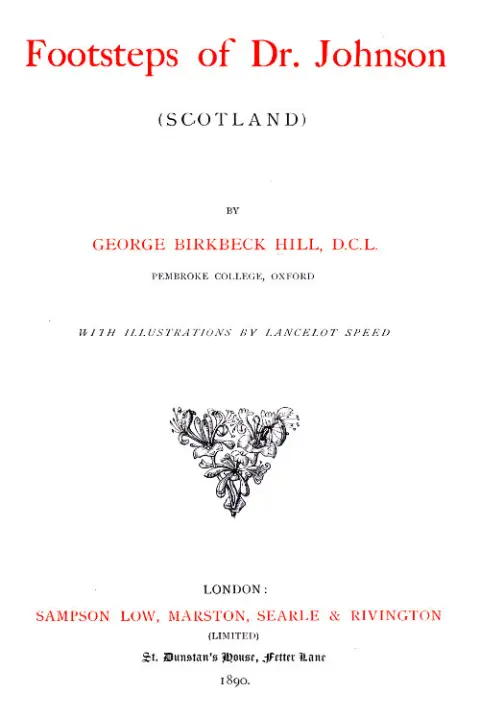
THE CLASSIC COLLECTION · 1890
"Footsteps of Dr. Johnson (Scotland)" by George Birkbeck Hill is a historical account written in the late 19th century. The work focuses on the journey of Dr. Samuel Johnson through Scotland, detailing the various places he visited and the cultural nuances he observed during his travels. The author aims to bring to light the Scotland that Johnson experienced, emphasizing the social customs and traditions rather than the scenic beauty of the landscape. At the start of the book, the author explains his motivation for writing, sparked by his desire to document the sites associated with Johnson's travels as described in his letters and travel journals. Hill notes the existence of multiple accounts of Johnson's journey, including those by Boswell, and expresses his intention to weave these narratives into a cohesive account that honors the daily life and customs of the people Johnson encountered. The opening also hints at the fondness Johnson had for anecdotes and the rich traditions surrounding his legacy in Scotland, establishing a groundwork for exploring both Johnson's perspectives and the landscape he traversed.
Introduction adapted from the source catalogue; source summaries may be automatically generated.
Free to read · English · 123,782 words · No account needed
MAKE TIME FOR A GOOD BOOK
On by default. Untick to stop anonymous reading totals. Each page counts after 10 seconds in view. How this works.
Anonymous counting is on unless you have switched it off.
Lochbuy had no doubt been the more unwilling to believe in the abolition of his jurisdiction as he had, it should seem, no share in that “valuable consideration in money which was granted to every nobleman and petty baron who was thus deprived of one part of his inheritance.”[706] On what principle of justice this compensation was given is not clear, unless we agree with Johnson in his assertion that “those who have long enjoyed dignity and power ought not to lose it without some equivalent.”[707] Professor Thorold Rogers informs me that we have here, he believes, the first instance in our history where compensation is paid by the country at large for the vested interests of a class. The claims which were made were excessive, partly no doubt in the hope that when much was demanded at all events something would be given, but partly, it was said, with the intention of “obstructing the Act, and raising discontents in the country.”[708] The total sum asked for was £587,000, but only £152,000 was granted. Among the claimants I found “Maclean of Lochbuie, Bailie of the Bailiery of Morovis and Mulerois, £500.” His name does not appear among the list of those whose claims were allowed.[709]
[Sidenote: LOCHBUY CASTLE.]
Though in 1759 the castle was described as ruinous, nevertheless it had been inhabited by the laird a few years earlier. Over the entrance of the house in which he received Johnson is inscribed: “Hæc domus [a word effaced] erat per Johannem M’Laine De Lochbuy Anno Dom. 1752.” It has, in its turn, given way to a more modern mansion, and has been converted into stables, coach-houses, and hay-lofts. The castle was built on the edge of the sea, “four-square to all the winds that blew.” The walls, nine or ten feet thick, “are probably as old as the fourteenth century, but the upper part seems to have been modified in the seventeenth.”[710] The ivy has climbed up to the top, nevertheless much of the stonework is still seen. It would be a pity if it were suffered to cover the walls on all sides. Hard by a little stream shaded with trees makes its way into the loch. To the north-west rises the steep hill of Dun Buy. “Buy in Erse,” says Boswell, “signifies yellow. The hill being of a yellowish hue, has the epithet of buy.” This hue I altogether failed to discover; perhaps it is only seen in the autumn. On the bright summer’s day in which I saw the castle, it seemed to be almost unsurpassed in the pleasantness of its seat. Tall trees grew near it, their leaves rustling in the wind, and the lights and shadows dancing on the ground as the branches swayed to and fro, while in front lay the loch with its foaming waves. The old ruin looked as if it had been set there to add to the beauty of the scene, not for a place where lairds and their pipers should let down luckless folk into dismal pits. In the inside there was gloom enough. A few well-worn stone steps lead up to the entrance. The strong old door studded with iron nails which had withstood the storms of many a long year, has at length yielded to time, and been replaced. Behind it is an iron grate secured by bolts and by an oaken bar that is drawn forth from a hole in the wall. Passing on I went into a gloomy vault known as the store-room. Not a ray of light entered save by the open door. In the rocky floor there is a shallow well, which in the driest seasons is always full of water. The arched roof is built of huge boulders gathered from the beach, the spaces between being filled up with thin layers of stone after the fashion of Roman masonry. A dark staircase in the thickness of the wall leads up through another strong door to a second vaulted chamber, dimly lighted by narrow slits at the end of two slanting recesses, on each side of which are stone benches. This I was told was the court-room or judgment-hall. Opening out of it on one side is a very small chamber, in which was a kind of cupboard, a hiding-place perhaps for title-deeds and plate, for it could be so closed with stones as to look like solid wall. On the other side is the door to the dungeon, dismal enough, but not so dismal as the pit below, with its well in which women could be put to death with decency. On either side of the mouth of the well is a narrow ledge some eighteen inches wide, but not long enough to allow the prisoner to stretch himself at full length. On the floor above the court-room was the kitchen, with walls more than seven feet thick. It occupied the whole of the story. On the freestone joints of the great hearth can be seen the deep marks made by sharpening knives. Above the kitchen was the family sitting-room, which was entered from a gallery running all round it outside, and built in the overhanging part of the tower. Here at length I arrived at what may be called the front door. There was some attempt at ornament in the carving on the stones at the top and each side of the doorway. There was, moreover, light enough to see it clearly, for the gallery can boast of fair-sized windows. From one of them the laird could look out on the Hangman’s Hill, about a third of a mile off, now covered with fir-trees, but then bare. Some stones remain, in which the gallows were set up. The view from the castle, except when a hanging was going on, must on a fine day have been always beautiful, even when the country was bare of trees. To the north and east they looked over fields, once yellow every autumn with grain, but now pleasant meadow-land, shut in with hills and mountains down whose sides in rainy weather rivers stream and cascades leap. From one corner of the gallery a turret projects with two narrow windows, where the watchman could see anyone approaching from the side of the land. Not far from it was “the whispering hole,” where, by removing a stone which exactly fits into an opening, a suspicious laird could overhear the talk in the kitchen beneath. Above the sitting-room was another story divided into small rooms, the bed-chamber of the family. So solidly had the roof been built, that unrepaired it withstood all the blasts of heaven, till that terrible storm burst upon it and brought it down, which swept away the Tay Bridge.
Your reading position is saved on this browser. Take it to another device with a library code. Reading pages adapt to text, rather than matching a printed edition.
BEHIND THE BOOK
This eBook is for the use of anyone anywhere in the United States and most other parts of the world at no cost and with almost no restrictions whatsoever. You may copy it, give it away or re-use it under the terms of the Project Gutenberg License included with this eBook or online at www.gutenberg.org. If you are not located in the United States, you will have to check the laws of the country where you are located before using this eBook. Read the source licence.
The original source file, including credits and licence, is retained by this library. Request an original-format copy at no charge. Please include the book title and Project Gutenberg identifier #57715.
KEEP YOUR CURIOSITY GOING
Wilfrid Scawen Blunt
Wilfrid Scawen Blunt

E. W. (Edgar Watson) Howe
Cécile Tormay

Moritz Busch
John L. Ransom