THE CLASSIC COLLECTION✦My diaries, being a personal narrative of events 1888-1914, Part 2 (1900-1914)CLASSIC FREE BOOKS
My diaries, being a personal narrative of events 1888-1914, Part 2 (1900-1914)
Wilfrid Scawen Blunt
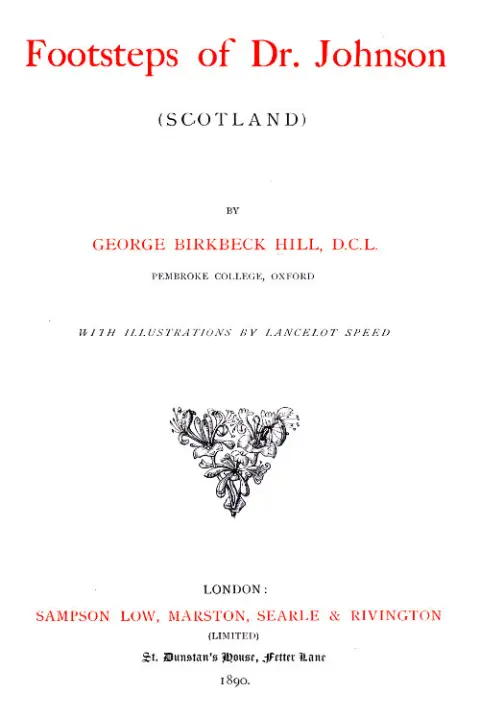
THE CLASSIC COLLECTION · 1890
"Footsteps of Dr. Johnson (Scotland)" by George Birkbeck Hill is a historical account written in the late 19th century. The work focuses on the journey of Dr. Samuel Johnson through Scotland, detailing the various places he visited and the cultural nuances he observed during his travels. The author aims to bring to light the Scotland that Johnson experienced, emphasizing the social customs and traditions rather than the scenic beauty of the landscape. At the start of the book, the author explains his motivation for writing, sparked by his desire to document the sites associated with Johnson's travels as described in his letters and travel journals. Hill notes the existence of multiple accounts of Johnson's journey, including those by Boswell, and expresses his intention to weave these narratives into a cohesive account that honors the daily life and customs of the people Johnson encountered. The opening also hints at the fondness Johnson had for anecdotes and the rich traditions surrounding his legacy in Scotland, establishing a groundwork for exploring both Johnson's perspectives and the landscape he traversed.
Introduction adapted from the source catalogue; source summaries may be automatically generated.
Free to read · English · 123,782 words · No account needed
MAKE TIME FOR A GOOD BOOK
On by default. Untick to stop anonymous reading totals. Each page counts after 10 seconds in view. How this works.
Anonymous counting is on unless you have switched it off.
M’Nicol is ingenious in his treatment of the great Ossian controversy. “The poems,” he says, “must be the production either of Ossian or Mr. Macpherson. Dr. Johnson does not vouchsafe to tell us who else was the author, and consequently the national claim remains perfectly entire. The moment Mr. Macpherson ceases to be admitted as a translator, he instantly acquires a title to the original.”[43] Granted that he was a ruffian who had tried by menaces to hinder the detection of a cheat. What of that? He was a great original ruffian, and his cheat was a work of great original genius. So that Caledonia, if she had one forger the more, had not one poet the less. She made up in genius what she lost in character. But this Dr. Johnson failed to see, being, poor man, “naturally pompous and vain, and ridiculously ambitious of an exclusive reputation in letters.” It must have been this same pomposity, vanity, and ambition which led him to say of these poems: “Sir, a man might write such stuff for ever, if he would abandon his mind to it.”[44]
That Johnson’s narrative should have roused resentment is not surprising. Even his friend Beattie, “much as he loved and revered him,” yet found in it “some asperities that seem to be the effect of national prejudice.”[45] That “this true-born Englishman,” as Boswell delights to call him, should have given a wholly unprejudiced account of any country not his own was an impossibility. As regards Scotland, the position which he took certainly admitted of justification. “When I find,” he said, “a Scotchman to whom an Englishman is as a Scotchman, that Scotchman shall be as an Englishman to me.”[46] Boswell, and perhaps Boswell alone, exactly answered this requirement, and the two men were fast friends. For many other Scotchmen, indeed, he had strong feelings of regard, and even of friendship—for Andrew Millar the bookseller, for William Strahan the printer, for Blair, Beattie, John Campbell, Hailes, and Robertson, among authors, and for his poor assistants in the great work of his Dictionary, who all came from across the Tweed. There was no want of individual affection, no John Bull disinclination that had to be overcome in the case of each fresh acquaintance which he made. His “was a prejudice of the head and not of the heart.”[47] He held that the Scotch, with that clannishness which is found in almost equal strength in the outlying parts of the whole island, in Cornwall and in Cumberland, achieved for themselves in England “a success which rather exceeded the due proportion of their real merit.”[48] Jesting with a friend from Ireland, who feared “he might treat the people of that country more unfavourably than he had done the Scotch,” he answered, “Sir, you have no reason to be afraid of me. The Irish are not in a conspiracy to cheat the world by false representations of the merits of their countrymen. No, Sir: the Irish are a fair people;—they never speak well of one another.”[49] To Boswell he began a letter, not meant, of course, for the public eye, by saying: “Knowing as you do the disposition of your countrymen to tell lies in favour of each other.”[50] When he came to write his Journey, he was led neither by timidity nor false delicacy to conceal what he thought. He attacks that “national combination so invidious that their friends cannot defend it,” which is one of the means whereby Scotchmen “find, or make their way to employment, riches, and distinction.”[51] He upbraids that “vigilance of jealousy which never goes to sleep,”[52] which sometimes led them to cross the borders of boastfulness and pass into falsehood, when Caledonia was their subject and Englishmen their audience. “A Scotchman,” he writes, “must be a very sturdy moralist who does not love Scotland better than truth; he will always love it better than inquiry.”[53] Even in his talk when among Scotchmen he was inclined “to expatiate rather too strongly upon the benefits derived to their country from the Union.”[54] “‘We have taught you,’ said he, ‘and we’ll do the same in time to all barbarous nations, to the Cherokees, and at last to the Ouran-Outangs,’ laughing with as much glee as if Monboddo had been present. BOSWELL. ‘We had wine before the Union.’ JOHNSON. ‘No, Sir; you had some weak stuff, the refuse of France, which would not make you drunk.’ BOSWELL. ‘I assure you, Sir, there was a great deal of drunkenness.’ JOHNSON. ‘No, Sir; there were people who died of dropsies, which they contracted in trying to get drunk.’”[55]
Your reading position is saved on this browser. Take it to another device with a library code. Reading pages adapt to text, rather than matching a printed edition.
BEHIND THE BOOK
This eBook is for the use of anyone anywhere in the United States and most other parts of the world at no cost and with almost no restrictions whatsoever. You may copy it, give it away or re-use it under the terms of the Project Gutenberg License included with this eBook or online at www.gutenberg.org. If you are not located in the United States, you will have to check the laws of the country where you are located before using this eBook. Read the source licence.
The original source file, including credits and licence, is retained by this library. Request an original-format copy at no charge. Please include the book title and Project Gutenberg identifier #57715.
KEEP YOUR CURIOSITY GOING
Wilfrid Scawen Blunt
Wilfrid Scawen Blunt

E. W. (Edgar Watson) Howe
Cécile Tormay

Moritz Busch
John L. Ransom