THE CLASSIC COLLECTION✦My diaries, being a personal narrative of events 1888-1914, Part 2 (1900-1914)CLASSIC FREE BOOKS
My diaries, being a personal narrative of events 1888-1914, Part 2 (1900-1914)
Wilfrid Scawen Blunt
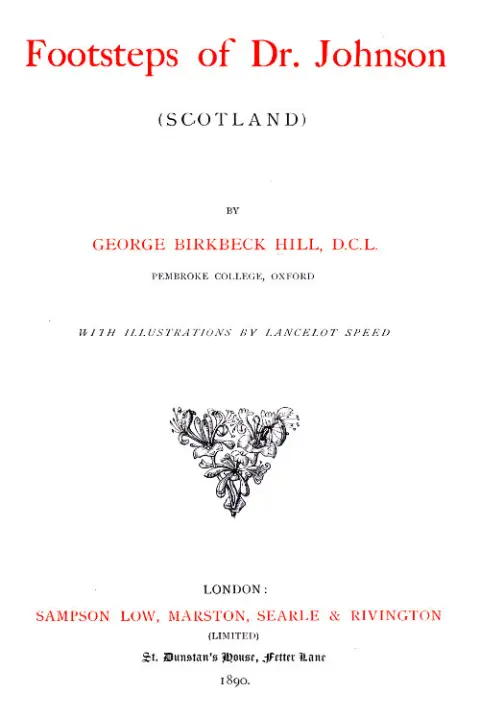
THE CLASSIC COLLECTION · 1890
"Footsteps of Dr. Johnson (Scotland)" by George Birkbeck Hill is a historical account written in the late 19th century. The work focuses on the journey of Dr. Samuel Johnson through Scotland, detailing the various places he visited and the cultural nuances he observed during his travels. The author aims to bring to light the Scotland that Johnson experienced, emphasizing the social customs and traditions rather than the scenic beauty of the landscape. At the start of the book, the author explains his motivation for writing, sparked by his desire to document the sites associated with Johnson's travels as described in his letters and travel journals. Hill notes the existence of multiple accounts of Johnson's journey, including those by Boswell, and expresses his intention to weave these narratives into a cohesive account that honors the daily life and customs of the people Johnson encountered. The opening also hints at the fondness Johnson had for anecdotes and the rich traditions surrounding his legacy in Scotland, establishing a groundwork for exploring both Johnson's perspectives and the landscape he traversed.
Introduction adapted from the source catalogue; source summaries may be automatically generated.
Free to read · English · 123,782 words · No account needed
MAKE TIME FOR A GOOD BOOK
On by default. Untick to stop anonymous reading totals. Each page counts after 10 seconds in view. How this works.
Anonymous counting is on unless you have switched it off.
While Boswell mentions the mean kirk, with his indifference to natural objects he passes over in silence the celebrated Falls of Fiers or Foyers. He does not even mention the bridge over the river, or the rocks which on three sides of it rise to a great height. Here Johnson’s imagination was deeply impressed, for he describes them as “exhibiting a kind of dreadful magnificence; standing like the barriers of nature placed to keep different orders of being in perpetual separation.” Dismounting from their horses, “we clambered,” he writes, “over very rugged crags, till we came at last to a place where we could overlook the river, and saw a channel torn, as it seems, through black piles of stone, by which the stream is obstructed and broken, till it comes to a very steep descent, of such dreadful depth, that we were naturally inclined to turn aside our eyes. But we visited the place at an unseasonable time, and found it divested of its dignity and terror. Nature never gives everything at once. A long continuance of dry weather, which made the rest of the way easy and delightful, deprived us of the pleasure expected from the Falls of Fiers.” This same month Mason, the poet, was complaining that the cascades at Lodore had been “reduced by the dry season to a scanty rill, which took away more than half the beauties of the scene.”[594]
[Sidenote: FORT AUGUSTUS.]
It was dark when our travellers reached “the wretched inn” at Fort Augustus. Happily it was not in it that they were to lodge, for the governor invited them to sleep in his house. Of the fort, the rebels had made a bonfire on April 15, 1746, the day before Culloden, “to celebrate the Duke of Cumberland’s birthday.”[595] It had since been rebuilt and greatly strengthened, “being surrounded by two trenches filled with water, and having draw-bridges, strong walls, and bastions.”[596] Nothing is left of it. Where rough soldiers once carried things with a high hand, now smooth priests rule. On the site of the old fortifications which bore the second name of the butcher duke has been raised a college and monastery dedicated to St. Benedict. Johnson long remembered the rest which he enjoyed in the governor’s hospitable home. Nearly four years later he recorded in his diary: “I passed the night in such sweet uninterrupted sleep as I have not known since I slept at Fort Augustus.” The following year, writing to Boswell, he said, “The best night that I have had these twenty years was at Fort Augustus.” From this spot to the sea-shore opposite Skye they had about forty-four miles of highland paths to traverse. This part of their journey they were forced to divide very unequally, as Anoch, the only place where they could find entertainment, was scarcely a third of the way. [Sidenote: GLENMORISON.] Crossing the mountains by a road which had been made “with labour that might have broken the perseverance of a Roman legion,” early in the afternoon they came “through a wild country” to Glenmorison.[597] They did not, as the guide-book says, follow the course of the river Moriston from Invermoriston, but joined it some miles higher up, above the fine scenery and the wild tumble of water which are shown in the accompanying sketch. This fact I did not discover till too late. Anoch Johnson describes as “standing in a glen or valley pleasantly watered by a winding river. It consists of three huts, one of which is distinguished by a chimney.” It was in the house thus distinguished that they lodged. When I visited this spot last summer, we halted at a farmhouse hard by to rest our horses and take some lunch. We sat on the bank of a dried-up brook, beneath a row of witch-elms. A cuckoo was flying about, resting now and then on the garden wall. “Its two-fold shout” it scarcely uttered, thinking, perhaps, that as it was the month of June, it would be “heard, not regarded.” The wind rustled in the leaves, the river, blue beneath a blue sky, ran swiftly by, now under a shady bank, and now round a stony foreland, till it lost itself at last from our sight behind a bend. To the west rose lofty mountains; on the other side of the valley were sloping hills. We lunched on frothing milk, oat-cakes, scones, and butter; the sheep dogs playing around us, and with wistful gaze asking for their share of the feast. We lay on the ground and looked across the little ravine at an old hut that was “distinguished by a chimney.” This we all voted, and very likely with truth on our side, was the very place where our travellers had lodged. Talking of “far-off things,” of Johnson and the copy of Cocker’s Arithmetic which he gave to his landlord’s “gentle and pleasing daughter,” of her father’s library of odd volumes, and of the old hut and the old life, an hour slipped quickly and pleasantly by.
Your reading position is saved on this browser. Take it to another device with a library code. Reading pages adapt to text, rather than matching a printed edition.
BEHIND THE BOOK
This eBook is for the use of anyone anywhere in the United States and most other parts of the world at no cost and with almost no restrictions whatsoever. You may copy it, give it away or re-use it under the terms of the Project Gutenberg License included with this eBook or online at www.gutenberg.org. If you are not located in the United States, you will have to check the laws of the country where you are located before using this eBook. Read the source licence.
The original source file, including credits and licence, is retained by this library. Request an original-format copy at no charge. Please include the book title and Project Gutenberg identifier #57715.
KEEP YOUR CURIOSITY GOING
Wilfrid Scawen Blunt
Wilfrid Scawen Blunt

E. W. (Edgar Watson) Howe
Cécile Tormay

Moritz Busch
John L. Ransom