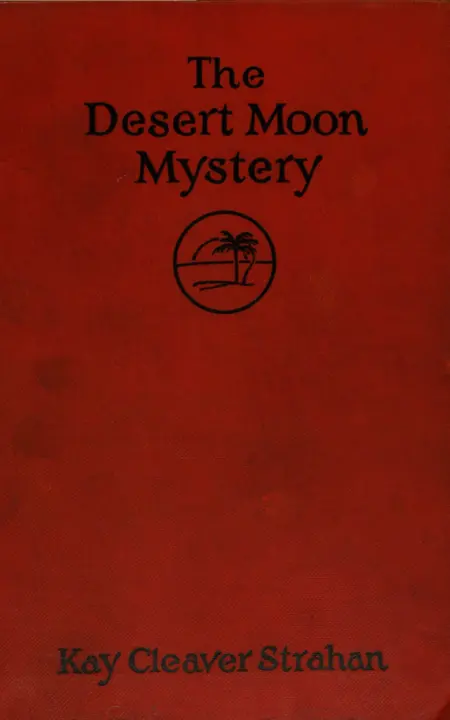
The Desert Moon mystery
Kay Cleaver Strahan
THE CLASSIC COLLECTION · 1928
"Footprints" by Kay Cleaver Strahan is a novel written in the late 1920s. The story revolves around Judith Quilter Whitefield, a widow and member of a prominent family in Oregon, who struggles with family secrets and past traumas as she navigates her relationships. The novel begins with Judith’s arrival at a hotel, where she is introduced to the dynamics of upper-class society, revealing her past and the enigmatic troubles surrounding her family. The opening of the novel introduces readers to Judith as she ventures through the hotel lobby and prepares to meet her brother, Neal Quilter. This initial glimpse establishes a complex familial backdrop, with hints of past tragedies, particularly the unresolved murder of Judith and Neal’s father, Richard Quilter. Neal's psychological struggles surface early on, leading to a gripping dialogue where he confesses to feeling guilty over their father's death. Their interactions blend elements of intrigue and emotional depth, indicating that the narrative will tackle themes of guilt, family loyalty, and the burden of past actions. The stage is set for a story that interweaves mystery and introspection as Judith seeks to understand her family's legacy while grappling with Neal's troubling revelations.
Introduction adapted from the source catalogue; source summaries may be automatically generated.
Free to read · English · 86,914 words · No account needed
MAKE TIME FOR A GOOD BOOK
On by default. Untick to stop anonymous reading totals. Each page counts after 10 seconds in view. How this works.
Anonymous counting is on unless you have switched it off.
Perhaps it wasn’t a trial. But it came too close to being one to suit me. Though, in another way, a real trial might have been better. Right at the beginning, if Mr. Ward could have defended Irene, it would, at least, have carried the enormous advantage of straight dealing. He couldn’t defend Irene, because no one had accused her. What he was fighting was the accusation. But he had to hide even that.
He played the rope, which the fiend had been afraid to use, and the weapon that the fiend had carried away with him, hard and fast. The trouble, or the chief trouble was, I think, that he did not believe in them himself.
Thopson chivied Irene, next, on what he called “the victim’s last
words.”
Irene had told that Father had said, “Got away,” and then, “Red mask.”
“You think the victim meant to indicate that some person, wearing a
red mask, had got away?”
“I don’t know what the words indicated. I only know that he said
them.”
“You have, perhaps, thought of some other meaning that the words were
meant to convey?”
“No, I have not.”
“You have given the matter no thought whatever?”
Mr. Ward stopped that. He asked whether the purpose of this investigation was to discover the facts of the case or to allow Mr. Thopson to torture a grief-stricken lady. He said that, clearly, Richard Quilter’s last words had meant to indicate that the man who had murdered him had been masked, and had escaped. Knowing, Mr. Ward said, that the family’s chief future concern would be to apprehend the fiend who had committed this heinous crime, Richard Quilter had, in spite of the fact that he was a dying man, done his best to aid his dear ones with the frightful task which he knew, even then, would soon devolve upon them. “His duty, first, gentlemen, though Richard Quilter performed it from the edge of the grave. Duty done, he called for his children, for his aged father——” On and on. But Ward was no fool. Remember, Judy, the men who were on the jury. Ward was merely heating his wind for the shorn lambs, as it were; or, at least, that was the way I sized him up.
Thopson asked Mr. Ward, directly, if he thought that red masks were the customary apparel for murderers.
Mr. Ward said, “Dying men don’t lie, Mr. Thopson.”
Thopson said, “No. Dying men do not.”
But I think that went high over the heads of the jury.
Thopson then began on the keys. How had Irene happened to see them
there on the table?
Your reading position is saved on this browser. Take it to another device with a library code. Reading pages adapt to text, rather than matching a printed edition.
Kay Cleaver Strahan
BEHIND THE BOOK
This eBook is for the use of anyone anywhere in the United States and most other parts of the world at no cost and with almost no restrictions whatsoever. You may copy it, give it away or re-use it under the terms of the Project Gutenberg License included with this eBook or online at www.gutenberg.org. If you are not located in the United States, you will have to check the laws of the country where you are located before using this eBook. Read the source licence.
The original source file, including credits and licence, is retained by this library. Request an original-format copy at no charge. Please include the book title and Project Gutenberg identifier #75577.
KEEP YOUR CURIOSITY GOING
Coulson Kernahan

Maurice Baring
Frances Wright
Cécile Tormay

Frederic Jesup Stimson

W. H. P. (William Henry Pope) Jarvis