THE CLASSIC COLLECTION✦An outlaw’s diary: the CommuneCLASSIC FREE BOOKS
An outlaw’s diary: the Commune
Cécile Tormay
THE CLASSIC COLLECTION · 1906
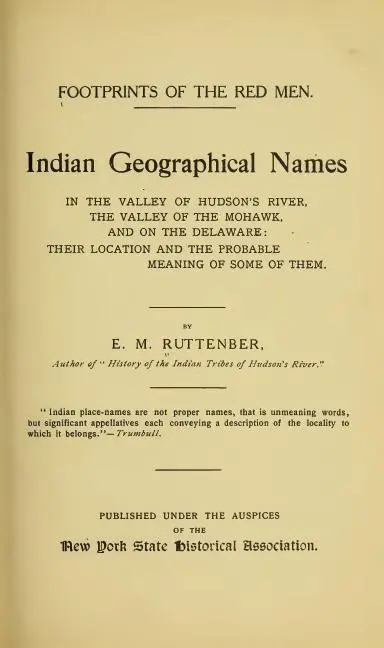
"Footprints of the Red Men" by Edward Manning Ruttenber is a historical account written in the early 20th century. This work delves into Indian geographical names found in the Hudson River valley, the Mohawk valley, and on the Delaware, exploring their locations and meanings. The book aims to preserve and elucidate the significance of these names, which reveal insights into the geography, history, and culture of the indigenous peoples who inhabited these regions. The opening of the book lays the groundwork by emphasizing the importance of Indian geographical names as descriptive and significant rather than mere arbitrary labels. Ruttenber discusses the inconsistencies in the recording and understanding of these names due to variations in dialects, spelling by early European settlers, and the loss of original meanings over time. He intends to investigate the original meanings and connections of these names to the features of the land they described, ultimately suggesting that they can offer a richer understanding of the natural world and historical context from the perspective of the indigenous tribes.
Introduction adapted from the source catalogue; source summaries may be automatically generated.
Free to read · English · 94,341 words · No account needed
MAKE TIME FOR A GOOD BOOK
On by default. Untick to stop anonymous reading totals. Each page counts after 10 seconds in view. How this works.
Anonymous counting is on unless you have switched it off.
Rapahamuck, a neck or point of land so called, is from Appé-amuck, "Trap fishing-place." (Tooker.) The name is assigned to the mouth of Birch Creek. (See Suggamuck.)
Memanusack and Memanusuk, given as the name of Stony Brook, probably has its locative "At the head of the middle branch of Stony Brook," Which formed the boundmark noted in the Indian deed. The same name is probably met in Mayomansuk, from Mawé, meaning "To bring together," "To meet"; and -suck, "Outlet," i. e. of a pond, marsh or river. The brook was "stony" no doubt, but that description is English.
Cussqunsuck is noted as the name of Stony Brook referred to in Memanusack. The stream is probably the outlet of the waters of a swamp. In his will Richard Smith wrote: "I give to my daughter Sarah, 130 acres of land at the two swamps called Cutts-cunsuck." The first word seems to stand for Ksúcqon, "Heavy" (Zeisb.), by metonymie, "Stone," -es, "Small," and -uck, locative, "Place of small stone." Ksúcqon may be employed as an adjectival prefix. Eliot wrote, "Qussukquemin, Stone fruit," the cherry.
Mespaechtes, deed to Governor Keift, 1638, from which Mespath (Brodhead), Mespat (Riker), Mashpeth and Mashpett (Co. Hist. N. Y., xiv, 602), now Maspeth, a village in Newtown, Queens County, and met in application to Newtown Creek (Col. Hist. N. Y., xiii, 25), has been translated by Dr. Tooker, "From Mech-pe-is-it, Bad-water place," and by Wm. R. Gerard, "From Massapichtit, verbal describing scattered settlements, as though the Indians who sold the lands had said, 'We include the lands of those living here and there.'" [FN] Flint, in his "Early History of Long Island," wrote: "Mespat Kills, now Maspeth, from the Indian Matsepe, written by the Dutch, Maespaatches Kiletje"--long known as "Dutch Kills." In patent of 1642, for lands described as lying "on the east side of Mespatches Kil," the boundary is stated: "Beginning at the kil and the tree standing upon the point towards the small kil." Obviously there were two streams here, the largest called Mespatches, which seems to be, as Flint states, a Dutch rendering of Matsepe-es, from Mas (Del. Mech), a comparative term--"great," as distinguished from "small," the largest of two, and Sepees (Sepoûs, Sepuus), "a brook." Sepe, Sipo, Sipu, etc., is generally applied to a long stream. The west branch of Mespatt Kill has the record name of Quandoequareus. Flint wrote: "The Canapauke, or Dutch Kills, sluggishly winding its way through the meadows of bronzed grasses." Canapauke stands for Quana-pe-auke, "Long water-land," or "Land on the long water." The stream is a tidal current receiving several small streams. (See Massepe.) Mespatches seems to belong to the stream noted in patent of 1642.
Your reading position is saved on this browser. Take it to another device with a library code. Reading pages adapt to text, rather than matching a printed edition.
BEHIND THE BOOK
This eBook is for the use of anyone anywhere in the United States and most other parts of the world at no cost and with almost no restrictions whatsoever. You may copy it, give it away or re-use it under the terms of the Project Gutenberg License included with this eBook or online at www.gutenberg.org. If you are not located in the United States, you will have to check the laws of the country where you are located before using this eBook. Read the source licence.
The original source file, including credits and licence, is retained by this library. Request an original-format copy at no charge. Please include the book title and Project Gutenberg identifier #51217.
KEEP YOUR CURIOSITY GOING
Cécile Tormay

Moritz Busch
John L. Ransom
Frances Wright
Cécile Tormay

Mabel Potter Daggett