THE CLASSIC COLLECTION✦An outlaw’s diary: the CommuneCLASSIC FREE BOOKS
An outlaw’s diary: the Commune
Cécile Tormay
THE CLASSIC COLLECTION · 1906
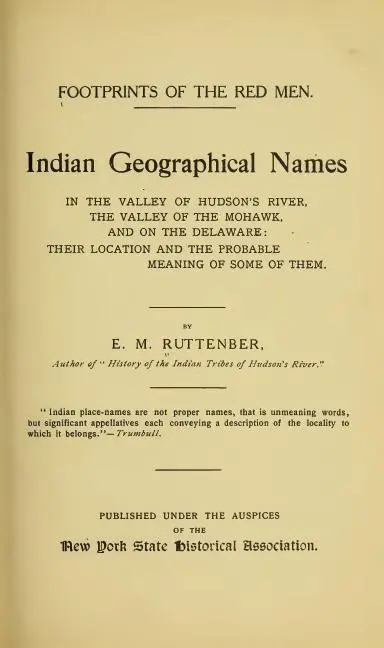
"Footprints of the Red Men" by Edward Manning Ruttenber is a historical account written in the early 20th century. This work delves into Indian geographical names found in the Hudson River valley, the Mohawk valley, and on the Delaware, exploring their locations and meanings. The book aims to preserve and elucidate the significance of these names, which reveal insights into the geography, history, and culture of the indigenous peoples who inhabited these regions. The opening of the book lays the groundwork by emphasizing the importance of Indian geographical names as descriptive and significant rather than mere arbitrary labels. Ruttenber discusses the inconsistencies in the recording and understanding of these names due to variations in dialects, spelling by early European settlers, and the loss of original meanings over time. He intends to investigate the original meanings and connections of these names to the features of the land they described, ultimately suggesting that they can offer a richer understanding of the natural world and historical context from the perspective of the indigenous tribes.
Introduction adapted from the source catalogue; source summaries may be automatically generated.
Free to read · English · 94,341 words · No account needed
MAKE TIME FOR A GOOD BOOK
On by default. Untick to stop anonymous reading totals. Each page counts after 10 seconds in view. How this works.
Anonymous counting is on unless you have switched it off.
[FN-1] "Meteauhock, the Periwinkle of which they made their wampum." (Williams.) "Perhaps derived from Mehtauog, 'Ear-shaped,' with the generic suffix hock (hogki, hackee), 'shell.'" (Trumbull.)
[FN-2] Wompompeag is another form quoted as Mohegan, from which Wompum. "Wompom, which signifies white." (Roger Williams.)
[FN-3] Seahwhoog, "they are scattered." (Eliot.) "From this word the Dutch traders gave the name of Sewan, or Zeawand, to all shell money; just as the English called all Peag, or strung beads, by the name of the white, Wampum." (Trumbull.)
[FN-4] An interpretation of Paumanack as indicating a people especially under tribute, is erroneous. The belts which they made were in universal use among the nations as an offering, the white belts denoting good, as peace, friendship, etc., the black, the reverse. The ruling sachem, or peace-chief, was the keeper and interpreter of the belts of his nation, and his place sometimes took its name from that fact. That several of the sachems did sign their names, or that their names were signed by some one for them, "Sachem of Pammananuck," proves nothing in regard to the application of that name to the island.
Wompenanit is of record as the name of "the utmost end eastward" of the Montauk Peninsula. The description reads: "From the utmost end of the neck eastward, called Wompenanit, to our utmost bound westward, called Napeake." (Deed of July 11, 1661.) In other papers Wompenonot and Wompenomon, corrupted orthographies. The meaning is "The utmost end eastward," i. e. from the east side of Napeake to the extreme end. The derivatives are Nar. Wompan (from Wompi, white, bright), "It is full daylight, bright day," hence the Orient, the East, the place of light, and -anit, "To be more than," extending beyond the ordinary limit. The same word appears in Wompanánd, "The Eastern God" (Williams), the deity of light. From Wompi, also Wapan in Wapanachkik, "Those of the eastern region," now written Abanaqui and Abnaki, and confined to the remnant of a tribe in Maine. (See Wahamanesing,) Dr. Trumbull wrote: "Anit, the subjunctive participle of a verb which signifies 'To be more than,' 'to surpass'"; with impersonal M prefixed, Manit, as in Manitou, a name given by the Indians, writes Lahontan, "To all that passes their understanding"; hence interpreted by Europeans, "God." It has no such meaning in Wompenanit, but defined a limit that was "more than," or the extreme limits of the island. No doubt, however, the Indians saw, as do visitors of to-day, at the utmost end of the Montauk Peninsula, in its breast of rock against which the ocean-waves dash with fearful force; its glittering sun-light and in its general features, a Wompanánd, or Eastern God, that which was "more than ordinary, wonderful, surpassing," but those features are not referred to in Wompenanit, except, perhaps, as represented by the glittering sun-light, the material emblem of the mystery of light--"where day-light appears."
Your reading position is saved on this browser. Take it to another device with a library code. Reading pages adapt to text, rather than matching a printed edition.
BEHIND THE BOOK
This eBook is for the use of anyone anywhere in the United States and most other parts of the world at no cost and with almost no restrictions whatsoever. You may copy it, give it away or re-use it under the terms of the Project Gutenberg License included with this eBook or online at www.gutenberg.org. If you are not located in the United States, you will have to check the laws of the country where you are located before using this eBook. Read the source licence.
The original source file, including credits and licence, is retained by this library. Request an original-format copy at no charge. Please include the book title and Project Gutenberg identifier #51217.
KEEP YOUR CURIOSITY GOING
Cécile Tormay

Moritz Busch
John L. Ransom
Frances Wright
Cécile Tormay

Mabel Potter Daggett