THE CLASSIC COLLECTION✦An outlaw’s diary: the CommuneCLASSIC FREE BOOKS
An outlaw’s diary: the Commune
Cécile Tormay
THE CLASSIC COLLECTION · 1906
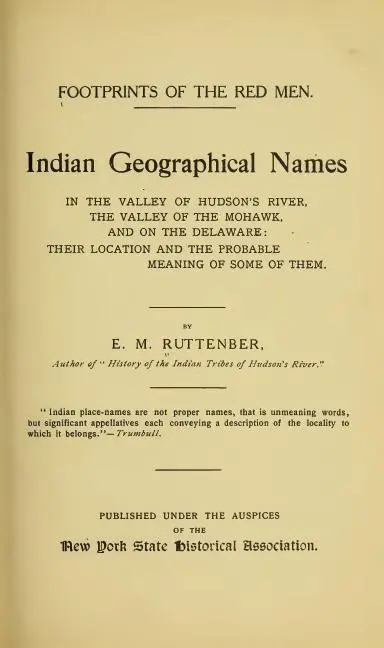
"Footprints of the Red Men" by Edward Manning Ruttenber is a historical account written in the early 20th century. This work delves into Indian geographical names found in the Hudson River valley, the Mohawk valley, and on the Delaware, exploring their locations and meanings. The book aims to preserve and elucidate the significance of these names, which reveal insights into the geography, history, and culture of the indigenous peoples who inhabited these regions. The opening of the book lays the groundwork by emphasizing the importance of Indian geographical names as descriptive and significant rather than mere arbitrary labels. Ruttenber discusses the inconsistencies in the recording and understanding of these names due to variations in dialects, spelling by early European settlers, and the loss of original meanings over time. He intends to investigate the original meanings and connections of these names to the features of the land they described, ultimately suggesting that they can offer a richer understanding of the natural world and historical context from the perspective of the indigenous tribes.
Introduction adapted from the source catalogue; source summaries may be automatically generated.
Free to read · English · 94,341 words · No account needed
MAKE TIME FOR A GOOD BOOK
On by default. Untick to stop anonymous reading totals. Each page counts after 10 seconds in view. How this works.
Anonymous counting is on unless you have switched it off.
[FN] The root of the name is Peske or Piske (Paske, Zeisb.), meaning, primarily, "To split," "To divide forcibly or abruptly." (Trumbull.) In Abnaki, Peskétekwa, a "divided tidal or broad river or estuary"--Peskahakan (Rale), "branche." In the Delaware, Zeisberger wrote Pasketiwi, "The division or branch of a stream." Pascataway, Md., is an equivalent form. Pasgatikook, Greene County, is from the Mohegan form. Paghataghan and Pachkataken, on the east branch of the Delaware, and Paghatagkam on the Otterkill, Vt., are equivalent forms of Peskahakan, Abnaki. The Hoosick is not only a principal branch, but it is divided at its mouth and at times presents the appearance of running north in the morning and south at night. (Fitch's Surv.)
Quequick and Quequicke are orthographies of the name of a certain fall on Hoosick River, in Rensselaer County. In petition of Maria van Rensselaer, in 1684, the lands applied for were described as "Lying on both sides of a certain creek called Hoosock, beginning at ye bounds of Schaakook, and so to a fall called Quequick, and thence upward to a place called Nachacqikquat." (Cal. Land Papers, 27.) The name may stand for Cochik'uack (Moh.), "Wild, dashing" waters, but I cannot make anything out of it. The first fall east of Schaakook (Schagticoke) Patent is now known as Valley Falls, in the town of Pittstown (Pittstown Station).
Pahhaoke, a local name in Hoosick Valley, is probably an equivalent of Pauqna-ohke, "Clear land," "open country." It is frequently met in Connecticut in different forms, as in Pahqui-oke, Paquiag, etc., the name of Danbury Plains. The form here is said to be from the Stockbridge dialect, but it is simply an orthography of an English scribe. It has no relation whatever to the familiar Schaghticoke or Scat'acook.
Panhoosick, so written in Indian deed to Van Rensselaer in 1652, for a tract of land lying north and east of the present city of Troy, extending north to nearly opposite Kahoes Falls and east including a considerable section of Hoosick River, appears in later records as an apheresis in Hoosick, Hoosack, and Hoosuck, in application to Hoosick River, Hoosick Mountains, Hoosick Valley, Hoosick Falls, and in "Dutch Hossuck," an early settlement described in petition of Hendrick van Ness and others, in 1704, as "land granted to them by Governor Dongan in 1688, known by the Indian name of Hoosack." (Cal. N. Y. Land Papers, 27, 74.) The head of the stream appears to have been the outlet of a lake now called Pontoosuc from the name of a certain fall on its outlet called Pontoosuck, "A corruption," wrote Dr. Trumbull, "of Powntucksuck, 'falls of a brook,' or outlet." "Powntuck, a general name for all falls," according to Indian testimony quoted by the same writer. "Pantuck, falls of a stream." (Zeisb.) Several interpretations of the name have been suggested, of which the most probably correct is from Massachusetts Pontoosuck, which would readily be converted to Hoosick or Panhoosick (Pontoosuck). It was applicable to any falls, and may have had locative at Hoosick Falls as well as on the outlet of Pontoosuck Lake. Without examination or warrant from the local dialect, Heckewelder wrote in his Lenape tradition, "The Hairless or Naked Bear": "Hoosink, which means the basin, or more properly, the kettle." The Lenape or Delaware Hōōs, "certainly means, in that dialect, 'a pot or kettle.' Figuratively, it might be applied to a kettle-shaped depression in land or to a particular valley. Hoosink means 'in' or 'at' the pot or kettle. Hoosack might be read 'round valley land,' or land with steep sides." (Brinton.) Of course this does not explain the prefix Pan, nor does it prove that Hōōs was in the local dialect, which, in 1652, was certainly Mahican or Mohegan. Still, it cannot be said that the tradition was not familiar to all Algonquians in their mythical lore.
Your reading position is saved on this browser. Take it to another device with a library code. Reading pages adapt to text, rather than matching a printed edition.
BEHIND THE BOOK
This eBook is for the use of anyone anywhere in the United States and most other parts of the world at no cost and with almost no restrictions whatsoever. You may copy it, give it away or re-use it under the terms of the Project Gutenberg License included with this eBook or online at www.gutenberg.org. If you are not located in the United States, you will have to check the laws of the country where you are located before using this eBook. Read the source licence.
The original source file, including credits and licence, is retained by this library. Request an original-format copy at no charge. Please include the book title and Project Gutenberg identifier #51217.
KEEP YOUR CURIOSITY GOING
Cécile Tormay

Moritz Busch
John L. Ransom
Frances Wright
Cécile Tormay

Mabel Potter Daggett