THE CLASSIC COLLECTION✦An outlaw’s diary: the CommuneCLASSIC FREE BOOKS
An outlaw’s diary: the Commune
Cécile Tormay
THE CLASSIC COLLECTION · 1906
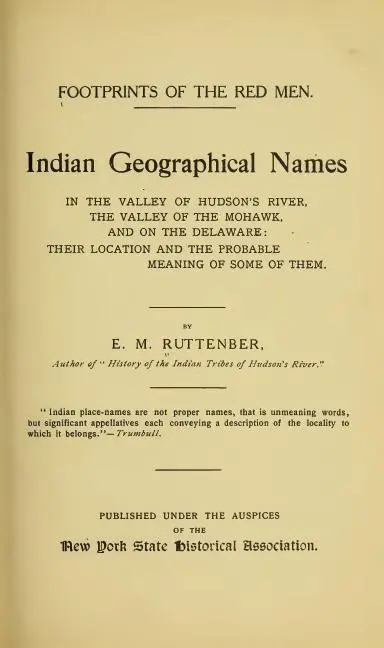
"Footprints of the Red Men" by Edward Manning Ruttenber is a historical account written in the early 20th century. This work delves into Indian geographical names found in the Hudson River valley, the Mohawk valley, and on the Delaware, exploring their locations and meanings. The book aims to preserve and elucidate the significance of these names, which reveal insights into the geography, history, and culture of the indigenous peoples who inhabited these regions. The opening of the book lays the groundwork by emphasizing the importance of Indian geographical names as descriptive and significant rather than mere arbitrary labels. Ruttenber discusses the inconsistencies in the recording and understanding of these names due to variations in dialects, spelling by early European settlers, and the loss of original meanings over time. He intends to investigate the original meanings and connections of these names to the features of the land they described, ultimately suggesting that they can offer a richer understanding of the natural world and historical context from the perspective of the indigenous tribes.
Introduction adapted from the source catalogue; source summaries may be automatically generated.
Free to read · English · 94,341 words · No account needed
MAKE TIME FOR A GOOD BOOK
On by default. Untick to stop anonymous reading totals. Each page counts after 10 seconds in view. How this works.
Anonymous counting is on unless you have switched it off.
Mahaskakook, a boundmark in the Livingston Patent, is described, in one entry, as "A copse," i. e. "A thicket of underbrush," and in another entry, "A cripple bush," i. e. "A patch of low timber growth"--Dutch, Kreupelbosch, "Underwood." Probably the Indian name has, substantially, the same moaning. Manask (Del.), "Second crop"; -ask, "Green, raw, immature"; -ak, "wood"; -ook (ûk), locative. The location has not been ascertained.
Nachawawakkano, given as the name of a creek described as a "creek which comes into another creek," is an equivalent of Léchau-wakhaune (Lenape), "The fork of a river," a stream that forks another stream. Aupaumut, the Stockbridge Historian, wrote, with locative suffix, Naukhuwwhnauk, "At the fork of the streams."
Mawichnauk--"the place where the two streams meet being called Mawichnauk"--means "The fork place," or place where the Nachawawakkano and the Tawastaweka came together, or where the streams meet or flow together. In the Bayard Patent the name is written Mawighanuck and Wawieghanuck. (See Wawighanuck.)
Shaupook and Skaukook are forms of the name assigned to the eastern division of a stream, "which, a little lower down," was "called Twastawekah," known later as Claverack Creek. It may be translated from Sóhk, Mass., "outlet," and ûk, locative, "At the outlet" or mouth of the stream.
Twastawekah and Tawastawekah, given, in the Livingston Patent, as the name of Claverack Creek, is described as a place that was below Shaukook, The root is Tawa, an "open space," and the name apparently an equivalent of Lenape Tawatawikunk, "At an open place," or an uninhabited place, a wilderness. Tauwata-wique-ak, "A place in the wilderness." (Gerard.)
Sahkaqua, "the south end of a small piece of land called Sahkaqua and Nakawaewick"; "to a run of water on ye east end of a certain flat or piece of land called in ye Indian tongue, Sahkahka; then south . . . one hundred and forty rods to . . . where two runs of water come together on the south side of the said flat; then west . . . to a rock or great stone on the south corner of another flat or piece of low land called by the Indians Nakaowasick." (Doc. Hist., iii, 697.) On the surveyor's map Nakaowasick, the place last named, is changed to Acawanuk. From the text, Sahkaqua described "Land or place at the outlet or mouth of a stream," from Sóhk, "outlet," and -ohke, "land" or place. The second name Nakawaewick (Nakaouaewik, Nakawasick, Acawasik) is probably from Nashauewasuck, "At (or on) a place between," i. e. between the streams spoken of.
Your reading position is saved on this browser. Take it to another device with a library code. Reading pages adapt to text, rather than matching a printed edition.
BEHIND THE BOOK
This eBook is for the use of anyone anywhere in the United States and most other parts of the world at no cost and with almost no restrictions whatsoever. You may copy it, give it away or re-use it under the terms of the Project Gutenberg License included with this eBook or online at www.gutenberg.org. If you are not located in the United States, you will have to check the laws of the country where you are located before using this eBook. Read the source licence.
The original source file, including credits and licence, is retained by this library. Request an original-format copy at no charge. Please include the book title and Project Gutenberg identifier #51217.
KEEP YOUR CURIOSITY GOING
Cécile Tormay

Moritz Busch
John L. Ransom
Frances Wright
Cécile Tormay

Mabel Potter Daggett