THE CLASSIC COLLECTION✦An outlaw’s diary: the CommuneCLASSIC FREE BOOKS
An outlaw’s diary: the Commune
Cécile Tormay
THE CLASSIC COLLECTION · 1906
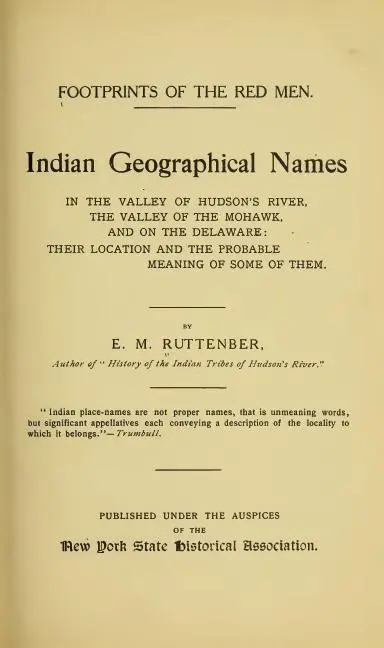
"Footprints of the Red Men" by Edward Manning Ruttenber is a historical account written in the early 20th century. This work delves into Indian geographical names found in the Hudson River valley, the Mohawk valley, and on the Delaware, exploring their locations and meanings. The book aims to preserve and elucidate the significance of these names, which reveal insights into the geography, history, and culture of the indigenous peoples who inhabited these regions. The opening of the book lays the groundwork by emphasizing the importance of Indian geographical names as descriptive and significant rather than mere arbitrary labels. Ruttenber discusses the inconsistencies in the recording and understanding of these names due to variations in dialects, spelling by early European settlers, and the loss of original meanings over time. He intends to investigate the original meanings and connections of these names to the features of the land they described, ultimately suggesting that they can offer a richer understanding of the natural world and historical context from the perspective of the indigenous tribes.
Introduction adapted from the source catalogue; source summaries may be automatically generated.
Free to read · English · 94,341 words · No account needed
MAKE TIME FOR A GOOD BOOK
On by default. Untick to stop anonymous reading totals. Each page counts after 10 seconds in view. How this works.
Anonymous counting is on unless you have switched it off.
Mawenawasigh, so written in the Rombout Patent of 1684, covering lands extending from Wappingers' Creek to the foot of the hills on the north side of Matteawan Creek, was the name of the north boundmark of the patent and not that of Wappingers' Creek. The Indian deed reads: "Beginning on the south side of a creek called Matteawan, from thence northwardly along Hudson's river five hundred yards beyond the Great Wappingers creek or kill, called Mawenawasigh." The stream was given the name of the boundmark and was introduced to identify the place that was five hundred yards north of it, i. e. the rocky point or promontory through which passes the tunnel of the Hudson River R. R. at New Hamburgh. The name is from Mawe, "To meet," and Newásek, [FN] "A point or promontory"--literally, "The promontory where another boundary is met." The assignment of the name to Wappingers' Falls is as erroneous as its assignment to the creek.
[FN] Nawaas, on the Connecticut, noted on the Carte Figurative of 1614-16, is very distinctly located at a point on the head-waters of that river.
Neversink is a corruption of Newas-ink, "At the point or promontory."
Wahamanesing is noted by Brodhead (Hist. N. Y.) as the name of Wappingers' Creek--authority not cited and place where the stream was so called not ascertained. The initial W was probably exchanged for M by mishearing, as it was in many cases of record. Mah means "To meet," Amhannes means "A small river," and the suffix -ing is locative. The composition reads: "A place where streams come together," which may have been on the Hudson at the mouth of the creek. In Philadelphia Moyamansing was the name of a marsh bounded by four small streams. (N. Y. Land Papers, 646.) Dr. Trumbull in his "Indian Names on the Connecticut," quoted Mahmansuck (Moh.), in Connecticut, with the explanation, "Where two streams come together." The name was extended to the creek as customary in such cases. The Wahamanesing flows from Stissing Pond, in northern Duchess County, and follows the center of a narrow belt of limestone its entire length of about thirty-five miles southwest to the Hudson, which it reaches in a curve and passes over a picturesque fall of seventy-five feet to an estuary. From early Dutch occupation it has been known or called Wappinck (1645), Wappinges and Wappingers' Kill or creek, taking that name presumably from the clan which was seated upon it of record as "Wappings, Wappinges, Wapans, or Highland Indians." [FN-1] On Van der Donck's map three castles or villages of the clan are located on the south side or south of the creek, indicating the inclusion in the tribal jurisdiction of the lands as far south as the Highlands. From Kregier's Journal of the "Second Esopus War" (1663), it is learned that they had a principal castle in the vicinity of Low Point and that they maintained a crossing-place to Dans Kamer Point. Their name is presumed to have been derived from generic Wapan, "East"--Wapani, "Eastern people" [FN-2]--which could have been properly applied to them as residents on the east side of the river, not "Eastern people" as that term is applied to residents of the more Eastern States, but locally so called by residents on the west side of the Hudson, or by the Delawares as the most eastern nation of their own stock. They were no doubt more or less mixed by association and marriage with their eastern as well as their western neighbors, but were primarily of Lenape or Delaware origin, and related to the Minsi, Monsey or Minisink clans on the west side of the river, though not associated with them in tribal government. [FN-3] Their tribal jurisdiction, aside from that which was immediately local, extended on the east side of the river from Roelof Jansen's Kill (south of opposite to the Catskill) to the sea. At their northern bound they met the tribe known to the Dutch as the Mahicans, a people of eastern origin and dialect, whose eastern limit included the valley of the Housatonic at least, and with them in alliance formed the "Mahican nation" of Dutch history, as stated by King Ninham of the Wappingers, in an affidavit in 1757, and who also stated that the language of the Mahicans was not the same as that of the Wappingers, although he understood the Mahicani. Reduced by early wars with the Dutch around New Amsterdam and by contact with European civilization, they melted away rapidly, many of them finding homes in New Jersey and Pennsylvania, others at Stockbridge, and a remnant living at Fishkill removing thence to Otsiningo, in 1737, as wards of the Senecas. (Col. Hist. N. Y., vii, 153, 158.)
Your reading position is saved on this browser. Take it to another device with a library code. Reading pages adapt to text, rather than matching a printed edition.
BEHIND THE BOOK
This eBook is for the use of anyone anywhere in the United States and most other parts of the world at no cost and with almost no restrictions whatsoever. You may copy it, give it away or re-use it under the terms of the Project Gutenberg License included with this eBook or online at www.gutenberg.org. If you are not located in the United States, you will have to check the laws of the country where you are located before using this eBook. Read the source licence.
The original source file, including credits and licence, is retained by this library. Request an original-format copy at no charge. Please include the book title and Project Gutenberg identifier #51217.
KEEP YOUR CURIOSITY GOING
Cécile Tormay

Moritz Busch
John L. Ransom
Frances Wright
Cécile Tormay

Mabel Potter Daggett