THE CLASSIC COLLECTION✦An outlaw’s diary: the CommuneCLASSIC FREE BOOKS
An outlaw’s diary: the Commune
Cécile Tormay
THE CLASSIC COLLECTION · 1906
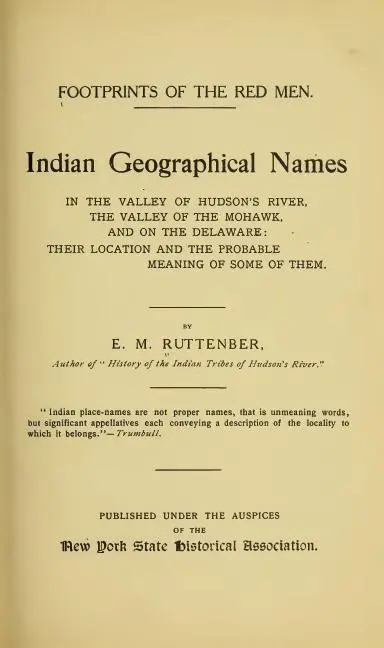
"Footprints of the Red Men" by Edward Manning Ruttenber is a historical account written in the early 20th century. This work delves into Indian geographical names found in the Hudson River valley, the Mohawk valley, and on the Delaware, exploring their locations and meanings. The book aims to preserve and elucidate the significance of these names, which reveal insights into the geography, history, and culture of the indigenous peoples who inhabited these regions. The opening of the book lays the groundwork by emphasizing the importance of Indian geographical names as descriptive and significant rather than mere arbitrary labels. Ruttenber discusses the inconsistencies in the recording and understanding of these names due to variations in dialects, spelling by early European settlers, and the loss of original meanings over time. He intends to investigate the original meanings and connections of these names to the features of the land they described, ultimately suggesting that they can offer a richer understanding of the natural world and historical context from the perspective of the indigenous tribes.
Introduction adapted from the source catalogue; source summaries may be automatically generated.
Free to read · English · 94,341 words · No account needed
MAKE TIME FOR A GOOD BOOK
On by default. Untick to stop anonymous reading totals. Each page counts after 10 seconds in view. How this works.
Anonymous counting is on unless you have switched it off.
In structure all Algonquian dialects are Polysynthetic, i. e., words composed wholly or in part of other words or generic roots. Pronunciations and inflections differ as do the words in meaning in many cases. In all dialects the most simple combinations appear in geographical names, which the late Dr. J. H. Trumbull resolved into three classes, viz.: "I. Those formed by the union of two elements, which we will call adjectival and substantival, or ground-word, with or without a locative suffix, or post-position word meaning 'at,' 'in,' 'on,' 'near,' etc. [I use the terms 'adjectival' and 'substantival,' because no true adjectives or substantives enter into the composition of Algonquian names. The adjectival may be an adverb or a preposition; the substantival element is often a verbal, which serves in composition as a generic name, but which cannot be used as an independent word--the synthesis always retains the verbal form.] II. Those which have a single element, the substantival, or ground-word, with locative suffix. III. Those formed from verbs as participials or verbal nouns, denoting a place where the action of the verb is performed. Most of these latter, however," he adds, "may be shown by strict analysis to belong to one of the two preceding classes, which comprise at least nine-tenths of all Algonquian local names which have been preserved." For example, in Class I, Wapan-aki is a combination of Wapan, "the Orient," "the East," and aki, "Land, place or country," unlimited; with locative suffix (-ng, Del., -it, Mass.), "In the East Land or Country." Kit-ann-ing, Del., is a composition from Kitschi, "Chief, principal, greatest," hanné, "river," and ing locative, and reads, "A place at or on the largest river." The suffix -aki, -acki, -hacki, Del., meaning "Land, place, or country, unlimited," in Eastern orthographies -ohke, -auke, -ague, -ke, -ki, etc., is changed to -kamik, or -kamike, Del., -kamuk or -komuk, Mass., in describing "Land or place limited," or enclosed, a particular place, as a field, garden, and also used for house, thicket, etc. The Eastern post-position locatives are -it, -et, -at, -ut; the Delaware, -ng, -nk, with connecting vowel -ing, -ink, -ong, -onk, -ung, -unk, etc. The meaning of this class of suffixes is the same; they locate a place or object that is at, in, or on some other place or object, the name of Which is prefixed, as in Delaware Hitgunk, "On or to a tree;" Utenink, "In the town;" Wachtschunk, "On the mountain." In some cases the locative takes the verbal form indicating place or country, Williams wrote "Sachimauónck, a Kingdom or Monarchy." Dr. Schoolcraft wrote: "From Ojibwai (Chippeway) is formed Ojib-wain-ong, 'Place of the Chippeways;' Monominikaun-ing, 'In the place of wild rice,'" Dr. Brinton wrote "Walum-ink, 'The place of paint.'" The letter s, preceding the locative, changes the meaning of the latter to near, or something less than at or on. The suffixes -is, -it, -os, -es mean "Small," as in Ménates or Ménatit, "Small island." The locative affix cannot be applied to an animal in the sense of at, in, on, to. There are many formative inflections and suffixes indicating the plural, etc.
Your reading position is saved on this browser. Take it to another device with a library code. Reading pages adapt to text, rather than matching a printed edition.
BEHIND THE BOOK
This eBook is for the use of anyone anywhere in the United States and most other parts of the world at no cost and with almost no restrictions whatsoever. You may copy it, give it away or re-use it under the terms of the Project Gutenberg License included with this eBook or online at www.gutenberg.org. If you are not located in the United States, you will have to check the laws of the country where you are located before using this eBook. Read the source licence.
The original source file, including credits and licence, is retained by this library. Request an original-format copy at no charge. Please include the book title and Project Gutenberg identifier #51217.
KEEP YOUR CURIOSITY GOING
Cécile Tormay

Moritz Busch
John L. Ransom
Frances Wright
Cécile Tormay

Mabel Potter Daggett