THE CLASSIC COLLECTION✦An outlaw’s diary: the CommuneCLASSIC FREE BOOKS
An outlaw’s diary: the Commune
Cécile Tormay
THE CLASSIC COLLECTION · 1906
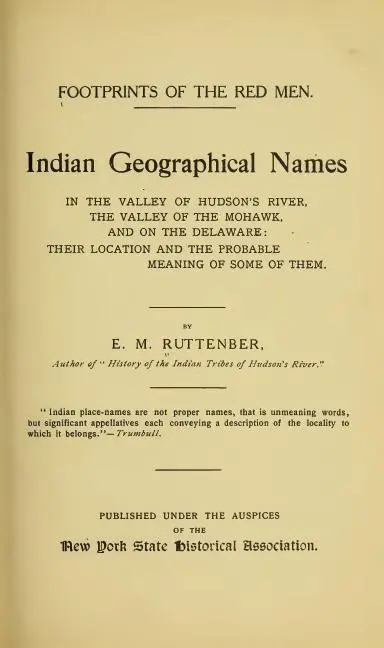
"Footprints of the Red Men" by Edward Manning Ruttenber is a historical account written in the early 20th century. This work delves into Indian geographical names found in the Hudson River valley, the Mohawk valley, and on the Delaware, exploring their locations and meanings. The book aims to preserve and elucidate the significance of these names, which reveal insights into the geography, history, and culture of the indigenous peoples who inhabited these regions. The opening of the book lays the groundwork by emphasizing the importance of Indian geographical names as descriptive and significant rather than mere arbitrary labels. Ruttenber discusses the inconsistencies in the recording and understanding of these names due to variations in dialects, spelling by early European settlers, and the loss of original meanings over time. He intends to investigate the original meanings and connections of these names to the features of the land they described, ultimately suggesting that they can offer a richer understanding of the natural world and historical context from the perspective of the indigenous tribes.
Introduction adapted from the source catalogue; source summaries may be automatically generated.
Free to read · English · 94,341 words · No account needed
MAKE TIME FOR A GOOD BOOK
On by default. Untick to stop anonymous reading totals. Each page counts after 10 seconds in view. How this works.
Anonymous counting is on unless you have switched it off.
Schenectady, now so written, is claimed by some authorities to be an Anglicism of a Mohawk-Iroquoian verbal primarily applied by them to Fort Orange (Albany), with the interpretations, "The place we arrive at by passing through the pine trees" (Bleecker); "Beyond the opening" (L. H. Morgan); "Beyond (or on the other side) of the door" (O'Callaghan), and by Horatio Hale: "The name means simply, 'beyond the pines.' from oneghta (or skaneghet), 'pine,' and adi or ati, a prepositional suffix (if such an expression may be allowed), meaning 'beyond,' or 'on the other side of.' The suffix is derived from skati, side. It was equally applicable to Albany or Schenectady, both being reached from the Mohawk castles by passing through openings in the pine forest." Mr. Hale's interpretation, from the standpoint of a Mohawk term, is exhaustive and no doubt correct, and the correctness of the preceding interpretations may be admitted from the combinations which may have been employed to determine the object of which askati was "one side," as in "Skannátati, de un coste du village," or the end of, as in "Skannhahati, a l'autre bout de la cabane" (Bruyas). The word does not appear to mean "beyond," but one side or one end of anything. Aside from a critical rendering, it would seem to be evident that all the interpretations are in error, not in the translation of the name as a Mohawk word-sentence, but in the assumption that Schenectady was primarily a Mohawk phrase, instead of a confusion of the Mohawk Skannatati with the original Dutch Schaenhecstede, the primary application of which is amply sustained by official record, while the Mohawk term is without standing in that connection, or later except as a corrupt Mohawk-Dutch [FN-1] substitution. The facts of primary application may be briefly stated. The deed from the Mohawk owners of the Schenectady flats, in 1661, reads: "A certain parcel of land called in Dutch the Groote Vlachte, lying behind Fort Orange, between the same and the Mohawk country called in Indian Skonowe." Skonowe is the equivalent of the Dutch "great flat," and nothing more. Its Mohawk equivalent is written on the section Shenondohawah, which the Dutch reduced to Skonowe. (See Shannondhoi.) Van der Donck wrote on his map (1656), in pure Dutch, Schoon Vlaack Land, or "Fine flat land." It was not continued in application to the Dutch settlement, the proprietors of which immediately (1661) gave to it the Dutch name Schaenechstede, "as the town came to be called." (Munsell's Annals of Albany, ii, 49, 52; Brodhead's Hist. N. Y., i, 691.) Under that name the tract was surveyed (1664), and it has remained apparent in the synthesis of the many corrupt forms in which it is of record. Schaenechstede is a clear orthographic pronunciation of the Dutch Schoonehetstede, signifying, literally, "The beautiful town." The syllable het is properly hek, "fence, rail, gate," etc., and in this connection indicates an enclosed or palisaded town. In 1680, Schaenschentendeel appears--a pronunciation of Schoonehettendal, "Beautiful valley," or the equivalent of the German Schooneseckthal, "Beautiful corner or turn of a valley." The German Labadists, Jasper Bankers and Peter Sluyter, made no mistake in their recognition of the name when they wrote Schoon-echten-deel in their Journal in 1679-80, describing the town as a square set off by palisades. [FN-2] Unfortunately for the Dutch name it was conferred and came into use during the period of the transition of the province from the Dutch to the English, with the probability of its conversion to Mohawk-Dutch, as already noted. Certain it is that the name is not met in any form until after its introduction by the Dutch, and is not of record in any connection except at Schenectady, the statement by Brodhead, on the authority of Schoolcraft, that it was applied in one form, by the Mohawks, to a place some two miles above Albany, as "the end of a portage path of the Mohawks coming from the west," being without anterior or subsequent record, though possibly traditional, and it may be added that it was never the name of Albany, nor is there record that there ever was a Mohawk village "on the site of the present city of Albany," nor anywhere near it. The Mohawks did go there to trade and on business with the government and occupied temporary encampments probably. The occupants primarily were Mahicans. The evolution of the name from the original Dutch to its present form may be readily traced in the channels through which it has passed. Even though clouded by traditional and theoretical rendering, the truth of history will ever rest in Schoonehetstede (Schaenechstede) and in the interpretation which it was designed to express by the intelligent men who conferred it. It is not expected that the correction will be adopted, now that the term has passed to the domain of a "proper name." With the aroma of assumed Mohawk origin and the negative "beyond" clinging to it, it will remain at least as a harmless fiction, although the honor due to a Dutch ancestry would seem to warrant a different result. By ancient measurements Schenectady is "about nine miles (English) above the falls called Cahoes" (1792).
Your reading position is saved on this browser. Take it to another device with a library code. Reading pages adapt to text, rather than matching a printed edition.
BEHIND THE BOOK
This eBook is for the use of anyone anywhere in the United States and most other parts of the world at no cost and with almost no restrictions whatsoever. You may copy it, give it away or re-use it under the terms of the Project Gutenberg License included with this eBook or online at www.gutenberg.org. If you are not located in the United States, you will have to check the laws of the country where you are located before using this eBook. Read the source licence.
The original source file, including credits and licence, is retained by this library. Request an original-format copy at no charge. Please include the book title and Project Gutenberg identifier #51217.
KEEP YOUR CURIOSITY GOING
Cécile Tormay

Moritz Busch
John L. Ransom
Frances Wright
Cécile Tormay

Mabel Potter Daggett