THE CLASSIC COLLECTION✦An outlaw’s diary: the CommuneCLASSIC FREE BOOKS
An outlaw’s diary: the Commune
Cécile Tormay
THE CLASSIC COLLECTION · 1906
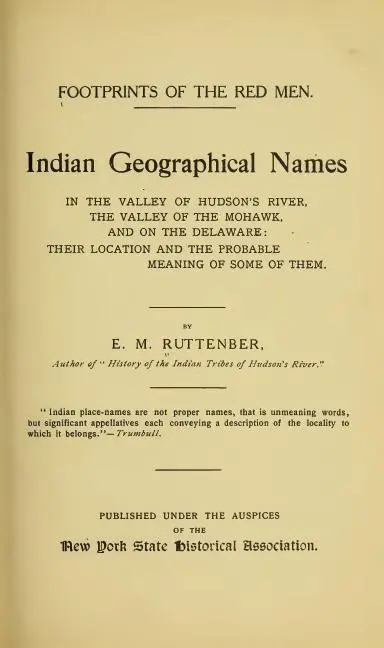
"Footprints of the Red Men" by Edward Manning Ruttenber is a historical account written in the early 20th century. This work delves into Indian geographical names found in the Hudson River valley, the Mohawk valley, and on the Delaware, exploring their locations and meanings. The book aims to preserve and elucidate the significance of these names, which reveal insights into the geography, history, and culture of the indigenous peoples who inhabited these regions. The opening of the book lays the groundwork by emphasizing the importance of Indian geographical names as descriptive and significant rather than mere arbitrary labels. Ruttenber discusses the inconsistencies in the recording and understanding of these names due to variations in dialects, spelling by early European settlers, and the loss of original meanings over time. He intends to investigate the original meanings and connections of these names to the features of the land they described, ultimately suggesting that they can offer a richer understanding of the natural world and historical context from the perspective of the indigenous tribes.
Introduction adapted from the source catalogue; source summaries may be automatically generated.
Free to read · English · 94,341 words · No account needed
MAKE TIME FOR A GOOD BOOK
On by default. Untick to stop anonymous reading totals. Each page counts after 10 seconds in view. How this works.
Anonymous counting is on unless you have switched it off.
[FN-1] "Land lying about six or seven miles beyond ye Town where ye Walloons dwell, upon ye same creek; ye name of ye place is Chauwanghungh and Nescotack, two small parcels of land lying together." (N. Y. Land Papers, 29, 30.)
[FN-2] "Comprehending all those lands, meadows and woods called Nescotack, Chawangon, Memorasink, Kakogh, Getawanuck and Ghittatawah." (Deed to Gov. Dongan.)
[FN-3] "Beginning on the east side of the river (now Wallkill), and at the south end of a small island in the river, at the mouth of the river Chauwangung, in the County of Ulster, laid out for James Graham and John Delaval." (N. Y. Land Papers, 38.)
[FN-4] "Description of a survey of 410 acres of land, called by the Indian name Chauwangung, laid out for Thomas Lloyd." (N. Y. Land Papers, 44.)
[FN-5] N. Y. Land Papers, 60.
[FN-6] Ib. 169. Other early forms are Shawongunk (1685), Shawongonck (1709), Shawongunge (1712).
[FN-7] From Jacobus Bruyn came the ancient hamlet still known as Bruynswick. He erected a stone mansion on the tract, in the front wall of which was cut on a marble tablet, "Jacobus Bruyn. 1724." The house was destroyed by fire in 1870 (about), and a frame dwelling erected on its old foundation. It is about half-way between Bruynswick and Tuthilltown; owned later by John V. McKinstry. The location is certain from the will of Jacobus Bruyn in 1744.
[FN-8] The most worthless interpretation is that in Spofford's Gazeteer and copied by Mather in his Geological Survey: "Shawen, in the Mohegan language, means 'White,' also 'Salt.' and Gunk, 'A large pile of rocks,' hence 'White Rocks' or mountain." The trouble with it is that there is no such word as Shawen, meaning "White" in any Algonquian dialect, and no such word as Gunk, meaning "Rocks."
[FN-9] The monosyllable Shaw or Schaw, radical Scha, means "Side, edge, border, shore," etc. Schauwunuppéque, "On the shore of the lake." Enda-tacht-schawûnge, "At the narrows where the hill comes close to the river." (Heck.) Schajawonge, "Hill-side" (Zeisb.), from which Schawong-unk, "On the hill-side," or at the side of the hill, the precise bound of the name cannot be stated.
[FN-10] Doc. Hist. N. Y., iv, 71, 72, et. seq. Col. Hist. N. Y.,
xiii, 272, 326.
[FN-11] Authorities quoted and paper by Rev. Charles Scott, D. D., in "Proceedings Ulster Co. Hist. Soc."
Your reading position is saved on this browser. Take it to another device with a library code. Reading pages adapt to text, rather than matching a printed edition.
BEHIND THE BOOK
This eBook is for the use of anyone anywhere in the United States and most other parts of the world at no cost and with almost no restrictions whatsoever. You may copy it, give it away or re-use it under the terms of the Project Gutenberg License included with this eBook or online at www.gutenberg.org. If you are not located in the United States, you will have to check the laws of the country where you are located before using this eBook. Read the source licence.
The original source file, including credits and licence, is retained by this library. Request an original-format copy at no charge. Please include the book title and Project Gutenberg identifier #51217.
KEEP YOUR CURIOSITY GOING
Cécile Tormay

Moritz Busch
John L. Ransom
Frances Wright
Cécile Tormay

Mabel Potter Daggett