THE CLASSIC COLLECTION✦An outlaw’s diary: the CommuneCLASSIC FREE BOOKS
An outlaw’s diary: the Commune
Cécile Tormay
THE CLASSIC COLLECTION · 1906
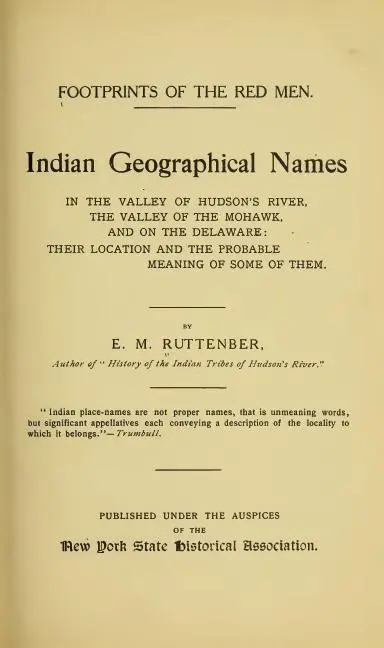
"Footprints of the Red Men" by Edward Manning Ruttenber is a historical account written in the early 20th century. This work delves into Indian geographical names found in the Hudson River valley, the Mohawk valley, and on the Delaware, exploring their locations and meanings. The book aims to preserve and elucidate the significance of these names, which reveal insights into the geography, history, and culture of the indigenous peoples who inhabited these regions. The opening of the book lays the groundwork by emphasizing the importance of Indian geographical names as descriptive and significant rather than mere arbitrary labels. Ruttenber discusses the inconsistencies in the recording and understanding of these names due to variations in dialects, spelling by early European settlers, and the loss of original meanings over time. He intends to investigate the original meanings and connections of these names to the features of the land they described, ultimately suggesting that they can offer a richer understanding of the natural world and historical context from the perspective of the indigenous tribes.
Introduction adapted from the source catalogue; source summaries may be automatically generated.
Free to read · English · 94,341 words · No account needed
MAKE TIME FOR A GOOD BOOK
On by default. Untick to stop anonymous reading totals. Each page counts after 10 seconds in view. How this works.
Anonymous counting is on unless you have switched it off.
Paquapick is entered on Pownal's map as the name of Passaic Falls. It is from Poqui, "Divided, broken," and -ápuchk, "Rock." Jasper Dankers and Peter Sluyter, who visited the falls in 1679-80, wrote in their Journal that the falls were "formed by a rock stretching obliquely across the river, the top dry, with a chasm in the center about ten feet wide into which the water rushed and fell about eighty feet." It is this rock and chasm to which the name refers--"Divided rock," or an open place in a rock.
Pequannock, now so written, is the name of a stream flowing across the Highlands from Hamburgh, N. J. to Pompton, written Pachquak'onck by Van der Donck (1656); Paquan-nock or Pasqueck, in 1694; Paqunneck, Indian deed of 1709, and in other forms, was the name of a certain field, from which it was extended to the stream. Dr. Trumbull recognized it as the equivalent of Mass. Paquan'noc, Pequan'nuc, Pohqu'un-auke, etc., "A name common to all cleared land, i. e. land from which the trees and bushes had been removed to fit it for cultivation." Zeisberger wrote, Pachqu (Paghqu), as in Pachqu-échen, "Meadow;" Pachquak'onck, "At (or on) the open land."
Peram-sepus, Paramp-seapus, record forms of the name of Saddle River, [FN] Bergen County, N. J., and adopted in Paramus as the name of an early Dutch village, of which one reads in Revolutionary history as the headquarters of General George Clinton's Brigade, appears in deed for a tract of land the survey of which reads: "Beginning at a spring called Assinmayk-apahaka, being the northeastern most head-spring of a river called by the Indians Peram-sepus, and by the Christians Saddle River." Nelson (Hist. Ind. of New Jersey) quoted from a deed of 1671: "Warepeake, a run of water so called by the Indians, but the right name is Rerakanes, by the English called Saddle River." Peram-sepus also appears as Wieramius, suggesting that Pera, Para, Wara, and Wiera were written as equivalent sounds, from the root Wil (Willi, Winne, Wirri, Waure), meaning, "Good, fine, pleasant," etc. The suffix varies, Sepus meaning "Brook"; Peake (-peék), "Water-place," and Anes, "Small stream," or, substantially, Sepus, which, by the prefix Ware, was pronounced "A fine stream," or place of water.
[FN] Called "Saddle River," probably, from Richard Saddler, a purchaser of lands from the Indians in 1674. (Col. Hist. N. Y., xiii, 478.)
Monsey, a village in Rockland County, takes that name from an Indian resident who was known by his tribal name, Monsey--"the Monseys, Minsis, or Minisinks."
Your reading position is saved on this browser. Take it to another device with a library code. Reading pages adapt to text, rather than matching a printed edition.
BEHIND THE BOOK
This eBook is for the use of anyone anywhere in the United States and most other parts of the world at no cost and with almost no restrictions whatsoever. You may copy it, give it away or re-use it under the terms of the Project Gutenberg License included with this eBook or online at www.gutenberg.org. If you are not located in the United States, you will have to check the laws of the country where you are located before using this eBook. Read the source licence.
The original source file, including credits and licence, is retained by this library. Request an original-format copy at no charge. Please include the book title and Project Gutenberg identifier #51217.
KEEP YOUR CURIOSITY GOING
Cécile Tormay

Moritz Busch
John L. Ransom
Frances Wright
Cécile Tormay

Mabel Potter Daggett