
A world of green hills
Bradford Torrey
THE CLASSIC COLLECTION · 1901
"Footing it in Franconia" by Bradford Torrey is a nature-focused travel narrative written in the early 20th century. This work captures the author’s experiences and observations while hiking in the Franconia region of New Hampshire, particularly exploring the area's flora and fauna. With a keen eye for detail and a love for the outdoors, Torrey immerses readers in the beauty of his surroundings and expresses his philosophical reflections on nature and companionship. The opening of the book transports readers into Torrey's journey through the scenic Franconia landscape, starting with a vivid description of a train ride and his ascent into the autumn-scented forests. As he arrives at his destination, he reflects on the company of a deceased friend who had shared many walks with him in the past. Despite the absence of this companion, he finds solace in engaging with the natural world around him, detailing his encounters with birds, butterflies, and other elements of wilderness life. The narrative blends personal nostalgia with a profound appreciation for the beauty of nature, setting the tone for a meditative exploration of existence and the simple joys of walking in the hills.
Introduction adapted from the source catalogue; source summaries may be automatically generated.
Free to read · English · 48,097 words · No account needed
MAKE TIME FOR A GOOD BOOK
On by default. Untick to stop anonymous reading totals. Each page counts after 10 seconds in view. How this works.
Anonymous counting is on unless you have switched it off.
The men who live in such houses, the keeper tells me, are very wide-awake and well informed, reading their weekly newspaper with thoroughness, and always ready for rational talk on current topics. They are not rich, of course, in the down-country sense of the word, and see very little money, subsisting mainly upon the produce of the farm; a matter of twenty-five dollars a year may cover all their expenditures; but they are better fed, and really live in more comfort, than a great part of the folks who live in cities. I am glad to believe it; and I like the man’s way of standing by his neighbors. In fact, I think highly of him as a person of a good heart and no small discrimination; and therefore I am all the gladder when, having left the summit and stopped for a minute in the shade of a tree, I overhear him say to the musician, “That old man enjoys himself; he’s a nice old man.” “Thank you,” say I, not aloud, but with deep inward sincerity; “that’s one of the best compliments I’ve had for many a day.” Blessings on this mountain air, that makes human speech unintentionally audible. An old man that enjoys himself is pretty near to my ideal of respectable senility. “Thank you,” I repeat; “that’s praise, and faith, I’ll print it.” And so I will, pleasing myself, let the ungentle reader--if I have one--think what he may. A good name is more to brag of than a million of money.
Yes, I am enjoying myself (why not?), and I loiter down the road with a light heart (an old man should be used to going downhill), pausing by the way to notice a little group--a family party, it is reasonable to guess--of golden-crowned kinglets. One of them, the only one I see fully, has a plain crown, showing neither black stripes nor central orange patch. But for his unmistakable zee-zee-zee, which he is considerate enough to utter while I am looking at him, he might be taken for a ruby-crown. So the lover of beauty and the hobbyist descend the hill together, keeping step like inseparable friends. And so may it be to the end of the chapter.
Adder’s-mouth, 149.
Arbutus, trailing, 57, 91, 133.
Aster Lindleyanus, 5, 181.
Azalea, Lapland, 140.
Beech-fern, 146.
Blueberries, alpine, 24.
Bluebird, 123, 125, 209, 210, 234.
Bobolink, 97, 110, 117, 213.
Butterflies, 10, 28, 36, 123, 145, 172.
Catbird, 29, 106, 117, 189, 191.
Cedar-bird, 15, 187.
Cherry, wild red, 79, 130, 148, 211;
rum, 183.
Chickadee, black-capped, 13, 15, 16, 22, 72, 83, 94, 170, 191;
Hudsonian, 15, 53.
Chokeberry, 133.
Chokecherry, yellow, 181.
Cicada, 54.
Clintonia, 164, 231.
Coltsfoot, 67.
Cornel, dwarf, 57, 122, 133, 150, 163, 231.
Creeper, brown, 129, 138.
Crossbill, red, 19, 194, 228;
white-winged, 19.
Crow, 11, 97, 210.
Cuckoo, black-billed, 145.
Finch, pine, 126, 144, 170, 228;
purple, 117.
Fleas, 32.
Flowers, alpine, 140.
Flycatcher, alder, 105, 125, 148, 214, 230, 240;
crested, 99, 125, 210, 214;
least, 212, 213, 214;
olive-sided, 101, 105, 130, 169, 212, 214;
yellow-bellied, 101, 215.
Fox, 58.
Goldfinch, 72, 172, 189, 191, 211.
Goldthread, 57, 83, 133, 150, 231.
Grosbeak, rose-breasted, 86, 117, 127.
Grouse, 27, 101, 192, 205, 210, 211.
Hardhack, 155.
Hawk, sparrow, 240.
Hobble-bush, 13, 130.
Houstonia, 133.
Humming-bird, 160, 205.
Hyla, 192.
Indigo-bird, 159.
Kinglet, golden-crowned, 138, 192, 246;
ruby-crowned, 29, 66, 72, 192.
Your reading position is saved on this browser. Take it to another device with a library code. Reading pages adapt to text, rather than matching a printed edition.
Bradford Torrey
Bradford Torrey
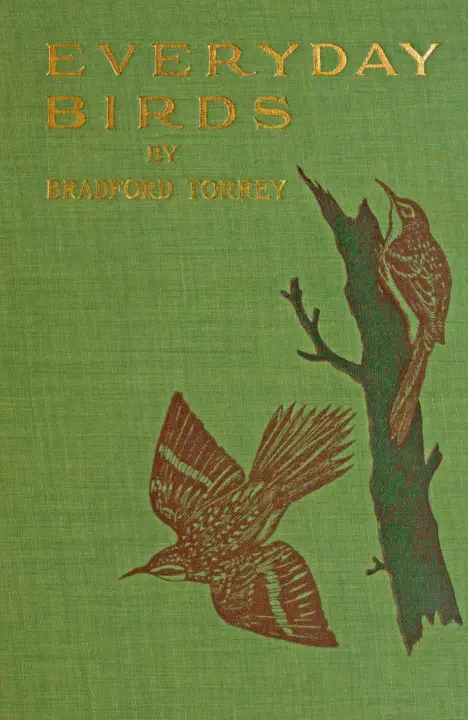
Bradford Torrey

Bradford Torrey
BEHIND THE BOOK
This eBook is for the use of anyone anywhere in the United States and most other parts of the world at no cost and with almost no restrictions whatsoever. You may copy it, give it away or re-use it under the terms of the Project Gutenberg License included with this eBook or online at www.gutenberg.org. If you are not located in the United States, you will have to check the laws of the country where you are located before using this eBook. Read the source licence.
The original source file, including credits and licence, is retained by this library. Request an original-format copy at no charge. Please include the book title and Project Gutenberg identifier #69355.
KEEP YOUR CURIOSITY GOING
Wilfrid Scawen Blunt
Wilfrid Scawen Blunt

E. W. (Edgar Watson) Howe
Cécile Tormay

Moritz Busch
John L. Ransom