
Letters to a Friend, Written to Mrs. Ezra S. Carr, 1866-1879
John Muir
THE CLASSIC COLLECTION · 1887
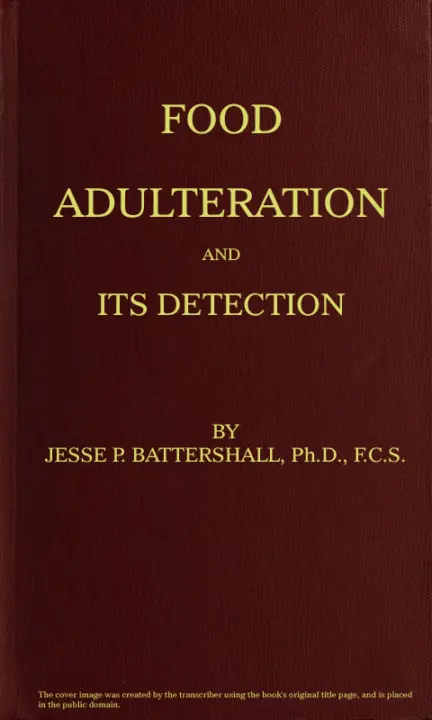
"Food Adulteration and Its Detection" by Jesse P. Battershall is a scientific publication written in the late 19th century. The work focuses on the critical topic of food adulteration, particularly addressing its prevalence in the United States and providing methodologies for its detection. At the start of the book, the author outlines the motivations behind food adulteration, highlighting the issues of public safety and health concerns. He discusses the historical context of food falsification and the lapses in public awareness surrounding the issue, pointing out that much of existing literature has been sensationalized. The introduction sets the stage for a more systematic investigation into various types of adulterated foods, beginning with tea, and emphasizes the necessity for reliable information to help combat and understand the complexities surrounding food safety.
Introduction adapted from the source catalogue; source summaries may be automatically generated.
Free to read · English · 97,978 words · No account needed
MAKE TIME FOR A GOOD BOOK
On by default. Untick to stop anonymous reading totals. Each page counts after 10 seconds in view. How this works.
Anonymous counting is on unless you have switched it off.
The examination of the colouring matter of cheese can be made by first neutralising the free lactic acid, separating the fat by agitation with water, filtering and drying; the fat is then tested with carbon disulphide and potassium hydroxide (see p. 77).
[47] ‘Analyst,’ Jan. 1885, p. 3.
[48] Chem. News, pp. 47, 85.
[49] Dingl., vol. i. pp. 247, 474.
Wheat (Triticum vulgare) forms the principal bread-stuff of civilized nations, and is by far the most important of all cereal grasses. It has one or more slender, erect and smooth stalks, which, owing to the large proportion of siliceous matter present, possesses the strength necessary for the support of the ears. The grain is imbricated in four rows. The following are the averages of the results obtained by the analyses of 260 samples of American wheat, made by the United States Department of Agriculture, in 1883:--
Per cent.
Water 10·27
Ash 1·84
Oil 2·16
Carbohydrates 71·98
Fibrin 1·80
Albuminoids 11·95
Nitrogen 1·91
Analyses of the ash of wheat by the same Department, furnished the
following results:--
----------------+---------+------------------- | | Foreign. | Dakota. +---------+--------- | | Winter. | Spring. ----------------+---------+---------+--------- |Per cent.|Per cent.|Per cent. Insoluble | 1·44 | 2·11 | 1·64 Phosphoric acid | 47·31 | 46·98 | 48·63 Potassa | 30·63 | 31·16 | 29·99 Magnesia | 16·09 | 11·97 | 12·09 Lime | 3·36 | 3·34 | 2·93 Soda | 1·17 | 2·25 | 1·93 Sulphuric acid | trace | 0·37 | 0·48 Chlorine | „ | 0·22 | 0·51 Ferric oxide | „ | 1·31 | 0·28 Undetermined | .. | 0·29 | 1·52 | ------ | ------ | ------ | 100·00 | 100·00 | 100·00 | | | Total ash | 1·88 | 1·97 | 2·14 ----------------+---------+---------+---------
The name flour is usually given to the product obtained by grinding wheat and removing the bran, or woody portion of the grain, by sifting or bolting. Its constituents are starch, dextrine, cellulose, and sugar (carbohydrates), the nitrogenous compounds albumen, gliadin, mucin, fibrin, and cerealin, and fat, mineral substances and water. Upon kneading flour with water, and removing the starch and soluble matters by repeated washing, an adhesive body termed gluten remains behind. This is chiefly composed of gliadin, mucin, and fibrin.
According to Wanklyn,[50] the general composition of flour is:--
Per cent.
Water 16·5
Fat 1·5
Gluten 12·0
Modified starch 3·5
Vegetable albumen 1·0
Starch granules 64·8
Ash 0·7
The average of numerous analyses of American flour examined by the Department of Agriculture gave:--
Per cent.
Water 11·67
Fat 1·25
Sugar 1·91
Dextrine 1·79
Starch 71·72
Soluble albuminoids 2·80
Insoluble „ 7·90
Total „ 10·70
Ash 0·54
The composition of the ash of flour from Minnesota wheat (1883), is as
follows:--
Per cent.
Insoluble 0·98
Phosphoric acid 49·63
Potassa 31·54
Magnesia 9·05
Lime 5·87
Soda 2·93
The following are the determinations generally required in the
proximate analysis of flour:--
Water.--Two or three grammes of the sample are weighed in a tared platinum dish, and heated in an air bath, until constant weight is obtained. The proportion of water should not exceed 17 per cent.
Your reading position is saved on this browser. Take it to another device with a library code. Reading pages adapt to text, rather than matching a printed edition.
BEHIND THE BOOK
This eBook is for the use of anyone anywhere in the United States and most other parts of the world at no cost and with almost no restrictions whatsoever. You may copy it, give it away or re-use it under the terms of the Project Gutenberg License included with this eBook or online at www.gutenberg.org. If you are not located in the United States, you will have to check the laws of the country where you are located before using this eBook. Read the source licence.
The original source file, including credits and licence, is retained by this library. Request an original-format copy at no charge. Please include the book title and Project Gutenberg identifier #54004.
KEEP YOUR CURIOSITY GOING
John Muir

Asa Gray
Asa Gray

Florence Nightingale
Elizabeth Robins Pennell
Denison Olmsted